Mode fintech trading surges 950% on Bitcoin rush

LSE-listed fintech, Mode Global Holdings (LON:MODE), has been on the right side of the recent Bitcoin surge, with the company reporting that in-platform trading volumes spiked by 950% between August and November.

The company said that customers have been using their app to buy and hold Bitcoin as the cryptocurrency hit its highest price since 2017. Mode Global added that some 80% of trades occurring during the three-month period were purchases, with the app’s total assets under custody increasing by 210%, and app usership increasing by almost 500%.
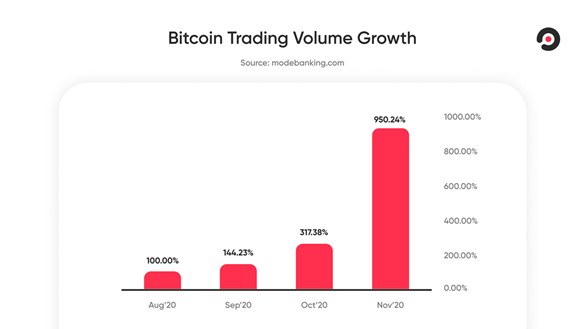
Bitcoin trading volumes on Mode Global

Jonathan Rowland, Executive Chairman of Mode, commented on the recent trends: “We’ve seen unprecedented interest in buying and holding Bitcoin just as the market rally really took off. That coincided with the chaotic US elections that brought with it market volatility, as well as a second UK lockdown with all the economic uncertainty this entails. Longer term, economists anticipate that the unprecedented fiscal support we’re seeing launched to tackle the pandemic crisis will boost inflation. We believe that this will only increase demand for inflation hedges and diversification strategies such as investing in Bitcoin.”

Mode Group added that the increase in trading volumes and assets under custody it has witnessed, reflect the strong performance of Bitcoin over the last few months, which has gained as much as 75% in USD terms since August, and almost 300% since its March nadir around eight months ago.

The company itself are also capitalising on the recent popularity of alternative currencies, with up to 10% of its own treasury holdings now allocated to Bitcoin. These recent shifts follow the news that Mode Global became one of the first consumer-focused, digital banking apps to list on the London’s main market. The company added that some 80% of Bitcoin held on the app has now switched from user accounts to the app’s Bitcoin Jars, which offers savers 5% interest APY.


Investing in the future of UK agriculture

Vertically Urban is a British designer and manufacturer within the horticultural (indoor vertical farming) industry, delivering efficient LED lighting solutions that are easy to install and setup. 

Offering a rare opportunity to grow with them – Vertically Urban recently launched a Seedrs campaign to raise £300k investment – a target which they have very nearly reached.

With a global market expected to reach £9.6 billion by 2026, early investors include Amazon’s Jeff Bezos and major supermarket chains, including Ocadoand Marks and Spencer

The world is rapidly recognising the benefits for good reason (it was even mentioned in the recent David Attenborough’s: A Life on Our Planet documentary). Benefits such as:

  • Reduced environmental impact – food is grown locally, where it’s needed 
  • Reduced carbon footprint – fewer ‘food miles’
  • Improved food freshness
  • Pesticide-free produce 

Lighting is essential for vertical farms and is Vertically Urban’s focus.

Using their unique expertise in light extraction techniques, product design, and build methodology, Vertically Urban are on a mission to become a leading supplier of LED lighting solutions for the agricultural tech sector.

So if you’ve been looking for an investment opportunity – don’t miss out, join a community of over 200 investorshelping to lead the way in indoor vertical farming.

If you’re interested in learning more, request a copy of the Vertically Urban investment deck or if you’re ready to jump straight in – join Seedrs campaign HERE.

Avon Rubber shares out of puff as investors overlook adjusted performance

1

Respiratory equipment manufacturer and military and police supplier, Avon Rubber (LON:AVON) watched its shares slide on Tuesday, following the publication of its full-year results.

The data showed that the company’s revenue shot up by 30.8% year-on-year, to £168 million, while its closing order book finished 117.4% ahead of the previous year, at £79.8 million.

On an adjusted basis, the company shone throughout the year. Overcoming the challenges of the pandemic, Avon Rubber boasted adjusted operating profits of £30.2 million and adjusted profit before tax of £28.2 million, up by 33.6% and 27% respectively. This trend appeared to be reflected in shareholder income, too, with adjusted basic earnings per share rising 13.8%, to 76.5p, while its dividend bounced 30%, to 27.08p a share.

Despite this, investors refused to look past the company’s statutory data, which showed that profits fell by 40.40% year-on-year, down from £9.9 million, to £5.9 million. Similarly, on a statutory basis, profit before tax collapsed 94.25%, from £8.7 million, to £0.5 million. This set of results reflected the costs of the company’s strategic acquisitions of 3M’s ballistic helmet and armour business, and Team Wendy – with the latter completed at the start of November.

Speaking on the company’s performance through the year and on building a strong foundation for the future, Paul MacDonald, CEO< said: “2020 has been a year of both significant strategic evolution and strong organic execution for Avon Rubber. We have again delivered strong results ahead of expectations and continued to make significant steps transforming the business into a leading provider of life critical personal protection products.”

“We have consistently delivered on our strategy to invest in expanding our product portfolio to meet more of the protection needs of our customers. This has enabled us to build a broader and more visible long-term contract portfolio to position the business to deliver further growth in 2021 and beyond.”

Following the update, Avon Rubber shares shed 6.71%, down to 4,314.83p apiece 13:00 GMT 02/12/20. This saw the company fall from its year-to-date high of 4,625.00p, though still over 15% ahead of analysts’ target price of 3,746p a share.

Analysts currently have a consensus ‘Buy’ rating on the stock, alongside a 62.79% ‘outperform’ stance from the Marketbeat community. It has a hefty p/e ratio of 103.48, and a dividend yield of 0.51%.

Slack sold to Salesforce in $27.7bn deal

0

Slack (NYSE: WORK) has been sold to Salesforce in a $27.7bn deal.

Slack was founded in 2009 and has provided workplaces with an alternative to email. The purchase of Slack is the largest deal carried out by Salesforce.

Salesforce CEO Marc Benioff said: “Stewart and his team have built one of the most beloved platforms in enterprise software history, with an incredible ecosystem around it.”

“This is a match made in heaven. Together, Salesforce and Slack will shape the future of enterprise software and transform the way everyone works in the all-digital, work-from-anywhere world. I’m thrilled to welcome Slack to the Salesforce Ohana once the transaction closes.”

Stewart Butterfield, Slack CEO, commented: “Salesforce started the cloud revolution, and two decades later, we are still tapping into all the possibilities it offers to transform the way we work. The opportunity we see together is massive.”

“As software plays a more and more critical role in the performance of every organization, we share a vision of reduced complexity, increased power and flexibility, and ultimately a greater degree of alignment and organizational agility. Personally, I believe this is the most strategic combination in the history of software, and I can’t wait to get going,”

Slack’s current valuation is just over $25bn.

G4S shares rise on £3.7bn Garda takeover bid

0

Shares in British security firm G4S (LON:GFS) rallied on Tuesday, in response to a revised takeover bid made during a competitive acquisition battle between Garda World Security Corporation (TSE:GW) and Allied Universal Services LLC.

G4S said that it notes the recent announcement made by Garda, in which it stated that it had made an unsolicited and revised offer of 235p per share in cash to acquire the entire issued and to-be-issued share capital of G4S. Speaking on the news, the company said that its Board are in the process of evaluating the offer, with its legal and financial advisers, and told shareholders to take ‘absolutely no action’ in relation to the offer.

The revised proposal sees G4S being pegged at a £3.7 billion valuation, with Garda needing just over 50% of shareholders to agree for the deal to go ahead – versus 90% previously. Garda have also agreed a £770 million support package with the G4S pension trust, which was regarded as a decisive issue in the takeover bid.

The G4S statement added: “G4S continues to be in discussions with Allied Universal Services LLC. Any firm offer from Allied Universal would be required to be announced by 9 December 2020. There can be no certainty that any firm offer will be made by Allied Universal nor as to the terms on which any such offer might be made by them.”

The Group said that a further update will be made in due course. Following the news, G4S shares rallied by 8.39%, up to 248.22p apiece. This price is the company’s highest since August 2018, and stands about 38% ahead of analysts’ consensus target price of 153.57p a share.

Analysts currently have a consensus ‘Buy’ stance on the stock, while the Marketbeat community gives it a 57.12% ‘underperform’ rating. Its p/e ratio of 224.73 makes it look far pricier versus the service sector average of 38.53, while it has a dividend yield of 1.44%.

Tesco to repay £585m business rates relief

0

Tesco has announced plans to repay the £585m of business rates relief it received during the pandemic.

The UK’s biggest supermarket revealed the news following pressure on supermarkets to do so. Supermarkets in the UK were criticised for not needing financial support as sales were boosted and profits increased.

Most recent results at the supermarket showed Tesco to report a 29% rise in pre-tax profits and the group was able to keep paying dividends.

“For food retailers, the impact was immediate and potentially disastrous: panic buying, severe pressure on supply lines, major safety concerns and the risk of mass absences from work, culminated in a real and immediate risk to the ability of supermarkets to feed the nation,” said the supermarket in a statement.

“Every penny of the rates relief we have received has been spent on our response to the pandemic. Our latest estimate at our Interim Results in October was that COVID would cost Tesco c.£725m this year – well in excess of the £585m rates relief received.”

“Ten months into the pandemic, our business has proven resilient in the most challenging of circumstances. While all businesses have been impacted – many severely so – we have been able to continue trading throughout, serving many millions of customers every day and although uncertainties still exist, some of the potential risks faced earlier in the year are now behind us. We remain absolutely committed to doing the right thing by our customers, colleagues and all our stakeholders.

“We are therefore announcing that we will return to the public the business rates relief received in full. We will work with the UK Government and Devolved Administrations on the best means of doing that.”

Tesco is the first of the major supermarkets to announce this move and payback the government support, which will pile on pressure to rivals to do the same.

“This gesture comes at a fairly sizeable cost – so it can’t be dismissed as meaningless – and it may well be that the boardrooms of its peer group are cursing the move. After all, if they follow suit, unlike Tesco they won’t be able to claim the brownie points for going first,” explained Russ Mould of stockbrokers AJ Bell.

“Previously the grocers had argued they were entitled to take advantage of this tax break, despite being able to operate throughout the pandemic, due to all the extra costs they incurred and the pressures they faced in feeding the nation. Tesco will argue that today’s decision is less a reflection of a change of heart and more a story of a change of circumstances as the backdrop has stabilised,” he added.

Tesco shares are trading -1.62% at 225,20 (1149GMT).

Are stock markets correctly pricing COVID-19 economic devastation?

Alan Green joins the UK Investor Magazine Podcast shortly after news the Pfizer vaccine will be rolled out in the UK over the next week. Market reaction was muted and we explore whether stocks have already priced in all the good news related to the economic reopening.

We also discuss Arkle Resources (LON:ARK), Brand Shield (LON:BRSD) and Eddie Stobart (LON:ESL).

Register for the UK Investor Magazine Virtual Conference 15th December here.

Science in Sport shares surge on trading update

0

Science in Sport shares (LON: SIS) opened 7% higher on Wednesday following a trading update for the current financial year, ending 31 December.

The nutrition company said that business was performing well and to the end of November, total Online revenues were ahead 39% year on year at £23m. For the full year, online sales are expected to grow 51%.

The group’s PhD.com digital business was up 108% to the end of November compared to the same period in 2019 and the USA business is up 32% year on year.

Stephen Moon, the group’s chief executive, commented: “I am pleased to announce the business is performing well. We bounced back strongly following our decisive actions in March and April to restructure the business and strengthen the balance sheet. Our focus has been accelerating our long-term growth strategy and investing in our online business, and this has successfully delivered for us.

“We have invested in technology and talent to drive our online business across global territories for 2021 onwards, and we have continued to drive innovation and brand equity to underpin our premium margin business.

“A new supply chain unit is planned for late 2021. This will build further on the substantial progress made in gross margin during this year, and we expect to make progress throughout the strategic planning period.

“Whilst it is too early to reinstate guidance for the longer term, once the COVID-19 pandemic abates, we are well positioned to take advantage of profitable growth opportunities in all major global regions,” Moon added.

The cash position is strong and the group expects to close the year with approximately £10m.

Science in Sport shares (LON: SIS) are trading +6.67% at 30,40 (1117GMT).

FTSE 100 makes slow start despite vaccine news

1

The FTSE 100 had a subdued start to the day despite news that the UK had approved the Pfizer/Biontech coronavirus vaccine.

The blue-chip index opened in the red and after an hour was up 0.1%. Analysts have said that it is likely that because the pound is down 0.4% against the dollar and 0.5% against the euro, following the reported tension within the EU and the ending of the transition period.

Despite the slower morning on the FTSE 100, yesterday it surged 2% as it continues November’s rally.

“The lack of market reaction suggests that this decision was probably widely expected at some point, and perhaps the real challenge now lies in the production, as well as the speed of any rollout of the two jab treatment,” said Michael Hewson from CMC Markets.

“Ultimately even if a vaccination program was to start this month, the fact that two jabs are required means that it’s likely to be several months before we start to see a possible economic benefit in terms of an easing of restrictions.”

Meanwhile, in Europe the DAX was down 0.7%, while the CAC saw a 0.4% drop.

In the US, main markets hit new record highs after there was news that talks over a new stimulus package were continuing.

Connor Campbell from SpreadEx said: “Failing to close above 30,000 yesterday evening, instead finishing at 29,823, the Dow Jones is set to retreat this afternoon, the futures pencilling in a 130 point fall. It may take FDA approval of the Pfizer and Moderna vaccines to get the Dow to spend more than a few hours at a time the right side of 30,000.”

Commenting on what the vaccine rollout in the UK means, he add: “It’s another step closer to pre-pandemic normality, and though there are still, minimum, months of lockdown measures left, and a war’s worth of economic damage to undo over the next few years, the markets are firmly focused on the long-term.”

Only 12% of UK investors think they would benefit from negative interest rates

4

Speaking earlier in the year, Governor of the Bank of England, Andrew bailey, said that he wouldn’t take negative interest rates off the table, if lenders and consumers required extra incentive to loosen their strings during the COVID downturn recovery. Interestingly, though, research conducted by FJP Investment indicates that half of UK investors are concerned about the prospect of such a measure being introduced.

The investment firm reports its findings from an independent, commissioned survey of more than 1,000 UK-based investors – all of whom had savings and investments in excess of £10,000, excluding their pension and primary residence.

The data showed that some 49% of those asked believe that the introduction of negative interest rates would harm their investments, while only 12% believe they would benefit from such a scenario.
 
Further, some 40% said they would restructure their portfolio in response to a negative interest rates announcement, while just 14% said they’d feel confident leaving their investment portfolio as it is. The remaining portion – 46% – said they were unsure how they would manage the change.

Commenting on the data, FJP Investment CEO, Jamie Johnson, said: “Investors are clearly worried about the impact negative interest rates could have on their portfolios. While the Bank of England is yet to play this card, there remains a great deal of speculation that negative rates could be around the corner.”

With the Bank of England announcing last Thursday that it would retain its 0.10% interest rate until the new year, speculation remains about a shift to negative rates in 2021, if economic sentiment and productivity do not improve at the desired rate.
 
“If COVID-19 cases cannot be brought under control and strict lockdown measures remain, the recovery of the UK economy is going to be significantly hindered. In such a situation, we could expect negative interest rates to come into play sooner rather than later. In any case, investors must start preparing now to avoid any negative repercussions on their portfolios”, Mr Johnson added.

In general, negative interest rates would offer downside for cautious savers, and potential upside for active enterprises, such as VCs and startups. In an effort to encourage people to spend the economy out of a slumber, negative rates would reward borrowing and penalise capital conservation. As stated by IW Capital CEO, Luke Davis, following earlier speculation:

“A policy maker at the Bank of England has defended the potential use of negative interest rates, calling results from other countries ‘encouraging’. The move could effectively mean that savers pay to have their money with banks and are incentivised to borrow money and increase their spending.”