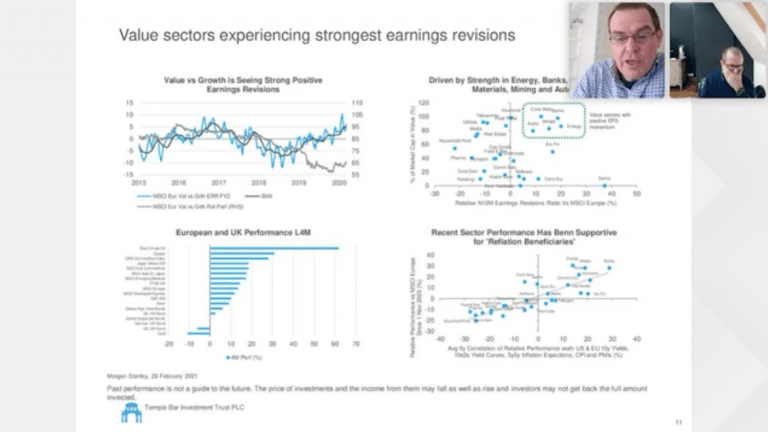
Temple Bar Investment Trust (LON:TMPL) Portfolio Managers Ian Lance and Nick Purves present the Trusts classic approach to value investing at the UK Investor Magazine Virtual Conference.
Temple Bar Investment Trust’s focus is on identifying undervalued UK equities that are ‘misunderstood by investors’.
With ongoing stimulus by central banks, the portfolio has a significant exposure to energy and banks – all sectors that tend to do well in higher inflationary environments.
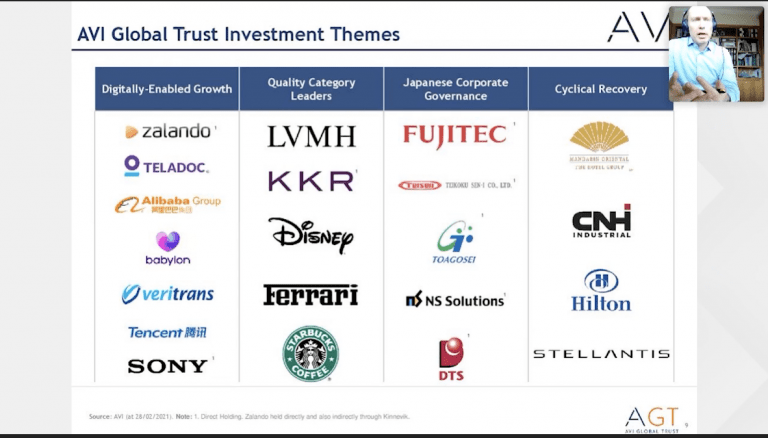
We were delighted to welcome AVI Global Trust to the UK Investor Magazine Virtual Conference 23rd March.
CEO & CIO Joe Bauernfreund delivered a insightful presentation on the inner working of the Trust and where their investment strategies have found success.
AVI Global Trust has a diverse portfolio of holdings that range from family-controlled assets to Japanese small cap companies.
Vietnam Holding (LON:VNH) presents at the UK Investor Magazine Virtual Conference 23rd March.
Craig Martin, Chairman of Dynam Capital, the manager of Vietnam Holding presents the case of investing in Vietnam and provides detailed insight into the Southeast Asian economy.
Mr Martin explores Vietnam Holding’s portfolio of high-growth Vietnamese companies and breaks down some of the Trust’s top holdings.
The FTSE 100 shrank below 6,700 on early Tuesday morning as it fell 0.6%. This was despite cable also shedding 0.4% as it ducked under $1.381.
The fall came on the back of employment news which “broadly disappointed” according to Connor Campbell, financial analyst at Spreadex. “Though the unemployment rate covering the 3 months to January unexpectedly fell from 5.1% to 5.0%, the more recent data paints a less rosy picture, with February’s claimant count change number hitting 86,600 against the 9,000 forecast,” Campbell said.
Extending Germany’s partial lockdown over the Easter period, Merkel stated that the country was in a ‘very serious’ situation, going as far to say that it is ‘basically in a new pandemic’ thanks to the new found dominance of the British variant.
“Britain should perhaps prepare itself for similar news. After all, yesterday Boris Johnson warned that we would feel the effects of the European third wave ‘in due course’,” said Campbell.
FTSE 100 Top Movers
At the top of the FSTE 100, Imperial Brands (1.97%), Reckitt Benckiser (1.88%) and Severn Trent (1.70%) are the day’s biggest risers so far.
Air travel companies IAG (-4.33%) and Rolls-Royce (-4.24%) are the day’s top fallers so far, closely followed by JD Sports (-3.08%).
£5,000 for Going on Holiday
Fines of £5,000 are set to be introduced for people from England who travel abroad before the end of June as the country is taking measures to control its borders.
While the government is still reviewing the possibility of international travel in April, ahead of a possible return in May, health minister Matt Hancock said travel fines were a part of legislation in the event that a resumption of travel is not possible.
Fines of £5,000 are set to be introduced for people from England who travel abroad before the end of June as the country is taking measures to control its borders.
While the government is still reviewing the possibility of international travel in April, ahead of a possible return in May, health minister Matt Hancock said travel fines were a part of legislation in the event that a resumption of travel is not possible.
The news took a toll on stocks in the travel industry with IAG, owner of British Airways, falling by 4.26% in early morning trading and InterContinental Hotels Group falling by 1.31%.
Foreign holidays are currently banned by the UK government with “the earliest date by which we will allow for international travel…is the 17th May”, according to Matt Hancock. “That has not changed,” he added.
Question marks remain over whether or not people can travel abroad without a specific reason such as work or education will still be addressed by the government’s travel review, which is due to report on April 12, said Hancock.
However, the travel industry and consumers alike are fearing the worst as cases of coronavirus are rising in Europe, and the vaccine roll-out looks as though it could stall.
Airlines are now facing the prospect of a second summer without revenue, having already taken measures to raise money in order to survive the first time around.
Hancock reaffirmed that it remained too soon to give an answer on what the government’s decision on holidays would be.
“The reason for that is that we are seeing this third wave rising in some parts of Europe and we’re also seeing new variants and it is very important that we protect the progress that we’ve been able to make here in the UK,” he said.
Workers under 25 account for 63.1% of jobs lost since February 2020
The UK unemployment rate stood at 5% for the three month period to February, 0.1% higher than the quarter before, while lower than economists’ forecast of 5.2%.
As furlough measures remained in place and the vaccine roll-out gained further momentum, UK employment has begun to stabilise in the early part of 2021.
The number of employees on payrolls across the UK also increased in February, for the third month in a row, while remaining 700,000 below the figure from the previous year.
Workers under the age of 25 accounted for 63.1% of the jobs lost since February 2020, while more than half of the drop came from hospitality in London.
However, the number of young people in full-time education hit a record high of around 46%, “which shows that many are using the opportunity to upskill in preparation for the jobs market opening up”, according to Laith Khalaf, financial analyst at AJ Bell.
Khalaf provided further historical context for the UK unemployment figures announced today.
“Overall unemployment has been relatively benign so far in the crisis, thanks to the ton of government support that has been thrown at the labour market. Indeed 19% of the business workforce are currently on furlough according to the ONS.”
“It’s scant consolation to anyone who has lost their job as a result of the pandemic, but the unemployment rate today is no worse than it was in 2015, despite large parts of the economy being shuttered for much of the last year.”
The OBR reckons unemployment will rise to a peak of 6.5% towards the end of 2021, which compares with a rate of over 8% during the financial crisis.
“That’s still hundreds of thousands of jobs which are expected to be lost,” said Khalaf.
“However, economists’ forecasts are usually confounded by reality and given the unique and dynamic nature of the current economic crisis, it’s best to record any predictions with a light pencil rather than a marker pen.”
YouGov adjusted pre-tax profit increased by 13% to £13.6m
YouGov (LON:YOU) confirmed on Tuesday that its revenue jumped by 3% to £79m over the half year period ending on 31 January 2021.
The polling company’s adjusted pre-tax profit increased by 13% to £13.6m, while its statutory operating profit fell by 22% to £7.4m.
Revenue generated from the AIM-listed company’s data products rose by 6% to £26.5m, while its data service revenue increased by 19% to £21.8m.
These figures were “driven by strong demand for more tactical, fast turnaround projects,” according to the company.
Stephen Shakespeare, chief executive of YouGov, commented on the results for the first of the year while looking forward to the next phase.
“We are extremely pleased with our performance in H1 as we continued to deliver against our strategy and demonstrate our resilience. During the period, our focus remained on providing connected data solutions, valuable opinions and consumer insights to our clients across the globe. We continue to innovate to better serve our clients and their changing needs. We have expanded our YouGov Direct offering, integrated it with YouGov Chat and YouGov Safe, and further expanded our panels to 15 more countries,” said Shakespeare.
“We have entered the second half with confidence buoyed by growing new and existing client demand for our syndicated Data Products augmented by long-term custom trackers. The second half has started well and current trading is in line with Board expectations for the full year.”
At early morning trading YouGov’s share price fell by 2.04% to 960p. Year-to-date the company’s share price is down from 1,055p per share.
Five years ago YouGov’s share price was valued at 137p per share.
A potential management buyout for Cambria Automobiles (LON: CAMB) at 80p a share could provide an indication about the attractiveness of the valuations of AIM-quoted rivals.
The Cambria share price increased 10p to 76p. The potential bid values Cambria at £80m. Net debt was £5.7m at the end of February 2021. Net assets were £71.7m, or £50.2m excluding intangibles, at the end of August 2020.
There are no forecasts for Cambria. Last year, underlying pre-tax profit was £11.1m, down from £12.3m. The potential bid represents nine times last year’s earnings and eight times the previous year when ear...
A strong Irish economy has helped property investor Yew Grove REIT (LON: YEW) to grow its NAV. There are opportunities to further increase valuations.
Both the Irish economy and Yew Grove have significant exposure to the life sciences sector – it accounts to 35% of Yew Grove’s rents. Ireland’s GDP grew by 3.4% in 2020, with pharmaceuticals and IT the fastest growing sectors.
Yew Grove focuses on commercial properties in Ireland that are let to good quality tenants, such as government departments and multinational companies. Management concentrates on property outside of the central busi...
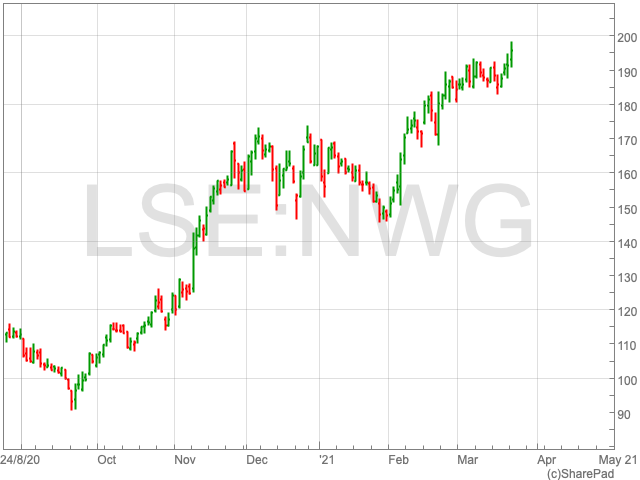
The Natwest Share Price Price (LON:NWG) has seen a significant rise of 54.6% over the past 12 months. However, the stock remains below the level it traded at before 2020, and is also down over three and five year periods. Nonetheless, investors are looking to the future and considering Natwest, which recently purchased shares back from the UK treasury, as a viable option.
Natwest Share Price
Treasury Sell-off
The UK treasury announced last week it had finalised the sale of £1.1bn worth of shares back to Natwest. The Treasury’s stake in the British bank is now down to 59.8% from 61.7% following the third sale of its holding. The shares were originally bought at around 500p apiece, so the sale represents a hefty loss.
This could prove to be good news for potential investors in the company formerly known as the Royal Bank of Scotland. The UK Government relinquishing its holdings could be seen as a show off faith in the bank’s management going forward. In addition, Natwest is planning to cancel 390m of the shares it bought back, equalling around 3% of the total. This means higher earnings per share for current and new investors.
Russ Mould, investment director at AJ Bell commented further on the buyback:
“NatWest’s move to buy back 4.9% of its shares from the Government adds up in one sense, in that the price paid, at 190.7p, comes in way below the bank’s last reported tangible book value, or net asset, value per share figure of 261p. The lowly price paid offers a welcome contrast to the majority of share buybacks,” Mould said.
However, there are some caveats for the price paid by Natwest to truly be considered a bargain. Russ Mould suggests that the bank would need to make a sustainable return on tangible equity.
“NatWest needs to make a sustainable return on tangible equity (RoTE) that exceeds its cost of capital – and last year’s negative 2.3% RoTE hardly fits that bill. NatWest had abandoned the 15% return on tangible equity target laid down by then-CEO Stephen Hester back in 2009 and given up on achieving the 12% targeted by his successor, Ross McEwan.”
In addition, the valuation of the assets needs to be on the money and not subject to further write-downs and loan impairments, according to Mould.
“The problem is that NatWest’s recent record on both counts is pretty spotty. TNAV per share continues to decline – although this is partly because the coming has been shedding assets in an attempt to shrink itself back to full health – and RoTE has, on a stated basis, been all over the place, thanks to a final rash of PPI claims in 2019, a jump in loan impairments owing to the pandemic in 2020, to name but two reasons.”
This may be why the Treasury chose to sell the shares to NatWest rather than sell the stock to institutional and retail investors, even if banking stocks are trying to forge a recovery, encouraged by hopes for an economic upturn, rising bond yields and a steeper yield curve. All three factors could help to boost banks’ profits and NatWest’s book value in the long-term.