


RBS profit halves on COVID-19 provision

RBS (LON:RBS) shares rallied on Friday after the UK bank revealed a 49% decline in first quarter profit due to provisions for bad loans related to the coronavirus pandemic.
RBS set aside £800m to deal with the impact of coronavirus meaning first quarter profit fell to £519m, down from £1,013m in in the same period a year prior.
RBS shares rallied despite the sharp reduction in profit with shares up over 2% at 112p in the first hour of trading on Friday.
Investors may have taken heart from the fact that if RBS had not set aside £800m to deal with COVID-19, the bank would have actually had a very stronger quarter and been well ahead of last year’s profitability.
Barclay’s shares rallied in a similar fashion after their first quarter results. The absence of significant PPI provisions were just starting to become evident in bank’s earnings and this combined with strong underlying earnings would have made the banks an attractive prospect.
However, bank COVID-19 provisions have almost wiped out profit for the first quarter so investors will now have to focus on whether there will be further provisions in the second quarter.
Commenting on the operations of RBS, the bank highlighted a successful shift to working from home despite managing to keep 90% of their branches open.
“We remain available to support as required; our systems remain robust and we have ensured that more than 90% of our branch network remains open, alongside our telephone, internet and mobile app channels. Across the Bank, over 60,000 colleagues, including those working in call centres, are now set up to work from home. Additionally, the Bank has committed to support special leave with full pay for all colleagues for six months as required,” RBS said in a statement.
RBS also pointed to increased capital ratios due to the scrapping of the dividend. A CET1 ratio would support the resumption of dividends if this can be maintained through the crisis.
“Following significant capital strengthening in recent years, the Bank is currently in a strong position to deal with a likely significant economic downturn. The CET1 ratio increased to 16.6% in the quarter following the cancellation of proposed dividend payments partially offset by the impact of increased RWAs. The Liquidity Coverage Ratio (LCR) remains strong at 152%.”
NatWest Markets also released a first quarter updated which pointed to disruption due to COVID-19 but largely had a strong quarter with income rising to £385m.
Avacta share price spikes on COVID-19 testing collaboration
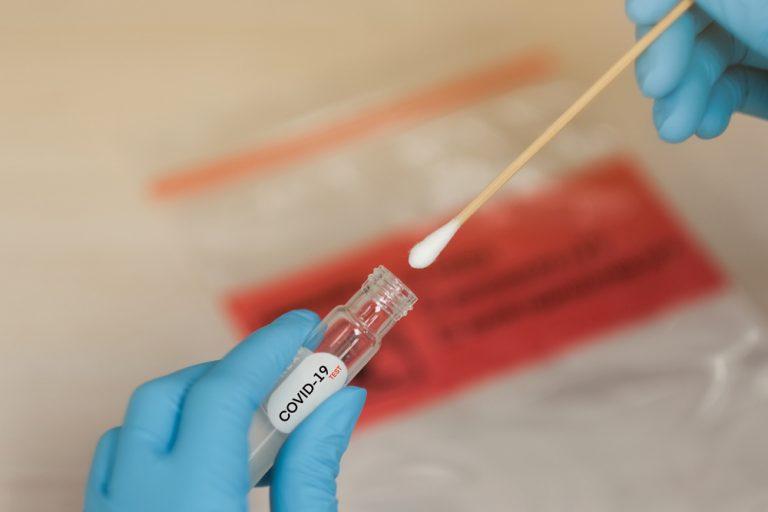
Avacta (LON:AVCT) shares spiked higher on Friday after the group announced a collaboration with US-based Adeptrix to develop an antigen COVID-19 test.
The tests will utilise Avacta’s Affimer® biotherapeutics and help to significantly increase the number of tests clinicians are able to conduct in hospitals. With the WHO and governments around the world emphasising the importance of testing, the demand for the tests will be substantial.
Tests using technology such as Avacta’s Affimer® antigen technology will be crucial to tracking the spread of coronavirus and help reopen global economies.
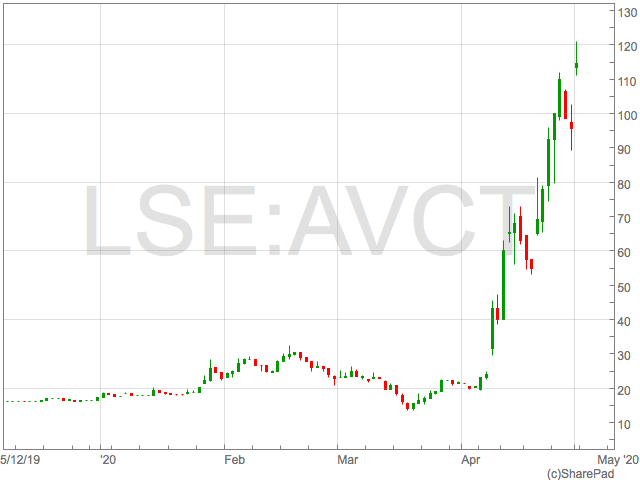
Avacta shares entered an auction after the open on Friday morning as shares spiked on the announcement. The Avacta share price was up in excess of 12% when shares eventually began trading.
Shares in Avacta have now increased more than 400% in April alone.
 Avacta’s Affimer® technology targets uses SARS-COV-2 spike proteins to target virus particles in tests such as swabs and saliva samples.
There were no commercial details released, but it was confirmed Avacta will earn a royalty from Adeptrix.
Dr Alastair Smith, Chief Executive Officer of Avacta Group, commented:
“We are delighted to have established this partnership with Adeptrix in our push to develop Affimer -based COVID-19 antigen tests. Jeff and his team are world-renowned in the mass spectrometry field, and the BAMS diagnostic platform is highly sensitive and specific, giving us great confidence that a high performance COVID-19 antigen test can be developed and launched commercially very quickly.”
“We believe that the BAMS test will be hugely attractive as an adjunct to PCR testing because it uses laboratory equipment that is already in hospital labs but not currently used for COVID-19 testing so it provides incremental testing capacity.”
“A consensus view is building around the world that hundreds of millions of COVID-19 tests are going to be required per month for a long period, and that the disease will be endemic after the initial pandemic has passed, meaning that testing for COVID-19 is going to be needed for many years.”
“I have made it clear that we intend to partner the SARS-COV-2 spike protein Affimer reagents with several select companies to support antigen test development on multiple diagnostic test platforms. This will contribute most effectively to the urgent need to increase antigen testing capacity globally and maximise the commercial return to Avacta. Adeptrix is one example of this and other discussions are underway. I look forward very much to further updating the market in the near future.”
Avacta’s Affimer® technology targets uses SARS-COV-2 spike proteins to target virus particles in tests such as swabs and saliva samples.
There were no commercial details released, but it was confirmed Avacta will earn a royalty from Adeptrix.
Dr Alastair Smith, Chief Executive Officer of Avacta Group, commented:
“We are delighted to have established this partnership with Adeptrix in our push to develop Affimer -based COVID-19 antigen tests. Jeff and his team are world-renowned in the mass spectrometry field, and the BAMS diagnostic platform is highly sensitive and specific, giving us great confidence that a high performance COVID-19 antigen test can be developed and launched commercially very quickly.”
“We believe that the BAMS test will be hugely attractive as an adjunct to PCR testing because it uses laboratory equipment that is already in hospital labs but not currently used for COVID-19 testing so it provides incremental testing capacity.”
“A consensus view is building around the world that hundreds of millions of COVID-19 tests are going to be required per month for a long period, and that the disease will be endemic after the initial pandemic has passed, meaning that testing for COVID-19 is going to be needed for many years.”
“I have made it clear that we intend to partner the SARS-COV-2 spike protein Affimer reagents with several select companies to support antigen test development on multiple diagnostic test platforms. This will contribute most effectively to the urgent need to increase antigen testing capacity globally and maximise the commercial return to Avacta. Adeptrix is one example of this and other discussions are underway. I look forward very much to further updating the market in the near future.”
 Avacta’s Affimer® technology targets uses SARS-COV-2 spike proteins to target virus particles in tests such as swabs and saliva samples.
There were no commercial details released, but it was confirmed Avacta will earn a royalty from Adeptrix.
Dr Alastair Smith, Chief Executive Officer of Avacta Group, commented:
“We are delighted to have established this partnership with Adeptrix in our push to develop Affimer -based COVID-19 antigen tests. Jeff and his team are world-renowned in the mass spectrometry field, and the BAMS diagnostic platform is highly sensitive and specific, giving us great confidence that a high performance COVID-19 antigen test can be developed and launched commercially very quickly.”
“We believe that the BAMS test will be hugely attractive as an adjunct to PCR testing because it uses laboratory equipment that is already in hospital labs but not currently used for COVID-19 testing so it provides incremental testing capacity.”
“A consensus view is building around the world that hundreds of millions of COVID-19 tests are going to be required per month for a long period, and that the disease will be endemic after the initial pandemic has passed, meaning that testing for COVID-19 is going to be needed for many years.”
“I have made it clear that we intend to partner the SARS-COV-2 spike protein Affimer reagents with several select companies to support antigen test development on multiple diagnostic test platforms. This will contribute most effectively to the urgent need to increase antigen testing capacity globally and maximise the commercial return to Avacta. Adeptrix is one example of this and other discussions are underway. I look forward very much to further updating the market in the near future.”
Avacta’s Affimer® technology targets uses SARS-COV-2 spike proteins to target virus particles in tests such as swabs and saliva samples.
There were no commercial details released, but it was confirmed Avacta will earn a royalty from Adeptrix.
Dr Alastair Smith, Chief Executive Officer of Avacta Group, commented:
“We are delighted to have established this partnership with Adeptrix in our push to develop Affimer -based COVID-19 antigen tests. Jeff and his team are world-renowned in the mass spectrometry field, and the BAMS diagnostic platform is highly sensitive and specific, giving us great confidence that a high performance COVID-19 antigen test can be developed and launched commercially very quickly.”
“We believe that the BAMS test will be hugely attractive as an adjunct to PCR testing because it uses laboratory equipment that is already in hospital labs but not currently used for COVID-19 testing so it provides incremental testing capacity.”
“A consensus view is building around the world that hundreds of millions of COVID-19 tests are going to be required per month for a long period, and that the disease will be endemic after the initial pandemic has passed, meaning that testing for COVID-19 is going to be needed for many years.”
“I have made it clear that we intend to partner the SARS-COV-2 spike protein Affimer reagents with several select companies to support antigen test development on multiple diagnostic test platforms. This will contribute most effectively to the urgent need to increase antigen testing capacity globally and maximise the commercial return to Avacta. Adeptrix is one example of this and other discussions are underway. I look forward very much to further updating the market in the near future.” Reckitt Benckiser shares jump on strong Dettol and Lysol sales
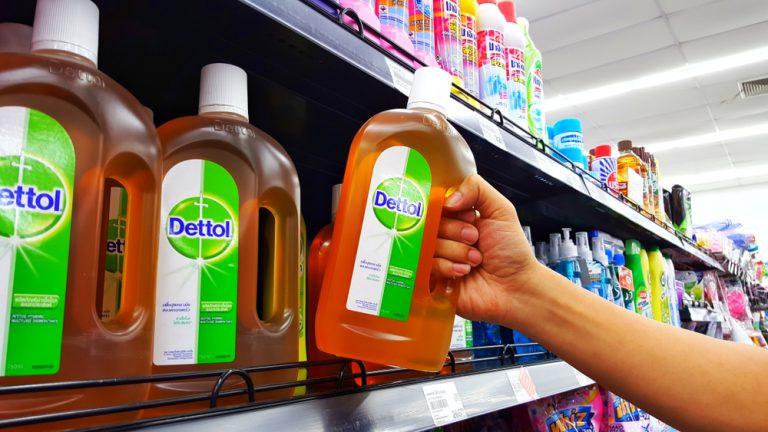
Shares in Reckitt Benckiser (LON:RB) rallied on Thursday as the FTSE 100 consumer group said they had a bumper first quarter driven by a jump in sales of hygiene products.
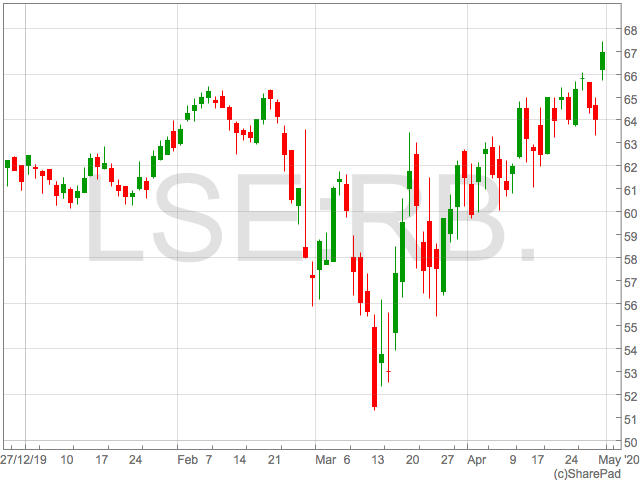
The Reckitt Benckiser share price rose over 4% to 6.679p, their highest level in 2020.
Reckitt Benckiser is one of only 12 companies in the FTSE 100 with shares in positive territory for 2020.
Group like-for-like sales increased by 13.3% in the first quarter as consumer stocked up on brands including Dettol, Lysol, Mucinex and Nurofen.
Reckitt Benckiser also enjoyed a 50% jump in online sales as consumer followed the ‘stay home’ guidance from governments.
However, the future performance of RB’s sales was unclear as sales may tail off after consumers stocked up on goods that may not necessarily need to be replaced.
Despite doubts surrounding the continuation of sales through 2020, RB said they had increases expectations for their full year performance after the strong first quarter.
Reckitt’s will provide further guidance in the half-year report.
Laxman Narasimhan, Chief Executive Officer of Reckitt Benckiser, commented on the results:
“We have seen strong consumer demand, particularly in March and April but the split between defensive buying and higher levels of underlying consumption is unclear. At this stage, it is uncertain how quickly this will change in the months ahead. Improved penetration and usage, particularly for products like Dettol and Lysol, may well sustain, although we will likely see some unwinding of ‘pantry load’ as we work our way through the crisis. The near- term operational challenges to meet additional demand and handle lockdown conditions, with the associated costs, are also likely to continue for some time.”
“As we set out in February, this is a good house in a great neighbourhood. There are four long-term trends that are shaping our business. Urbanisation and global warming continue to drive hygiene as the foundation of health.”
“Pressures on state-funded healthcare are growing demand for self-care. Sexual health and well-being are big societal issues that are growing demand for effective protection and related products. And an ageing and growing population is driving demand for personalised infant and adult nutrition. At the same time, technology and e-commerce are changing the way consumers know both what and how to buy, and where to look for information and advice.”
“Against this positive environment, we are making good strategic progress to position our business for success. I am heartened that the ambitions we have outlined to rejuvenate RB have gained support throughout the business. As a result, we are already executing our plan and making progress during this transformational year – one that lays the foundations for our success in the future; investing in our people, brands and operations, improving delivery performance and increasing productivity.”
 Reckitt Benckiser also enjoyed a 50% jump in online sales as consumer followed the ‘stay home’ guidance from governments.
However, the future performance of RB’s sales was unclear as sales may tail off after consumers stocked up on goods that may not necessarily need to be replaced.
Despite doubts surrounding the continuation of sales through 2020, RB said they had increases expectations for their full year performance after the strong first quarter.
Reckitt’s will provide further guidance in the half-year report.
Laxman Narasimhan, Chief Executive Officer of Reckitt Benckiser, commented on the results:
“We have seen strong consumer demand, particularly in March and April but the split between defensive buying and higher levels of underlying consumption is unclear. At this stage, it is uncertain how quickly this will change in the months ahead. Improved penetration and usage, particularly for products like Dettol and Lysol, may well sustain, although we will likely see some unwinding of ‘pantry load’ as we work our way through the crisis. The near- term operational challenges to meet additional demand and handle lockdown conditions, with the associated costs, are also likely to continue for some time.”
“As we set out in February, this is a good house in a great neighbourhood. There are four long-term trends that are shaping our business. Urbanisation and global warming continue to drive hygiene as the foundation of health.”
“Pressures on state-funded healthcare are growing demand for self-care. Sexual health and well-being are big societal issues that are growing demand for effective protection and related products. And an ageing and growing population is driving demand for personalised infant and adult nutrition. At the same time, technology and e-commerce are changing the way consumers know both what and how to buy, and where to look for information and advice.”
“Against this positive environment, we are making good strategic progress to position our business for success. I am heartened that the ambitions we have outlined to rejuvenate RB have gained support throughout the business. As a result, we are already executing our plan and making progress during this transformational year – one that lays the foundations for our success in the future; investing in our people, brands and operations, improving delivery performance and increasing productivity.”
Reckitt Benckiser also enjoyed a 50% jump in online sales as consumer followed the ‘stay home’ guidance from governments.
However, the future performance of RB’s sales was unclear as sales may tail off after consumers stocked up on goods that may not necessarily need to be replaced.
Despite doubts surrounding the continuation of sales through 2020, RB said they had increases expectations for their full year performance after the strong first quarter.
Reckitt’s will provide further guidance in the half-year report.
Laxman Narasimhan, Chief Executive Officer of Reckitt Benckiser, commented on the results:
“We have seen strong consumer demand, particularly in March and April but the split between defensive buying and higher levels of underlying consumption is unclear. At this stage, it is uncertain how quickly this will change in the months ahead. Improved penetration and usage, particularly for products like Dettol and Lysol, may well sustain, although we will likely see some unwinding of ‘pantry load’ as we work our way through the crisis. The near- term operational challenges to meet additional demand and handle lockdown conditions, with the associated costs, are also likely to continue for some time.”
“As we set out in February, this is a good house in a great neighbourhood. There are four long-term trends that are shaping our business. Urbanisation and global warming continue to drive hygiene as the foundation of health.”
“Pressures on state-funded healthcare are growing demand for self-care. Sexual health and well-being are big societal issues that are growing demand for effective protection and related products. And an ageing and growing population is driving demand for personalised infant and adult nutrition. At the same time, technology and e-commerce are changing the way consumers know both what and how to buy, and where to look for information and advice.”
“Against this positive environment, we are making good strategic progress to position our business for success. I am heartened that the ambitions we have outlined to rejuvenate RB have gained support throughout the business. As a result, we are already executing our plan and making progress during this transformational year – one that lays the foundations for our success in the future; investing in our people, brands and operations, improving delivery performance and increasing productivity.” Lloyds profit wiped out by COVID-19 provisions

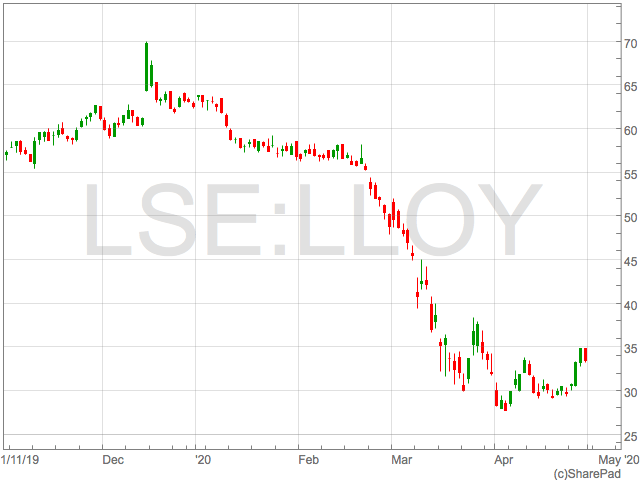
Lloyds (LON:LLOY) first quarter pre-tax profit has been almost completely wiped out by a £1.4bn provision for the increased macro uncertainty due to the COVID-19 pandemic.
Lloyds statutory pre-tax profit fell to £74m, considerably lower than the £1.6bn reported in the first quarter of 2019.
Lloyds shares were down as much as 4% in the first hour of trading on Thursday.
Just as Lloyds cut their dividend inline with other UK banks in April, Lloyds followed in the steps of other UK banks by saying their would be no consideration given to resuming dividends until the end of 2020.
UK banks scrapped dividends in April to help preserve cash for the possibility of a prolonged economic downturn, despite the banks having much stronger balance sheets than they did in the financial crisis.
Although Lloyds reported a sharp drop in profits, the bank said the company’s operations had been resilient to the spread of COVID-19 with around 90% of their branches remaining open.
In statement attached to the first quarter results, CEO António Horta-Osório highlighted Lloyds’ strong balance sheet and how this will be used to facilitate the UK economy.
“The coronavirus pandemic presents an unprecedented social and economic challenge which is having a significant impact on people and businesses in the UK and around the world. The economic outlook is clearly challenging with the longer- term outcome dependent on the severity and length of the pandemic and the mitigating impact of Government and other measures in the UK and across the world,” said António Horta-Osório, Group Chief Executive
“Throughout this period of uncertainty we will continue to work closely with Government, regulators and other authorities and use the strength of our balance sheet and business model to ensure that we play our part in supporting our customers and the UK economy.”
“I would like to pay tribute to the exemplary dedication being shown by all our colleagues across the Group providing vital banking services to those in need, but also in going above and beyond in countless and often unseen ways to support the most vulnerable.”
 Although Lloyds reported a sharp drop in profits, the bank said the company’s operations had been resilient to the spread of COVID-19 with around 90% of their branches remaining open.
In statement attached to the first quarter results, CEO António Horta-Osório highlighted Lloyds’ strong balance sheet and how this will be used to facilitate the UK economy.
“The coronavirus pandemic presents an unprecedented social and economic challenge which is having a significant impact on people and businesses in the UK and around the world. The economic outlook is clearly challenging with the longer- term outcome dependent on the severity and length of the pandemic and the mitigating impact of Government and other measures in the UK and across the world,” said António Horta-Osório, Group Chief Executive
“Throughout this period of uncertainty we will continue to work closely with Government, regulators and other authorities and use the strength of our balance sheet and business model to ensure that we play our part in supporting our customers and the UK economy.”
“I would like to pay tribute to the exemplary dedication being shown by all our colleagues across the Group providing vital banking services to those in need, but also in going above and beyond in countless and often unseen ways to support the most vulnerable.”
Although Lloyds reported a sharp drop in profits, the bank said the company’s operations had been resilient to the spread of COVID-19 with around 90% of their branches remaining open.
In statement attached to the first quarter results, CEO António Horta-Osório highlighted Lloyds’ strong balance sheet and how this will be used to facilitate the UK economy.
“The coronavirus pandemic presents an unprecedented social and economic challenge which is having a significant impact on people and businesses in the UK and around the world. The economic outlook is clearly challenging with the longer- term outcome dependent on the severity and length of the pandemic and the mitigating impact of Government and other measures in the UK and across the world,” said António Horta-Osório, Group Chief Executive
“Throughout this period of uncertainty we will continue to work closely with Government, regulators and other authorities and use the strength of our balance sheet and business model to ensure that we play our part in supporting our customers and the UK economy.”
“I would like to pay tribute to the exemplary dedication being shown by all our colleagues across the Group providing vital banking services to those in need, but also in going above and beyond in countless and often unseen ways to support the most vulnerable.” Royal Dutch Shell cuts dividend

Royal Dutch Shell (LON:RDSB) has cut their dividend as earnings fall due to the ongoing COVID-19 crisis and volatility in the price of oil.
Shell has reduced their first quarter dividend to 16 cents, down from 47 cents in the same period a year ago.
Royal Dutch Shell shares opened 4% lower in London on Thursday.
The deterioration in the macroeconomic picture due the pandemic was instrumental in Shell’s decision to cut their sacrosanct dividend for the first time since world war two.
“Shareholder returns are a fundamental part of Shell’s financial framework. However, given the risk of a prolonged period of economic uncertainty, weaker commodity prices, higher volatility and uncertain demand outlook, the Board believes that maintaining the current level of shareholder distributions is not prudent,” said Chad Holliday, Chair of the Board of Royal Dutch Shell.
“Following the announcement not to continue with the next tranche of the share buyback programme, the Board has also decided to reduce the first quarter 2020 dividend and reset to 16 US cents per share.”
The chair went on to outline the board’s thinking and highlighted the preference was to maintain the strength of the balance sheet as opposed to their investor’s income, in the short-term.
“As conditions allow, the Board will continue to evaluate our capital allocation priorities between ongoing investment in our business, maintaining a strong balance sheet and increasing returns to shareholders which remains our ambition.”
Royal Dutch Shell’s decisions to cut dividends comes just days after peer BP maintained their dividend, despite an increase in net debt.
However, just as BP earnings suffered, Shell did see profit falling as the impact of lower oil prices dented revenue.
Shell reported revenue of $60.96bn in the first quarter compared to $85.66bn in 2019.
Shell reports earnings based on Current Cost of Supplies (CCS) which takes into consideration the current price of oil instead of the historic price. It also accounts for the carrying cost of oil. CCS earnings reporting means profit tends to be higher when oil prices are falling and lower when prices are rising.
Shell reported first quarter CCS earnings of $2.9bn in the first quarter, down from $5.4bn in the same period last year.
Baron Oil strikes work-sharing agreement, shares jump 40%

Baron Oil (LON:BOIL) was one of AIM’s top risers on Wednesday after the oil explorer revealed a work-sharing agreement alongside the release of their final results.
Baron Oil announced a work-sharing agreement “with a large European Exploration and Production Company” for in the Inner Moray Firth area. The news is a milestone in the prospect which could lead to significant value creation for Baron Oil’s shareholders.
Baron Oil has a 15% interest in the prospect and the work sharing agreement could lead to a more formal farm-in agreement.
The explorer, who has prospects in South East Asia, Latin America and the UK, also posted a significant reduction in pre-tax losses to £1.7m in their final results.
Commenting on the results, Malcolm Butler, Executive Chairman, said:
“The final award of the Chuditch PSC was a great result for your Company and marks a step-change in Baron’s asset base. However, our industry is currently faced with the dual global impact of significantly lower oil prices and the rapid spread of the COVID-19 virus. While Baron is not insulated from the oil price shock, it should be noted that the Company’s assets are all in the pre-cashflow exploration phase and, following the award of the Chuditch PSC, are now heavily weighted towards gas where regional markets play a much greater role in pricing.”
“In Timor-Leste, there is no obligation to drill before 2022 and any commercial production is unlikely to be achieved before 2025. There are no plans to fund drilling in the UK for the foreseeable future. In both cases, work on these projects over the next 12 months is desk and computer-based and should not be affected by current movement restrictions, although gaining access to the necessary data is being delayed.”
“As regards the El Barco-3X well in Peru, it is unclear how much local oil companies’ appetite for drilling will be affected by oil price movements and although it is unlikely that local gas prices in this part of Peru will be affected by the drop in oil prices, it is impossible to predict the effects on short term gas demand of a COVID-19 related recession.
“Critically for shareholders, following our £2.5m (gross) fund raise in Q1 2020, our proposed work programme for 2020 and into 2021 is funded.”
Analysts were also positive on the results and pointed towards potential uplift for Baron Oil.
“Exclusivity may be extended until 31 December 2020 in the event that the interested party wishes to negotiate a formal farm-in agreement. In the event that the third parties’ technical work suggests significant potential resources to be present on the licence and a farm-in is agreed, we believe that the value of Baron’s interest could increase significantly,” Barry Gibb, Research Analyst at Turner Pope, wrote in a note.
Braveheart Investments shares rocket 71% on plans to grow portfolio

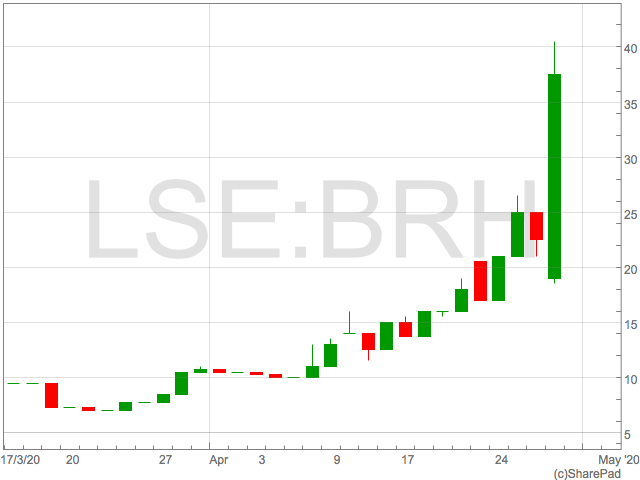
Shares in AIM-listed Braveheart Investments (LON:BRH) rocketed on Wednesday after the investment company announced the results of a placing to help grow their portfolio.
The Braveheart Investments share price was up 71% to 38p on Wednesday.
The jump followed a successful £275,000 placing at 17p. Th proceeds will be used to expand the company’s portfolio with investments already earmarked for the cash.
The cash will be invested in Braveheart’s strategic investments including Paraytec, Pharm2Farm, Kirkstall Limited, Gyrometric Systems , Phasefocus Holdings and Sentinel Medical.
Braveheart Investment’s portfolio is focused on technology companies with high levels of intellectual property.
Trevor Brown, Braveheart CEO, commented: “We are delighted to have been able to raise this extra funding and to have also increased our shareholder base. The balance sheet of Braveheart remains strong and so we will be able to provide financial support to our Strategic Investments if it is required to keep up their momentum in development.”
 The cash will be invested in Braveheart’s strategic investments including Paraytec, Pharm2Farm, Kirkstall Limited, Gyrometric Systems , Phasefocus Holdings and Sentinel Medical.
Braveheart Investment’s portfolio is focused on technology companies with high levels of intellectual property.
Trevor Brown, Braveheart CEO, commented: “We are delighted to have been able to raise this extra funding and to have also increased our shareholder base. The balance sheet of Braveheart remains strong and so we will be able to provide financial support to our Strategic Investments if it is required to keep up their momentum in development.”
The cash will be invested in Braveheart’s strategic investments including Paraytec, Pharm2Farm, Kirkstall Limited, Gyrometric Systems , Phasefocus Holdings and Sentinel Medical.
Braveheart Investment’s portfolio is focused on technology companies with high levels of intellectual property.
Trevor Brown, Braveheart CEO, commented: “We are delighted to have been able to raise this extra funding and to have also increased our shareholder base. The balance sheet of Braveheart remains strong and so we will be able to provide financial support to our Strategic Investments if it is required to keep up their momentum in development.” Next shares sink as the retailer scraps dividend
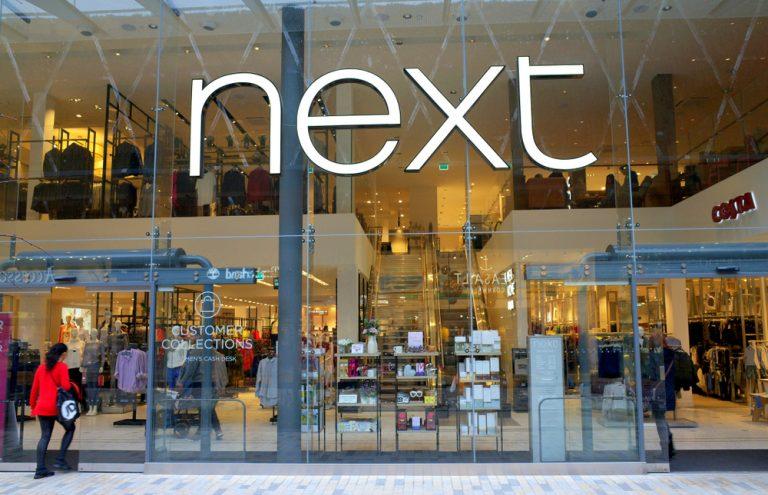
Shares in Next plc (LON:NXT) fell on Wednesday as the company scrapped their dividend amid disastrous sales performance due to the coronavirus pandemic.
The British retailer released full price sales figures that revealed an obliteration of sales during the lockdown with total sales for the year to April 25th down 38%.
Next faced pressure to close their warehouses after failing to implement social distancing measures meaning their website was forced to close.
With stores already closed, Next’s revenue generation was severely limited to the extent the company made no sales in the week commencing 29th March.
Online sales have since resumed but a well below the comparative period last year.
The company has scrapped the dividend to be paid in August and said it is unlikely the January dividend will be paid either. This is estimated to save £220m in an effort to conserve cash.
Next summuarised the results of stress tests and potential scenarios that showed even in the case of a 40% reduction in full year sales, the company would still be EBITDA positive.
“It is hard to think of a time when the outlook for sales and profit has been more difficult to predict. A pandemic of this scale has simply not been experienced by a modern global economy. No amount of information about the past can accurately guide us in our deliberations on the future. Our job is not to guess exactly how things will pan out but to prepare the Company for all outcomes that seem reasonably possible,” Next said in a statement.
“So, the scenarios we set out are just that, scenarios, not guidance, not a forecast. Their purpose is to demonstrate how the business is likely to perform under different levels of stress, without seeking to predict which outcome is most likely.”
“But these stress tests are more than an academic exercise. They serve to inform the decisions we take about the costs we should save, the cash we need to generate and investments we can afford to make.”
“The stress test also serves to demonstrate the financial stability of the Group. NEXT’s historic maintenance of healthy margins and high returns on capital have built a strong base from which to weather the storm: even in our worst case scenario of sales down -40% the Group still is likely to deliver positive EBITDA and reduce year end financial net debt.”