Shares in WPP (LON:WPP) rose on Tuesday after the advertising company released an update on operations during the coronavirus outbreak.
In an update that was generally taken well by the market the company highlighted a strong start of to 2020 and their ability to continue operations through remote working.
Shares in WPP were up over 7% on Tuesday morning.
Although the advertising agency said it had experienced cancellations and sales declines in some areas, it had seen growing demand for strategic communications while government and NGO bookings remained robust.
In an effort to conserve cash, WPP adopted measures similar to many companies in ceasing their share buyback programme and have scrapped the 37.3p Q4 2019 dividend.
This is expected to save £1.1 billion in cash. The company also announced cost cutting measures to the tune of £700-800 million.
Mark Read, Chief Executive Officer, WPP commented:
“The actions we have taken in the last 18 months to streamline and simplify WPP, together with raising £3.2 billion in asset disposals, have put WPP in a strong financial position. It is clear that the companies in the strongest financial position will be best placed to protect their people, serve their clients and benefit their shareholders during a period of great uncertainty, which is why we are taking the steps we are outlining today.”
“Across WPP we now have close to 95% of our people working effectively and productively away from their offices. I am very proud of the response from our people, who are looking out for each other and going the extra mile for clients while demonstrating the creativity, collaboration and resilience that will be key to the enduring success of WPP. At the same time, we are supporting many governments and international health organisations on communications programmes to limit the impact of COVID-19 on our communities. The important role we are playing in helping our clients navigate a difficult time gives us great confidence in the long-term future of the company.”
WPP are set to release their first quarter trading 29th April 2020.
Oil giant Royal Dutch Shell (LON:RDSB) have updated their 2020 outlook following the spread of the coronavirus.
In a brief update that covered Shell’s business units including integrated gas, upstream and oil products, the main take away was a possible $400-800 million in impairment charges.
“As a result of COVID-19, we have seen and expect significant uncertainty with macro-economic conditions with regards to prices and demand for oil, gas and related products.”
“The impact of the dynamically evolving business environment on first quarter results is being primarily reflected in March with a relatively minor impact in the first two months,” Shell said in a statement.
The adverse update was a result of a drop in oil prices causing Shell to make amendments to their average oil price forecasts for early 2020. A price war between Russia and Saudi Arabia threatens to increase oil supply just at the time demand is set to be severely reduced by coronavirus, driving prices lower.
The oil products businesses was also expected to see weaker margins in the refining business. In terms of production, Shell said they expected output to be between 2,650 and 2,720 thousand barrels of oil equivalent per day
The update comes shortly after Shell announced they would be cutting costs and stopping their share buyback programme in an effort to conserve cash.
In a prior statement, Ben van Beurden, Chief Executive Officer of Royal Dutch Shell said he was confident Shell could successfully navigate the slump in prices and demand.
“As well as protecting our staff and customers in this difficult time, we are also taking immediate steps to ensure the financial strength and resilience of our business,” he said.
“The combination of steeply falling oil demand and rapidly increasing supply may be unique, but Shell has weathered market volatility many times in the past.”
Shares in Royal Dutch Shell (LON:RDSB) rose 6% in early trade on Tuesday following the annoucement.
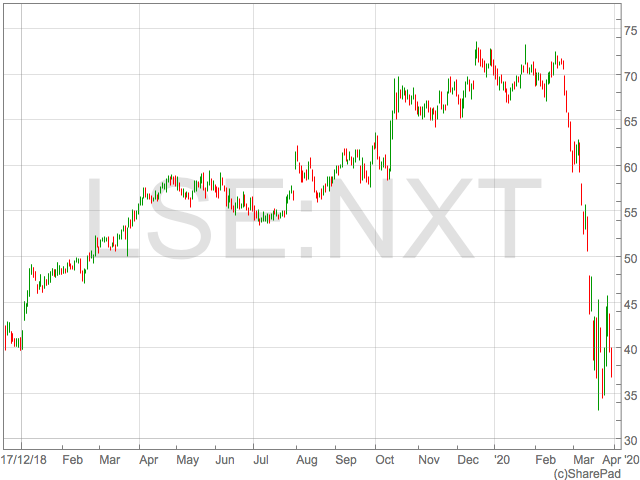
The Next share price (LON:NXT) fell heavily during the volatility caused by the spread of coronavirus and joined the raft of companies falling over 50% from their recent highs.
With such a sharp fall, shares in Next now have to nearly double to once again reach recent highs, but a culmination of changes to consumer behaviour and damage to Next as a brand could inhibit share price appreciation from current levels.
Unethical behaviour
The reputational damage to companies perceived to have behaved unethically or immorally during the coronavirus spread may well be punished by customers and investors after the crisis.
This could very well be the case for Next. Next came under well-publicised pressure from workers to cease operations at their warehouses after Next management refused to close, instead offering workers an additional 20% to remain at work.
This was met with an angry backlash from workers and politicians which led to Next ceasing it’s entire online operations.
In a brief and abrupt released to the market, Next said:
“NEXT has listened very carefully to its colleagues working in Warehousing and Distribution Operations to fulfil Online orders. It is clear that many increasingly feel they should be at home in the current climate.”
“NEXT has therefore taken the difficult decision to temporarily close its Online, Warehousing and Distribution Operations from this evening, Thursday 26 March 2020. NEXT will not be taking any more Online orders after this time until further notice.”
With stores already closed, Next is now unable to make any sales to customers and will have to refund any recent purchases that have not been delivered.
Next Mismanagement
Many companies will be forgiven for poor results during the spread of coronavirus. It has impacted every single company on the planet in ways that were impossible foresee.
However, Next is now in a position where it can not make any sales, which isn’t the case for most of it’s competitors, especially in the online space.
ASOS has gone full throttle with push notifications promoting sales, Top Shop have introduced a 30% sales for loungewear and created ‘Conference Call’ styles, and Boohoo’s PrettyLittleThing is running a 50%-70% sale.
Whilst margins will be compressed by discounts, Next’s competitors will maintain some levels of revenue as visitors to Next’s website are meet with ‘Sorry We Are Closed’ message.
Next’s competitors are not immune from criticism for continuing operations but have managed to keep their businesses running for the time being. Ocado, for example, ordered 100,000 testing kits for its employees.
The ability for other online business to keep going further highlights mismanagement by Next and the market will likely continue to punish them for this.
Next shares
With recent highs of 7,340p, Next shares would have to rally 86% to regain the losses.
This may be asking too much, even in normal circumstances, given that Next only managed to improve profit before tax by 0.8% in the year to January 2020.
Although the FTSE 100 listed company has seen a big increase in its online business in recent years, it was slow to adopt a strong online offering and has largely been left behind.
Next now has a dented reputation and will have to attract a consumer even more accustomed to online shopping after periods of self isolation imposed on them by coronavirus.
Crucially, these were periods when Next were shut for business.
New data revealed on Monday that more than half of people expect the British economy to be in recession within a year.
The data from YouGov reflects the economic fears caused by the outbreak of COVID-19.
Many countries have either been placed on total lockdown or closed all non-essential shops, restaurants and bars in order to contain the spread of the illness.
In order to assist those in the UK suffering economically, the British government has revealed plans to help businesses as the virus outbreak continues to evolve.
“Now almost three quarters expect that Britain’s economy will be in depression (19%) or recession (52%) within a year,” YouGov said in a report.
Meanwhile, only 1% believe that the economy will be booming within one year.
There is still much uncertainty over how long the national lockdowns and closures will last for.
“With unprecedented Government measures to crackdown on the spread of COVID-19 shutting small and large businesses across the country and confining Britons to their homes, it’s unsurprising that consumer confidence has been knocked,” Oliver Rowe, Director of Reputation Research at YouGov, commented on the data.
“But with little prospect of a solution in the next couple of months Britons are starting to believe that the economy will slide into recession or depression,” Oliver Rowe continued.
Kay Neufeld, Head of Macroeconomics at the Centre for Economics and Business Research, also commented: “The spread of coronavirus has dominated the headlines in recent weeks as Governments across the globe have taken drastic measures to protect their citizens. The data released in the coming days and weeks will show the significant economic costs associated with these measures.”
“Government mandated closures of non-essential shops, pubs, restaurants and other establishments will have a devastating effect on several industries and in particular on the leisure and hospitality sectors,” Kay Neufeld added.
Barclays (LON:BARC) announced on Monday that it will aim to be a “net zero bank” by 2050.
Shares in the bank were down by over 4% during trading on Monday.
The bank has also committed to align all of its financing activities with the goals and timelines of the Paris Agreement.
“The alignment of Barclays’ portfolio will start with the energy and power sectors, and will cover all sectors over time,” the bank said in a statement.
“Barclays will provide the transparent targets required to judge its progress and will report on them regularly, starting from 2021,” it continued.
Many have been joining the fight against climate change as the climate crisis continues to grow.
Last year, the UK government became the first G7 nation to write into law a target for net zero emissions.
The bank joins a list of companies making similar pledges. Earlier this year, BP (LON:BP) announced its plans to become net carbon zero by 2050.
Meanwhile, International Airlines Group (LON:IAG) has also said it will commit to achieving net zero carbon emissions by 2050.
On Monday, Barclays said that its shareholders will be asked to endorse this commitment through the passing of a resolution that the bank will propose to shareholders at its AGM.
“In developing its approach, Barclays has engaged extensively with its shareholders, as well as with stakeholders from across society more broadly,” the bank said.
Shares in Barclays plc (LON:BARC) were down on Monday, trading at -4.21% as of 12:30 BST.
EasyJet shares (LON: EZJ) fell on Monday after the low-cost airline announced that it has grounded its entire fleet of aircraft.
Shares in the airline were down by over 7% during trading on Monday.
“As a result of the unprecedented travel restrictions imposed by governments in response to the coronavirus pandemic and the implementation of national lockdowns across many European countries, easyJet has, today, fully grounded its entire fleet of aircraft,” the airline said in a statement.
The aviation industry has been hit particularly hard by the outbreak of COVID-19 as many nations have been placed under lockdown in an attempt to contain the spread of the illness.
Earlier this month, Europe’s worst-affected nation, Italy, was placed under lockdown.
This caused EasyJet rival Ryanair (LON:RYA) to announce that it will be lowering its passenger target for 2020.
On Monday, EasyJet said in a statement: “Over recent days easyJet has been helping to repatriate customers, having operated more than 650 rescue flights to date, returning home more than 45,000 customers. The last of these rescue flights were operated on Sunday 29 March. We will continue to work with government bodies to operate additional rescue flights as requested.”
The airline continued to add that it is uncertain when it will restart commercial flights.
EasyJet will continue to evaluate the situation based on regulations and demand. It will update the market when it has a clearer picture of the future.
“I am extremely proud of the way in which people across easyJet have given their absolute best at such a challenging time, including so many crew who have volunteered to operate rescue flights to bring our customers home,” Johan Lundgren, easyJet CEO, said.
“We are working tirelessly to ensure that easyJet continues to be well positioned to overcome the challenges of coronavirus,” the CEO continued.
Shares in EasyJet plc (LON:EZJ) were down on Monday, trading at -7.63% as of 11:55 BST.
Oil prices sunk again on Monday hitting 17-year lows and driving risk-off sentiment in equities as the FTSE 100 started the week in the red.
Brent oil for delivery in May fell as low as $19.89 in early Monday trade as concerns about the Saudi/Russia price war continued to put downside pressure on the price.
“Crude prices plunged further over the weekend, with WTI slipping below $20 and Brent around the $23 level, as Saudi Arabia said it was not in talks with Russia despite Washington pressuring both sides to help stabilise markets,” said Jack Allardyce, Oil & Gas analyst at Cantor Fitzgerald.
“The potential for a renewed supply pact had been one of the few factors helping to prop up benchmarks, as coronavirus-driven demand destruction has continued to outweigh global stimulus efforts.”
The United States’ attempts to resolve the spat between Russia and Saudi Arabia has so far yielded little results which threatens the future of their shale gas industry.
Vivek Dhar of the Commonwealth Bank of Australia said “US oil production cuts are expected to be the most significant,.”
“The plunge in US oil rigs last week signals the pressure facing the US shale oil sector.”
Some analysts have speculated Russia is attempted to permanently destroy the US shale gas industry and increase its control over large parts of oil supply.
Stocks fall
The drop in oil weighed on European stocks which are still vulnerable to bouts of negative sentiment in the face of a recession cause by coronavirus.
The FTSE 100 was particularly heavily hit due to the heavy weighting of commodity shares; BP and Shell represent a significant portion of the index and were down 1.5% and 1% respectively.
They were by no means the largest movers in the FTSE 100 on Monday with Meggitt falling 15% and Rolls Royce trading 11% in the red.
The drop in Meggitt shares comes a days after the company released financial results and withdrew its dividend.
Boku (LON: BOKU) appears to be one of the few companies that is prospering in the past few weeks. The latest trading details with the 2019 figures show higher than usual growth in direct carrier billing volumes.
The AIM-quoted digital payments and fraud prevention services provider has experienced volume uplifts from countries with lockdowns and has not had any negatives in other countries. It is benefiting from more video streaming and greater playing time on video games as people stay in their homes.
2019
There were no significant surprises in the 2019 figures. However, Boku reported underly...
Feedback (LON: FDBK) is offering its Bleepa medical imaging communications platform to help with COVID-19. Hospitals will be able to use it for free.
Bleepa was launched last July. It can be used to transmit encrypted data between a hospital and a clinician’s own device when they are away from the hospital. Images, such as x-rays, CT scans and ultrasound scans can be sent.
In the case of COVID-19, images of the lungs of patients can be transmitted. The image quality means that important decisions can be made from these images.
Bleepa uses Feedback’s Cadran picture archiving and communications ...
There should be news about potential standard list shell Insight Business Support during this week. The strategy is to acquire a company in the support services sector.
The offer for subscription was set to close at the end of last week. Insight wanted to raise up to £1.5m at 2p a share, with a minimum subscription level of £700,000. This is not an easy time to raise cash, though.
The offer was extended from 19 March to 26 March. The plan was for the shares to start trading on 2 April.
The financial adviser is The Share Republic.com Ltd, which is authorised by the FCA. It is headed by Hoodless...