
Melrose beat internal expectations and swing to a profit in 2019

Melrose Industries PLC (LON:MRO) have beaten internal and market expectations across the recently ended financial year.
The firm said: “The results for 2019 were comfortably ahead of the Board’s expectations for both profit and cash generation
2019 was a year of significant progress but encouragingly much remains to be done and our divisional teams are delivering.
As such, we expect 2020 to be another year of good progress driven by each of the key businesses with a dual focus on efficiency programmes, to deliver operational improvements, as well as record investment in R&D to maintain technological market leadership.”
The FTSE 100 listed firm told the market that pretax profit had amounted to £106 million across 2019, which sees a massive improvement on the loss of £452 million posted last year. On an adjusted metric, pretax profit surged 32% to £889 million.
Looking at revenue figures, Melrose delivered revenues of £10.97 billion – again seeing a massive 35% spike from a year ago.
Melrose noted that its operations within its GKN unit are gaining momentum following the first full year of ownership.
GKN gives Melrose access to the aerospace, automotive, and powder metallurgy industries – and the purchase was made in 2018 for a reported £8.4 billion.
Notably, aerospace revenue also increased 7% however automotive revenue was down 6% within market expectations.
Melrose going forward have told the market that 2020 should be another year of progress in each division.
The impact of the coronavirus is difficult to assess, and the firm have focused on what they can control.
Justin Dowley, Chairman of Melrose Industries PLC, said:
“We are delighted with the Melrose performance in 2019 and the substantial value that is being unlocked. Notwithstanding any implications of the COVID-19 outbreak, the bedrock has now been built for the GKN businesses to attain results which were not previously achievable, and, in addition, the shareholder value built up in our longer held assets is closer to being realised. This shows, once more, that the Melrose model thrives by investing properly in businesses and giving management the entrepreneurial freedom to succeed. This is just the start of what is possible for GKN.”
Shares in Melrose Industries PLC trade at 208p (+1.85%). 5/3/20 10:57BST.
Aviva report 6% higher profits across 2019
Aviva plc (LON:AV) have published their annual results today, with the firm reporting higher profits across 2019.
The FTSE 100 listed firm have seen a mixed few months, but the update today shows good signs of progress for the firm.
Maurice Tulloch, Chief Executive Officer, said:
“In 2019, we set out our priorities and financial targets, strengthened our leadership team and remained focused on helping our customers prepare for a better future. We’ve made good progress, but there is much more to do.
Our return on equity was 14.3% and operating profit increased 6% to a record £3.2 billion. Our capital position remains strong and resilient at a 206% Solvency cover ratio. The Board has increased the full year dividend by 3% to 30.9 pence per share”.
Aviva reported that statutory pretax profit totaled at £3.93 billion across 2019, which was a massive increase on the £1.65 billion figure reported in 2018.
Notably, the firm added that this was boosted by £40.58 billion investment income, following a £10.91 billion loss in 2018.
Following changes to accounting standards, total pretax profit surged 58% to £3.37 billion.
The firm also reported that its’ return on equity improved from 12% to 14.3%, while the Solvency II cover ratio was 206% from 204%.
Income totaled £31.24 billion, which sees a 9% improvement on the 2018 figure – whilst the value of new businesses also increased to £1.22 billion.
Operating profit across 2019 was 6% higher at a record figure of £3.18 billion, which beats initial market consensus of £3.1 billion.
Finally, general insurance net written premiums rose 2% to £9.3 billion, and customer numbers were up 2% to 33.4 million.
Aviva are declaring a final dividend of 21.4 pence per share, taking the 2019 sum to 30.9p.
Tulloch concluded: “Customers are choosing Aviva to help them save for their future, draw a secure income in retirement and insure what matters most to them. In 2019, we increased customer numbers by 2% to 33.4 million, and improved customer satisfaction levels.
In general insurance, sales are up 2% and the outlook is positive in the majority of our markets. In our major life businesses, we have increased customer net inflows and grown assets by 9% to £417 billion. Aviva Investors secured third party net inflows of £2.3 billion on the back of strong investment performance.
My objective is to run Aviva better. We will improve business performance and enhance returns through disciplined action on expenses and underwriting. We will focus capital and resources where we can achieve competitive advantage and strong returns and we will take robust action across the portfolio where our performance falls short or where we can see a better way of delivering value to our shareholders”.
Aviva’s push through Asian difficulties
In November, Aviva updated the market about its’ intentions to sell their Hong Kong Division. The insurance firm said it will simply its business structure into five operating divisions and sell its stake in the Hong Kong business to co-investor Hillhouse Capital. “I am committed to running Aviva better,” said Tulloch ahead of a presentation to investors. “We will be more commercially focussed, manage costs rigorously and be more disciplined in how we invest,” he added. Additionally, Aviva set targets for the next three years. The highlights being a 12% return on equity, a £300 million net cost saving and an aim to generate a cash flow between £8.5 billion and £9.5 billion. Aviva have managed to battle through a mixed year and produce a very impressive set of results – which will please and reassure shareholders. Shares in Aviva trade at 351p (+0.27%). 5/3/20 10:47BST.Flybe says Flybye as Coronavirus grounds any hope of a recovery
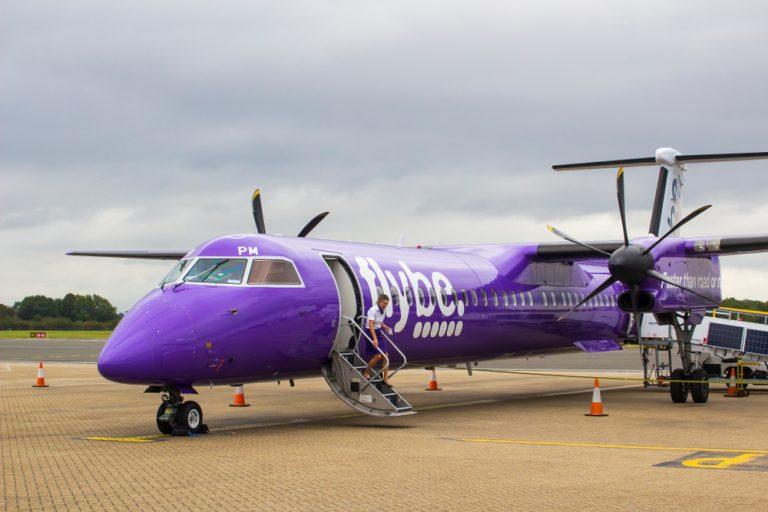
Exeter-based airline Flybe (LON:FLYB) is set to go bust ‘within hours’, after failing to secure additional, emergency financial support to keep the company afloat.
Slow violin music for Flybye
This comes amid a period of widespread hardship for the aviation and travel industries, with both Easyjet (LON:EZJ) and British Airways (LON:IAG) feeling the full force of the Coronavirus crunch, over the last week. After avoiding administration in January – courtesy of £100 million from the British taxpayer and changes to Air Duty Tax – the company and its 2,000 employees look set to be in real trouble on Wednesday evening. The imminent crash is being blamed on the impact Coronavirus has had on demand for air travel. It will come as a real kick in the teeth to British PM Boris Johnson, who bailed the company out as part of his initiative to keep the UK well-connected (at present, Flybe accounts for 40% of all domestic flights). After running into difficulties last year, the company was bought by a consortium containing Virgin Atlantic, who said they would pump £30 million into the business in January. Responding to the pressures of the Coronavirus outbreak earlier in the week, the company’s Chief Executive told the BBC they would be accepting a 20% pay cut, freeze recruitment and offer staff ‘unpaid leave’. Virgin added that Flybe bookings were 40% lower than this time last year.Trying to ignore IMF pessimism
Elsewhere on Wednesday, equities and national indexes were keen to hush the pessimistic GDP forecasts of the IMF, who joined the G7, WHO and central banks in revising their expectations in light of Coronavirus. Despite coming down off of their intraday highs, Wednesday still proved a positive day for markets, and a far-sight from the blood bath witnessed at the end of February. Somehow, most equities managed to cling on, to whatever contrived optimism was on offer. Speaking on the IMF’s statement and the Wednesday session outside of Flybe, Spreadex Financial Analyst Connor Campbell stated,“The Washington-based institution became the latest body to slash GDP forecasts, stating that ‘global growth in 2020 will dip below last year’s levels’. For reference, the IMF was previously expecting worldwide growth of 3.3% against 2019’s 2.9%.”
“It refused, however, to be drawn into exact forecasts, not only for the globe, but for China. Talking of the superpower, the IMF would only say that previous growth estimates are ‘no longer valid’.”
“This dose of reality – which came alongside a jump in UK coronavirus cases from 51 to 85 – undid some of the goodwill generated by the World Bank’s $12 billion stimulus pledge, taking the Western indices from their highs.”
“Nevertheless they remained strongly up on the day, the European gains firmed up by a 500 points surge from the Dow Jones. Though that sounds like a big movement, in the context of the last few sessions that doesn’t even recoup the ground lost by the Dow following the Fed’ impromptu rate cut. It was, however, better than the alternative.”
“The FTSE rose 1.1% to 6780, leaving it 80 points shy of the day’s peak, while the DAX and CAC climbed 160 points and 65 points respectively.”
Priti Patel bullying scandal – time to go, or civil service stitch-up?

On Wednesday a third allegation of bullying was made against UK Home Secretary Priti Patel, in what is being dubbed on Twitter the ‘civil service #MeToo’ movement.
The reaction today, at least on social media, has slowly become one of mounting suspicion against the individuals making the claims against Ms Patel. Prime Minister Boris Johnson firmly reiterated his support for the ‘fantastic Home Secretary’ during PMQs today, and his supporters online have lauded her as being the only Home Secretary in decades with the gusto (or gall) necessary to bring about radical change to immigration policy.
On the other side of the court, the allegations are seen as a rising tide of condemning evidence against the Home Secretary, with many of the more centre-ground politicians and media figures calling for her to be removed from government.Priti Patel adamantly denies the fresh claims as “completely false”, and allies blame a vendetta against her by a civil service faction. One friend: “A small number of civil servants are now actively trying to undermine a senior member of the elected government”.
— Tom Newton Dunn (@tnewtondunn) March 3, 2020
What’s the argument we’re really having?
I think the real danger is that we can no longer prove the veracity of claims of wrongdoing within positions of political office. With the argument being made that the allegations against Ms Patel are a concerted civil service stitch-up, and with a clear motive being present for such a malicious undertaking, I have sympathy for those who lose heart at the idea that accountability is boiling down to little more than a he-said she-said. The conflicts at play are complex and myriad, and they are conflating any process of arbitration for the issue at hand – but one tension stands out in particular. Most significantly, we have the very much alive-and-kicking tussle between the two most toxic forces in modern British politics: the enlightened, sanctimonious and London-centric equipe de frappe, and the pseudo-nostalgic, mob-like-Murdoch-disciples. The former is entirely counterproductive in the unsympathetic and condescending way it addresses the grievances of the latter, which accuse them of being the out-of-touch elite. The latter is equally guilty, though. With calls for dramatic overhaul of institutions which preserve democratic due process, and a seemingly flexible conception of truth and the lessons of history, there are some worrying parallels with the rhetoric of the Munich beer halls. How this seems to be playing out in politics – and wider society – is thoroughly disenchanting. Rather than resolving the elephant in the room, the bitterness between the two extremes appears to do little but turn off everybody between the two poles of opinion, who feel the only way to healthily engage with political discourse is to roll their eyes and avoid it altogether. I’d wager, perhaps cynically, that this is a dream outcome for Cummings et al. General ignorance is a far better breeding ground for the politics of plate-spinning, eponymous infrastructure projects and grand narratives, than an engaged body of citizens who hold leaders to account, for basing a country’s future on delusions of bygone glory.What’s the verdict on Priti Patel?
In the context of today’s events, this tension has left us with little hope of recourse. We have no conception – let alone a desire – to create a common idea of truth, and all this leaves us with is an undercurrent of ill-will and dissatisfaction (which naturally suits the side favouring hate, and dissatisfaction with the status quo). Playing for the Priti Patel camp for a moment: it seems intuitive to think the civil service would attempt to weaken or undermine a government threatening to dismantle and rebuild their entire institution. Ms Patel would also be the natural target for such an endeavour. She’s high profile, prone to making mistakes and disliked by many. With well-documented controversies such as her illicit diplomatic trip to Israel and her pay-for-favour approach to handing out MoD contracts, alongside her inability to discern between ‘terrorism’ and ‘counter-terrorism’ (among a series of golden soundbites) – she is the perfect comic-book villain. However, after a long digression, I tend to think the revelation of £25k hush money, to one of the alleged victims, provides some fire for the smoke. I might agree that our infrastructure and political institutions are in need of modernisation, but this should be done neither through the rhetorical chess of Mr Cummings, nor the empty spin methods favoured by his predecessors. Reform in all areas of politics needs to come from a place of rigour and a pragmatic search for solutions. The desire for change is palpable, but I fear (as recent events have shown us) that we lack a common conception of what is good and true. Without it, we risk entering a dangerous back-and-forth between divergent forces, attempting to bring about their differing conceptions of an ideal society.Severn Trent invest £1.2 billion into sustainability measures over next five years
Severn Trent Plc (LON:SVT) have told the market about their intentions to build a sustainable long term future.
The firm said today that it will invest £1.2 billion over the next five years, as it plans to fill it pledge to be a carbon neutral firm by 2030.
The firm commented: “By working to improve the natural habitat at each stage of the water cycle, we can improve the environment and the local areas our communities work and live in as well as substantially reduce the cost to our business.”
Severn Trent also added that they are aiming to source all of their energy from renewable sources directly and hold an all electric fleet.
The FTSE 100 listed firm have also made several other pledges, which have included reducing their water leakage by 15% by 2025 and by 50% by 2045.
Additionally, Severn Trent noted that will support 195,000 customers who struggle to pay their water expenses.
Other notable inclusions said that the firm will donate 1% of their profits over the next five years into the Severn Trent Community Fund, investing in projects in our local communities, while continuing to have one of the lowest combined bills in England and Wales for our customers.
Finally, Severn Trent added that they intend to work with 9,000 formats to adapt working practices and adopt nature based solutions to reduce pollutants in 44 catchments.
Liv Garfield, Chief Executive of Severn Trent, said:
“We firmly believe that businesses with a strong social purpose can deliver better and more sustainable outcomes for all stakeholders over the long term. To truly make a difference we need to look after nature and the precious resources it provides, we need the most talented and engaged minds helping us to drive performance and innovate, and we need customers who trust us to do the right thing for their communities. We’re incredibly proud of the work we have done so far when it comes to sustainability and excited that our stakeholders support the approach we are taking for the future. By committing to invest £1.2 billion in the next five years we believe we can make a real difference to the environment and people we serve while delivering strong business outcomes at the same time.”
Tony Juniper, Chair of Natural England, said of Severn Trent’s commitment to biodiversity:
“This very significant contribution from Severn Trent toward the creation of a national Nature Recovery Network could not be more welcome. If we are to achieve our goal to be the first generation to leave nature in a better state than we found it then this is exactly the kind of leadership, vision and partnership working that we will need. We hope that other major companies will soon come forward with comparable ambition, leading over time to an historic turnaround in the fortunes of our wildlife and natural environment.”
Shares in Severn Trent trade at 2,622p (+1.08%). 4/3/20 13:20BST.
DS Smith report like for like business growth despite macroeconomic challenges

Shareholders of DS Smith (LON:SMDS) have seen their shares bounce following an optimistic update from the firm.
The FTSE 100 listed firm said that it had seen like for like business growth across its’ third quarter.
On an even better note, DS Smith added that their results have not been impacted by the outbreak of the coronavirus – which will give shareholders reassurance.
The packaging firm said that it had seen like fo like corrugated box volume growth, which had met expectations.
DS Smith added that this performance was despite despite macroeconomic complications – which have hindered global businesses and stocks.
The firm added that it had seen ‘good performances’ across its operations in the UK, Eastern Europe and Iberian Peninsular.
Notably, the firm added that they have seen their ex-Europac packaging operations performing well and FMCG and e-commerce businesses growing strongly over the festive period.
North American business has been progressing, as DS Smith noted that initial customer reaction to a box plant had been very pleasing.
Miles Roberts, Group Chief Executive, said:
“The Group has delivered a robust performance during the period within a challenging macro-economic environment. Whilst we continue to monitor events and work closely with all our suppliers and customers, we have not to date seen any material impact to our business from coronavirus.
Our sustainable packaging offering including the replacement of plastics is becoming ever more important to our FMCG and e-commerce customers and we continue to gain market share.
Despite continued uncertainty in the macro-economic environment, our focus on pricing discipline, enhanced cost and efficiency improvements, and cash generation, support our expectation of further good progress in the year.”
DS Smith report productive half year trading
At the start of December, DS Smith noted that they had seen a productive half year of trading. The Group’s revenue rose 4% year-on-year to £3.19 billion. This lead a jump in adjusted operating profit of 15% and profit before tax of 31%, up to £351 million and £213 million respectively. DS Smith shareholders enjoyed similar success, with the Company’s adjusted EPS up 5% to 17.4p, and their interim dividend per share rising 4% to 5.4p per share. The Company celebrated ‘Record Group profitability’ despite economic headwinds. It added that it saw good organic profit growth in its European division, while progress in its US business was offset by the impact of export paper pricing. Shares in DS Smith trade at 335p (+3.97%). 4/3/20 12:25BST.Biffa expect performance to meet expectations

Biffa PLC (LON:BIFF) have given shareholders an update with confident sentiment on Wednesday.
Biffa said that its’ performance within its’ current financial year has met expectations, however there could be a delay on a new project announced a few weeks back.
Shares in Biffa trade at 290p (+1.40%). 4/3/20 12:04BST.
The firm noted that across its’ yearly period, ending March 27 – performance has been in line with board expectations.
Biffa added that progress has been made on underlying performance metrics and earnings per share.
The waste management firm said that it saw a strong performance within its’ Recycling division due to higher demand for recycled plastics. Additionally, the firms’ Collections division continued to grow.
A few weeks back, Biffa updated the market as they said that had reached financial close on the Protos energy-from-waste project in Cheshire. This project is set to cost between £285 million and £295 million, with Biffa planning to pay £45 million over the next three years.
In the update today, the firm noted that the development process was slightly behind schedule and now financial completion has been delayed.
The firm concluded by saying: “The Group has completed four small acquisitions in the year and continues to have a strong pipeline of opportunities.
Cash generation and net debt are in line with expectations, underpinning Biffa’s ability to deliver the Group’s established strategy for growth, whilst also returning cash to shareholders through its progressive dividend.
Biffa will launch its sustainability strategy: Resourceful, Responsible on Monday 16 March. The strategy will detail the Group’s ambitious approach to sustainability, defining its commitment to helping to solve the UK’s waste challenge and ensuring its business is fit for purpose over the critical years ahead.
The strategy is built around three pillars: Building a Circular Economy, Tackling Climate Change and Caring for our People and Supporting our Communities. Further detail will be shared on 16 March.
Biffa continues to closely monitor the potential impact of COVID-19 on its business and supply chains. There has not been any meaningful impact on the Group to date. The Board remains confident in the ongoing strategy and trading performance of the Group.”
IG Design unaffected by coronavirus, and remain confident to meet expectations

IG Design Group PLC (LON:IGR) have told the market that they have not been materially impact by the outbreak of the coronavirus.
The firm did note that they do have operations in China, but production volumes are set to rise over the next few weeks.
The firm said: “The Group is closely monitoring the developments regarding COVID-19 and its potential impact on the business. With the current known scale of the outbreak, it is not expected that there will be a material impact to the Group’s current forecasts.”
The stance that IG Design took today will reassure shareholders, in what has been a hectic week for global business and stocks.
IG Design also noted that the firm is set to meet expectations as it had a strong festive seasonal trading period and completed its CSS Industries Inc acquisition.
The CSS deal was worth £89.7 million, and was announced a few weeks back in January. Notably, this deal will also allow IG Design to double the size of its US operations.
Commenting on the performance, Paul Fineman, Group CEO, said:
”In what has been a particularly challenging year, we are pleased with the progress the business has made, and that we remain on target to deliver performance in line with expectations. This is truly a testament to the hard work of all of our teams and the inherent agility that runs throughout our business.
We are also delighted that we have completed the CSS acquisition on schedule and can now commence the process of integrating the two businesses. We have already been working hard on integration planning and look forward to delivering on the significant opportunity ahead for the enlarged group.”
IG Design see November success
Just before Christmas, IG Design posted a bumper set off fundamentals – which sent shares rallying. The Group’s revenue bounced 21% between the first and second half, up to £248.4 million. This led the Company’s adjusted operating profit to increase likewise by 21% to £23.6 million. Similarly, they narrowed their net debt from £100.0 billion to £86.2 million between the two halves, which allowed their average leverage to fall to 1.0 times, from 1.3 times for the 12 months to 30 September 2018. IG Design shareholders also fared well, with their adjusted fully diluted EPS up 2% to 20.1p, and their interim dividend surging 20% to 3.0p. Shareholders of IG Design Group should be pleased from the update today. The firm has taken a different stance to other companies that operate in China. The current situation of the coronavirus does not seem to be under control, as the UK Government yesterday announced intentions to release plans to limit the spread of COVID-19. The pathogen will have to be limited soon, as many firms are facing troubles in trading. However IG Design have remained optimistic and should deliver a steady set of results in 2019. Shares in IG Design Group trade at 749p (+0.43%). 4/3/20 11:37BST.Wizz Air announce measures to limit coronavirus impact
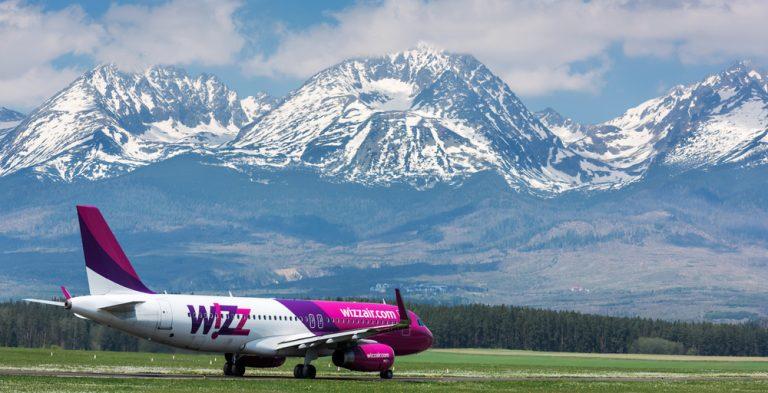
Wizz Air Holdings (LON:WIZZ) have told the market that they have taken some precautionary measures to limit the impact of the coronavirus.
Last week, British stocks faced a bruising after reports suggested that the coronavirus was in the UK and also had reached Italy.
There was no surprise that airline stocks had received the largest beating, with rivals such as IAG (LON:IAG) and easyJet (LON:EZJ) shedding volumes of their stock prices.
Wizz Air, who are a FTSE 250 listed firm today have announced measures that could mitigate the virus impact – as the airline industry faces another few months of tough trading.
Wizz Air noted that they have adjusted their travel schedule from March 11 to April 2 – with the main alterations being made in flights to and from Italy.
Measures have included cutting overhead and discretionary spending significantly, as well as leveraging staff across its network so as to pause recruitment along with “non-essential travel”.
Wizz Air added tat they are working with suppliers to reduce costs, and have speculated over further adjustments to network capacity in the magnitude of 10% in the first quarter of its financial year.
József Váradi, Wizz Air Chief Executive commented:
“Our ever-disciplined attitude to cost enables Wizz Air to partly offset some of the headwinds due to the COVID-19 outbreak, which have driven a temporary decline in demand and an increase in the cost of disruption as we put the well-being of passengers and crew first.
Wizz Air’s ultra-low cost business model and our strong balance sheet and liquidity provide a solid foundation and a significant competitive advantage in the current challenging environment for airlines, making us a structural winner in the aviation sector in the long term.
We are uniquely positioned for long-term value creation as Europe’s lowest cost, lowest emission airline and the market leader in the growing CEE market. The continuous rollout of the game-changing A321neo aircraft means that we will enjoy further cost improvements, while also ensuring Wizz Air is the most environmentally friendly choice of air travel for our passengers. We will continue to drive profitable growth in order to achieve one of the highest profit margins in the industry.”
The budget airline also noted that it was difficult to quantify the current impact of the coronavirus on their next financial year, however the firm added ‘we remain confident that as the situation normalizes, Wizz Air will continue its highly successful trajectory’.
Wizz Air concluded by saying that the firm will provide a pre-close year end trading statement ahead of the Company’s full year close period.
Wizz Air see strong February traffic
Yesterday, Wizz Air reported strong growth in passenger figures for February. The firm reported that passenger numbers rose 26% to 2.4 million, against a year on year basis. Wizz Air saw their passenger numbers rise 20% on a yearly rolling basis, to 41 million. Additionally, load factor rose to 93.7% from 92.6%, with capacity up 18%.Wizz Air expand into Abu Dhabi
This week started with a positive update from Wizz Air, with the firm noting that they will be expanding into the Middle East. The announcement to move into the Middle East was made a few months back, in December – and the firm said that it was looking to set up a deal with Abu Dhabi Development Holding Co PJSC. Wizz Air noted that the agreement had now bee completed, and that this means it can operate in Europe, the Middle East, Asia, and Africa from Abu Dhabi’s international airport. Shares in Wizz Air trade at 3,533p (+4.37%). 4/3/20 11:24BST.Hostelworld shares crash 10% following coronavirus speculation

Hostelworld Group PLC (LON:HSW) have seen their shares crash on Wednesday following speculation over the coronavirus impact.
The hostel booking firm cut its payout as earnings also fell, whilst adding that the ongoing coronavirus issues have caused treading to decline.
Hostelworld said that across 2019, revenue was 1.7% lower from €82.1 million to €80.7 million. Additionally, pretax profit also slumped to €3 million from €6.7 million.
Looking at costs, Hostelworld noted that administrative expenses climbed by 2.4% to €63.4 million from €61.9 million – which will leave a sour taste in the mouths of shareholders.
The firm did pay a full-year dividend of 6.3 euro cents per share – however this saw a massive drop of 54% from 13.8 cents in 2018.
Net bookings also dropped 4.8% o 6.6 million from 7.0 million reported in 2018, but on a slightly better note average booking value rose 2.8% from €11.64 to €11.97.
Gary Morrison, Chief Executive Officer, commented: “Following the group’s return to growth in 2019, I see significant opportunities to build a broader catalogue of experiential travel products beyond hostel accommodation. These types of experiences may include opportunities to study, work or volunteer abroad, with hostel stays featuring as part of an extended itinerary. Our research would also suggest that this market is very fragmented, with many different marketplaces and business models.
With the group’s deep knowledge of experiential travellers built up over 20 years, our trusted brand, and a loyal and relevant customer base, I believe we are uniquely positioned to help both our existing customers and new experiential travellers Meet the World® together with other like-minded travellers. To execute this strategy, the Group has increased its focus on potential M&A opportunities in the past six months and built an extensive pipeline of potential targets.
Overall, the Group sees significant potential for the further deployment of capital to enhance future growth through both organic and inorganic investment opportunities. As a result, the Board has taken the decision to rebase the dividend policy. A rebased progressive dividend with a pay-out of between 20-40% of Adjusted Profit After Tax will enable investment in organic and inorganic opportunities which should see shareholder return increase in the medium to long term.”
Hostelworld speculated over the impact of the coronavirus on future business, adding that trading had been affected.
There was a note that bookings had seen reduction and that its’ full year earnings before interest, tax, depreciation and amortisation could take a bruising between €3 million and €4 million.
Hostelworld commented: “While we entered 2020 with positive momentum, trading since late-January has been challenged by the outbreak of the COVID-19 virus which is having a significant impact on global travel demand, within Asian markets and more recently within the European market. As the Coronavirus has spread from region to region, we have observed a material reduction in bookings and an increase in marketing cost as a percentage of net revenue.
This has been driven by a significant reduction of bookings from free channels, an increase in longer lead time cancellations across all channels and an increase in investment in paid channels to partially offset the bookings decline in free channels. Given that the depth and duration of the virus outbreak is impossible to forecast at this time, we are unable to calibrate its effect for the balance of the year … With continued tight cost control and our strong cash generative characteristics, the Group remains resilient in volatile market conditions.”
Shares in Hostelworld trade at 94p (-10.48%). 4/3/20 11:03BST.