
Why savvy investors are buying wine En Premier in 2020

While the rest of us are recovering from the excesses of the holidays and broken New Year’s resolutions, January is a frenetic time for the fine wine market. Traditionally it’s the month for Burgundy En Primeur campaigns when top wines from the region are released for sale while still in the barrel. In a few frenzied trading weeks across January and February Burgundy’s finest and most sought-after wines are sold in this way, with some selling out within hours of being released.
“Buying wine En Primeur is a truly unique opportunity since it allows you to enter the market ahead of the crowd,” explanis Daniel Carnio, Director and Co-Founder of fine wine investment company OenoFuture. “The French term ‘en primeur’ is usually translated as ‘wine futures’ as you’re buying wines before they’ve even been bottled at the winery. This is brilliant news in investment terms because it means you’ll usually get a great price and you can be certain of the provenance and optimal storage of your purchases.”
En Primeur purchases also have the advantage of being relatively low-risk. Although you’re typically buying wines 6-24 months before they are bottled and released, En Primeur prices are nearly always much lower than the price after the wine is bottled. In some cases, prices can rocket to double the En Primeur price or more after the wine is bottled following a positive review from a top wine critic.
Another key advantage of purchasing wines En Primeur is that the wines are not initially subject to VAT and duty. While the wines remain at the winery or in a dedicated bonded warehouse in the U.K. these taxes do not need to be paid. This means investors have less initial outlay and more of their capital can be invested rather than used to pay taxes. It is worth bearing in mind that VAT and duty must be paid on any wines once they leave the winery or bonded warehouse.
“There’s never been a better time to invest in Burgundy En Primeur,” adds Carnio. “Over the past decade the wine collector’s favourite, Bordeaux, has continued to lose market share. According to Liv-Ex during 2019 Bordeaux accounted for just 55% of the market, down from over 95% in 2010.
Much of this ground has been taken by Burgundy as well as other regions like Italy and Champagne. Burgundy’s market share for 2019 hit 19%, beating 2018’s figure of 15%. Demand is especially strong in China and in the U.S. Proof of the region’s potential can be seen in the Liv-Ex Burgundy 150 index which has shown growth of 88% over the past five years. This is a trend which is almost certain to continue given the exceptional quality of the 2018 vintage.”
Sponsored by OenoFuture
Atlantic Capital Markets select Persimmon as their pick of the house builders

Atlantic Capital Markets have selected Persimmon (LON:PSN) as their pick of the house building shares following a raft of results from the sector.
John Woolfitt, Director of Trading at Atlantic Capital Markets said “after the recent flurry of figures from the sector I would lean towards Persimmon for investors as my pick of the big three.”
Atlantic Capital Market‘s view is derived from weakness they suffered last year causing underperformance against their peers.
“Despite the reputation being knocked last year due to poorer build quality and high executive pay they have taken strong steps to counter this problem which did weigh on figures. They have announced bigger investment into ensuring better build quality which did delay some completions in the short term but will good for the longer term.”
“From an investors point of view both the high dividend yield and low P/E makes for an appealing buy.”
Mr Woolfitt also touched on how Persimmon focused on their customers and that this is likely to provide support for their properties over the long term.
“From a home buyers point of view they are the first housebuilder to introduce a customer retention scheme and make a concerted effort to improve build quality which will have a good long term impact on sales.”
Although Atlantic Capital Markets are bullish on Persimmon, there were reservations on the rest of the sector saying they would “highlight caution in investing fresh money into the sector in the near term, based on the run they have all had since the election. Analysis on Taylor Wimpey, Barratt Developments and Persimmon all indicate overbought in the short term.”
“Existing holders should keep holding and any fresh investors should wait for a pullback in share prices to find an entry level.”
Persimmon (LON:PSN) shares were trading at 3,029p in Thursday afternoon trade, just shy of all time highs.
Wetherspoons toasts a further £80m of pub expansion

Well-known home of the cheap tipple, Wetherspoons (LON:JDW), enjoyed a strong festive period, which was crowned by the announcement that it would be expanding its pub portfolio during 2020.
The company reported like-for-like sales growth of 4.7% during the 12 weeks to the 19th of January alongside sales growth of 4.2%.
This positive financial performance was echoed by Revolution Bars (LON:RBG) which saw its shares jump following its announcement that it had booked a seventh consecutive year of record Christmas sales.
Unfortunately, the same couldn’t be said for City Pub Group PLC (LON:CPC), whose festive performance was “subdued” and anything but cheery. The firm saw its shares dip 8% on the announcement and said they would miss market expectations.
Wetherspoons’ progress, though, was expected and therefore somewhat overshadowed by the news that it had opened 1 pub and sold 5, and planned to open between 10 and 15 additional sites during the course of the financial year.
This is part of the pub’s strategy to spend £80 million on new pubs and pub conversions during the year.
So far this financial year, Wetherspoons has spent £57 million on buying the freehold reversions of 18 pubs of which it was previously the tenant. It expects full-year reversion expenditure to be around £85 million.
Additionally, the company announced it had spent £320 million on reversions since 2014, alongside £516 million on buying back or cancelling 53% of its own shares since 2003.
Wetherspoons court case
Commenting on a high court case involving the pub chain, Chairman Tim Martin stated,“In an important high court case involving Wetherspoon, the judge said that he would assume written statements by witnesses were true, unless contradicted by barristers in cross-examination.”
“This sensible principle of justice is also implicit in the ‘comply or explain’ provisions of corporate governance guidelines (the ‘code’).”
“Comply or explain must mean that the code envisaged flexibility and did not advocate a ‘one-type-suits-all’ approach.”
“If shareholders say nothing in response to company explanations, which have been made in order to comply with the code, it is reasonable to assume their assent.”
“However, in reality, detailed explanations are ignored by many fund managers and their corporate governance advisers – comply or explain has been corrupted to mean ‘comply or be humiliated in public and voted off the board’ – a risk which most NEDs are understandably reluctant to take.”
“A likely reason for ignoring explanations, in defiance of the code, is that it’s simpler and cheaper to apply arbitrary standards such as the ‘nine-year rule’- rather than engaging with companies and considering their explanations.”
Brexit chat over a pint, anyone?
In his usual fashion, the Wetherspoon Chairman also had to say his piece on Brexit:“It is disappointing to note that pro-remain organisations like the CBI and the Food and Drink Federation are, even at this late stage, doubling down on ‘project fear’ stories.”
“A dramatic headline on the BBC’s main news website (“Brexit: Price rises warning after chancellor vows EU rules divergence”, 18 January) predicted dire consequences in the event of ‘divergence’ from the EU.”
“The article contained a jobs warning from the CBI, which previously promoted the disastrous exchange rate mechanism and the euro, and a food prices warning from the Food and Drink Federation (FDF).”
“The CBI’s warnings about job losses and recession in the event of a leave vote in 2016 have proved to be mythical – over a million jobs have been created.”
“The FDF’s warnings about food price rises are absurd- the EU is a highly protectionist organisation which imposes tariffs and quotas on about 13,000 non-EU imports including many food and drink products such as bananas, rice, oranges, coffee and wine.”
“Elimination of tariffs will obviously reduce prices.”
“It is high time these organisations took a wise-up pill and supported the democratic decisions of the UK.”
Investor notes
After swinging to a rally, the company’s shares are now down 0.064% or 1.00p, to 1,562.00p per share. Peel Hunt reiterated their ‘Hold’ stance on the stock, their p/e ratio is 20.25 and their dividend yield isn’t generous at 0.51%.Tesla breaks through $100bn valuation after overtaking Volkswagen

American automotive and energy company Tesla Inc (NASDAQ:TSLA) announced on Thursday that it had replaced Volkswagen AG (ETR:VOW3) as the world’s second most valuable automotive producer.
The company broke through to a valuation of $102 billion or £76.1 billion, after a period of consistent growth in its share price.
This news marks just another significant development for the company, which, after earning its reputation as a loss-making enterprise, reported a rare quarterly profit in October.
Since then, the Company’s share price has more than doubled, and with this latest milestone being reached, Elon Musk could collect a payout worth $2.6 billion, contingent upon the company also earning revenue of $20 billion and earnings of $1.5 billion.
Tesla said that it had delivered more than 367,000 cars during the course of 2019, up some 50% from the year before.
This is due, in large part, to the opening of its Shanghai factory (which is little surprise to anyone familiar with the company’s issues with output and a long waiting list). It will also allow Tesla to capture a potentially lucrative Chinese market, which sees its number of affluent consumers grow by the day.
Looking forwards, the comapny still has some work to do on its output, with Volkswagen churning out 11 million units during the same period Tesla turned out fewer than 400,000.
It also has some way to go, to meet the lofty heights of Japanese car giant Toyota (LON:TYT), which currently has a valuation of $230.95 billion, and produces 9 million units per year.
Further food for thought is offered by way of investigations over battery fires and unexpected acceleration in its vehicles. So, not all sunshine and rainbows for Mr Musk yet, but perhaps in a better position than this time last year.
Since trading began on Thursday, the Company’s shares have rallied 4.09% or 22.36 USD to 569.56 USD per share 23/01/19 07:08 GMT.
FCA: 7 out of 10 users will be better off or see no change with new overdraft rules

The Financial Conduct Authority has said that 7 out of 10 overdraft users will be better off or see no change when the new rules are enforced in April.
Roughly 14 million people utilise an unarranged overdraft each year.
Salman Haqqi, personal finance editor at money.co.uk, shared some comments: “While the new FCA overdraft rules are set to make seven out of 10 people better off or see no change, banks have already announced a huge spike in overdraft interest charges, which may impact the most vulnerable households.”
“We mustn’t forget the other third of people who are going to end up paying the price for the change in overdraft terms and conditions, because they rely on their overdraft to make ends meet,” Salman Haqqi continued.
“If you are struggling with your overdraft and have no way to pay it off in full before the new rules come into force, other credit options such as a 0% balance transfer credit card, could be a good way to reduce the amount of interest you are paying on your debts.”
Salman Haqqi concluded: “We are urging people who do regularly use their overdraft to get in touch with their bank to check what the new FCA rules will mean for them. Moving debts away from an overdraft may help avoid the new extortionate interest rates that banks are set to introduce when the new rules launch in April 2020.”
Christopher Woolard, Executive Director of Strategy and Competition at the FCA, commented on the announcement: “Our changes expose the true cost of an overdraft. We have eliminated high prices for unarranged overdrafts.”
“This will result in a fairer distribution of charges, helping vulnerable consumers, who were disproportionately hit by high unarranged overdraft charges, and many people who use their overdraft from time-to-time,” Christopher Woolard said.
Markets feeling poorly with Coronavirus and Davos tensions

Asian markets have continued to suffer worst from the spread of Coronavirus, with investors fearing tentative attitudes towards trade and travel with China and surrounding regions.
The situation was also dim for European indices, with the FTSE and DAX also suffering losses after trading began, though this was also caused, in part, by the back-and-forth taking place in Davos.
Thursday will likely prove an eventful day, as these issues unfurl alongside the ECB‘s first strategic review since 2003, courtesy of Chirstine Lagarde.
Speaking on the morning’s events, Spreadex Financial Analyst Connor Campbell stated,
“Though they avoided a major slide, the European indices started the session in the red as the Coronavirus caused significant losses in Asia.”
“The Shanghai Composite suffered its worst day in almost 8 months, falling nearly 3% as Wuhan – the epicentre of Coronavirus – was put on lock down by Chinese officials. That decision came as the death toll rose to 17, with the number of cases now above 500. Elsewhere the Hang Seng slipped 2.2%, the Nikkei 1% and the South Korean KOSPI 0.9%.”
“The European markets weren’t quite as damaged after the bell. Nevertheless, the FTSE dropped 0.4% to fall below 7550 for the first time in a fortnight, while the DAX’s 75 point slide left it more than 200 points off the record high the German index briefly struck on Wednesday. The Dow Jones, which ended yesterday in the red, is set to slip to a one-week low of 29150 later this afternoon.”
“Complicating the atmosphere somewhat was the trade situation between the US and EU. The European Commission chief Urusla von der Leyen said in Davos that the pair are ‘expecting in a few weeks to have an agreement that we can sign together’. But this push for reconciliation came with a warning from Trump that if a deal isn’t reached the bloc will face ‘very high tariffs’ on cars and other products.”
“After Wednesday’s surge, one that came thanks to the chances of a rate cut next week dropping from 75% to 50%, the pound was relatively muted at the open. Cable was unchanged just below $1.315, its best price for 2 weeks, while against the euro sterling’s 0.1% increase left it at a fresh 5-week peak of €1.185. Those levels will be tested by Friday’s flash UK PMIs.”
“The headline event this Thursday is arguably Christine Lagarde’s second meeting as ECB head, one that will see her initiate the central bank’s first strategic review since 2003. Any clues as to what this will mean for Lagarde’s approach to monetary policy will be poured over by investors.”
Nearly 60,000 jobs shed from UK retail in 2019
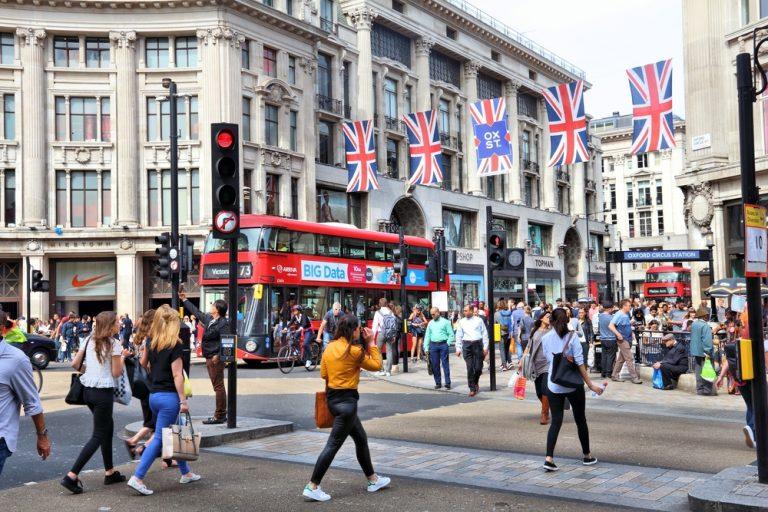
Latest figures revealed on Thursday that nearly 60,000 jobs were shed in the retail sector last year.
The news should not come as a surprise given that retail sales growth data for 2019 makes it “the worst year on record”.
The British Retail Consortium said that retail lost the equivalent of 57,000 jobs last year.
It is no secret that the UK retail sector has been struggling in recent years, with house hold names battling against gloomy trading conditions.
“There were many challenges in 2019: businesses had to contend with the repeated risk of no deal Brexit, a general election and the ongoing transformation of the industry, leading to weak consumer demand,” Helen Dickinson OBE, Chief Executive of the British Retail Consortium, said.
Indeed, last year was a rather turbulent one for UK politics; the Brexit deadline was extended several times, there was an attempt to prorogue parliament and a general election taking place all in one year.
“As a result, employment has suffered in retail, the UK’s largest private sector employer,” the Chief Executive continued.
“This matters – retail offers many people their first job, a range of flexible working options, and huge opportunities for progression. Retailers may be investing heavily in their workers, through training and apprenticeships, but more could be done. The current inflexibility in the Apprenticeship Levy system means that much essential training is not covered, limiting the opportunities for many working in the industry.”
The Chief Executive continued: “Moreover, it is worrying that the Government is standing by while tens of thousands of jobs are being lost. If the same was true in manufacturing or aviation, one can be sure that the Government would act. There are opportunities for action and the Government’s review of business rates could not come at a more crucial time. It is essential that they reform this broken system and rectify a tax that sees retail, which accounts for 5% of the economy, pay 25% of the burden.”
Elsewhere in retail on Thursday, online fashion retailer ASOS (LON:ASC) shares rose as its latest update hinted at recovery signs following its difficulties from last year.
Its string of profit warnings from last year suggests that the gloomy trading conditions to hit the sector were not merely confined to high street stores.
ASOS shares rise on recovery signs

ASOS (LON:ASC) shares rose on Thursday after the online fashion retailer posted a rise in revenue for the four months ended 31 December.
Shares in the company were up by 5% during Thursday morning trading.
The online fashion retailer said that revenue growth was driven by a “record” Black Friday trading period.
The results will provide joy to investors after a string of profit warnings were issued by ASOS last year.
ASOS said that, for the four months ended 31 December, group revenue was up 20% amounting to £1.1 billion.
Thursday’s update provides some relief compared to the situation ASOS found itself in over a year ago, back when the company issued a shock profit warning during the run-up to Christmas in 2018.
It is no secret that the UK retail sector has been struggling in recent years; earlier in January the British Retail Consortium said that figures for 2019 make it “the worst year on record”.
ASOS’ struggles over the past year shows that the gloomy trading conditions are not confined to the high street – online retailers also faced difficulty.
“ASOS has delivered an encouraging start to the year,” Nick Beighton, CEO, said in a company statement.
“Strong customer acquisition activity supported by robust operational performance has driven good momentum in all our markets,” the CEO continued.
“As we said in October, the focus for this year is to further enhance our capabilities and leverage the investments we have made. It is still early in the year and much remains to be done, but we are encouraged by the progress we have made so far. We remain confident in our ability to capture the substantial opportunity ahead of us.”
Shares in ASOS plc (LON:ASC) were up on Thursday, trading at +5.09% as of 10:07 GMT.


BlackRock CEO says climate change is an investment risk

The Chief Executive Officer of BlackRock said on Wednesday in an interview with Bloomberg that climate change could become a risk to investors.
BlackRock’s CEO Larry Fink commented on the topic during an interview with the Editor-In-Chief of Bloomberg John Micklethwait at Bloomberg’s The Year Ahead event, which is held alongside the World Economic Forum in Davos.
The debate surrounding climate change has accelerated recently, with activists such as Greta Thunberg advocating the urgent need to give attention to the climate crisis.
“Clients worldwide had been asking me repeatedly more and more about how should they frame a portfolio with climate change considerations,” Larry Fink said in the interview with Bloomberg.
“It was very clear to me that this is becoming a dominant theme in more and more of our investors.”
“I wasn’t prepared to answer many of those questions at that moment, and it was very clear to me that I needed to focus on it,” Larry Fink continued.
“I need to get BlackRock to focus on it. From September through the end of the year, we spent a great deal of time focusing on it.”
“I spent a great deal of time talking to insurance company CEOs. I talked to the CEOs of the housing companies of America, and I talked to some different mayors, and I had conversations worldwide related to the impact.”
“It was clear whether it was 10% or 20% more of our clients, it was clear to me that more and more clients were now thinking about how should they invest.”
“It was very clear to me the whole issue of climate change is really related to whether it is certainty or uncertainty as a science.”
Larry Fink continued: “I am not a scientist, but more and more, people are believing in some form of science, if not all the science. By being in the capital markets now for 44 years, it’s very clear we in the capital markets bring risk forward. We don’t wait until the risk is in front of us.”
“In most cases, we navigate the risk, and through that process, we mitigate most risk. So the process of having more and more clients focusing on these issues was very clear to me that there’s a greater belief of the science, and as a result of that now, we should not avoid the conversation about climate change.”
“Climate change is now becoming an investment risk.”
“Investors focus on yield curve of whatever forms of risk we have. It was very clear to me now we need to bring forward better risks tools to navigate risk. This is a component of the letter asking more companies to be self reporting on things so we have better clarity and understanding how each company is navigating this issues.”
“I’m not here to tell you these are the best tools. They are good tolls, and hopefully we have better tools. I do believe we are on this long path, and in 2019, most of the sustainable funds outperformed regular funds.”
“You could argue that is a big momentum trade. We had record inflows […] Record flows in ESG. We announced every one of our products was going to have a sustainable counterpart so we could bring this forward and have more investors as part of this dialogue,” Larry Fink concluded the Bloomberg interview.
You can watch the full interview for yourself on Bloomberg’s website here.
Last year saw the rise of climate change activism, with figureheads like Greta Thunberg advocating the need to urgently address the issue.
Greta Thunberg addressed the World Economic Forum on the topic:
https://platform.twitter.com/widgets.js Do you see climate change becoming a risk to your investment portfolio?“I wonder, what will you tell your children was the reason to fail and leave them facing the climate chaos you knowingly brought upon them?” Here’s a clip from my speech addressing the #WorldEconomicForum in Davos today. Full speech here: https://t.co/qAJIqYXxhd#WEF2020 pic.twitter.com/8Ev3HqRY7d
— Greta Thunberg (@GretaThunberg) January 21, 2020