British American Tobacco exceeds expectations by announcing increased profits

0

British American Tobacco looks to invest in new categories

British American Tobacco outperformed expectations in 2020, announcing a pre-tax profit of £8.67bn, up nearly 10% from £7.91bn in 2019. 

Revenue during 2020 fell slightly from £25.88bn in 2019 to £25.78bn, however this was in line with the company’s expectations and up on a constant-currency adjusted basis.  

On market opening, British American Tobacco’s share price dipped by 5% to 2,579.52p. Over a twelve month period, the FTSE 100 company’s share price is down by over 21%. In June 2017, British American Tobacco was valued at 5,578p a share, well over double its current value. 

The board confirmed it would payout a full-year dividend of 215.6p a share, up 2.5% from the year before. 

While British American Tobacco expects the pandemic to continue to affect its performance, the company is well on track to achieve yearly cost savings of £1bn by 2022. 

The savings will be reallocated to fund investments in new categories, according to the company’s chief executive, Jack Bowles. 

“Our investment behind New Categories has increased by a further £426m compared to 2019, enabled by a 5th consecutive year of value share growth in combustibles,” said Bowles.

“Enabled by Project Quantum, we continued to simplify the company and drive efficiencies, delivering £660m of cost savings (being well on track to deliver our ambitious £1bn of savings by 2022), further supporting new capabilities investment.”

Executives at the company have previously said that sales of “alternative” cigarette products are expected to grow by more than £5bn by 2022.

Bowles also made reassurances over British American Tobacco’s commitment to meeting ESG targets. 

“Our ESG targets are transformational and support our A Better Tomorrow ambition. We will track and share our progress. We are committed to reducing the health impact of our business, whilst delivering sustainable results that create long-term multi-stakeholder value.”

Russ Mould likened the FTSE company’s predicament to those of major oil and gas companies.

“British American Tobacco in many ways faces a similar challenge to the oil and gas sector, replacing a revenue stream which is widely perceived as harmful with one which is as yet much less profitable and where its ability to dominate the market is less certain,” said Mould.

Rio Tinto announces bumper final year dividend

0

Rio Tinto reveals new emissions goals

Rio Tinto has revealed a record $6.5bn final dividend as well as announcing new long-term carbon emission targets. 

The mining giant will pay a dividend of $3.09 a share, plus a one-time payout of 93 cents per share. In addition to the company’s half-year dividend, Rio Tinto’s payout for the financial year will amount to $9bn. 

Following the global economy’s ongoing recovery from worldwide lockdowns, Rio has benefited from a sustained rally in commodity prices, particularly iron ore, allowing the company to payout a generous dividend. 

Rio Tinto also announced a 22% rise in annual net profit of $9.77bn for 2020, up from $8.01bn the year before. 

The world’s leading producer of iron ore also reported a 20% increase in underlying earnings to $12.45bn, above analyst forecasts of $11.75bn. 

Jakob Stausholm, chief executive of Rio Tinto, praised the company’s response to the coronavirus-induced slump during 2020, while acknowledging the events at Juukan George. 

“It has been an extraordinary year – our successful response to the COVID-19 pandemic and strong safety performance were overshadowed by the tragic events at the Juukan Gorge, which should never have happened,” Stausholm said. 

“During 2020, the agility and resilience of the business and our employees, coupled with strong commodity prices, enabled us to deliver underlying EBITDA of $23.9 billion and Return on Capital Employed of 27%.” 

Rio also outlined plans to deal with carbon emissions, by pledging to reduce its steelmaking carbon intensity by at least 30% from 2030. 

“My new executive team and wider leadership of the company are all committed to unleashing Rio Tinto’s full potential. We will increase our focus on operational excellence and project development and strengthen our ESG credentials,” Stausholm continued. 

“Working closely with the Board, we must earn the right to become a trusted partner for Traditional Owners, host communities, governments and other stakeholders but we all recognise that this will require sustained and consistent effort.”

S&P 500 reaches all-time high amid economic optimism

0

The S&P 500 was trading well above yesterday’s close as the US index, up over 5%, continued its recent resurgence. The index reached an all-time high before 11am local time at a decimal point below 3,950 points. The S&P 500 was up 20% on its peak prior to the coronavirus-induced crash.

With high oil prices, along with optimism around vaccine roll-outs and a pending stimulus package, confidence in the US economy is growing.

“News of falling infection rates in the US is helping to feed the optimism as the Biden administration inches towards getting its $1 trillion-plus Covid relief package through Congress,” said Russ Mould, investment director at AJ Bell.

“The only creeping nervousness at present appears to be around the prospects for significant inflation driven by a combination of the emergence from Covid, generous stimulus packages and rising raw materials costs,” Mould added.

S&P 500 movers

At the top of the pile, Apache (6.84%), Marathon Oil Corp (5.87%) and Carnival Corp (5.49%), were the best performing stocks on Monday morning out of America’s top 500 companies. 

At the other end TechnipFMC (19.5%) dropped sharply as the company completed its split into two separate entities. The index’s other big fallers were NRG Energy (-6.51%) and Juniper Networks (-4.77%).  

Oil prices

A key driver of the S&P 500’s recent gains is the increase in oil prices. The commodity soared to its highest point since January 2020 as a cold spell in energy-rich Texas intensified demand.

Brent crude oil was up as high $63.76 before coming back down to $63.25 at midday. An increase of its opening price of 1.3%. West Texas Intermediate reached as high as $60.85, before settling at around $60.0, a rise of 1.9% from market opening.

Stimulus nears

On his first official trip outside of the US capital, Joe Biden will appeal directly to the public in a bid to pressure Congress to finalise a stimulus package.

Aviva share price could benefit from streamlining and consolidation in 2021

1

After a tough year for Aviva, the insurance firm is taking measures to protect the value of the its share price. Amanda Blanc, chief executive of Aviva, will set about negotiating sales for non-core assets in the first half of the year as the insurance company looks to consolidate its steady yet tepid recovery, following a dramatic fall in its share price in March 2020.

Aviva share price

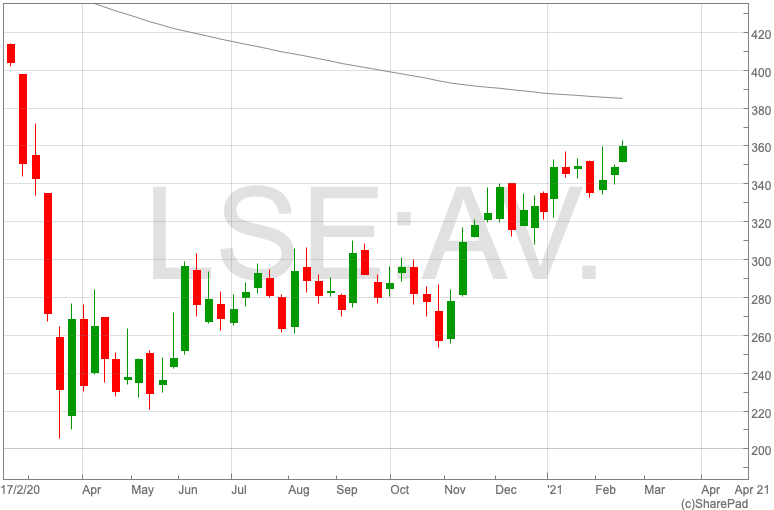
Aviva share price recovered steadily since the first lockdown

Aviva’s share price has been hit hard throughout the coronavirus pandemic. From a high of 423p in January 2020, its value had halved by March. The trendline has been moving steadily upwards since then, with a few troughs along the way. Year-to-date, the company’s share price is up by over 10% to 360p per share.

Aviva to sell-off non-core assets

Aviva is in the later stages of discussions to sell a number of its business operations. Reports have suggested the insurance company is looking to sell its Italian life insurance business to Paris-based CNP Assurances, as well as selling the company’s general insurance unit in the country. This follows similar sell-offs at the end of last year.

The sales are reported to be a part of chief executive Amanda Blanc’s strategy of streamlining the business in order to secure the company’s share price.

In January the insurance firm sent a warning out to fossil fuel companies that they will reallocate their investments if they fail do more to address climate change concerns. Aviva has said it will divest across its equity and credit portfolio if companies fail to meet its expectations over the next one to three years.

Argo Blockchain share price at all-time high as bitcoin continues to rally

0

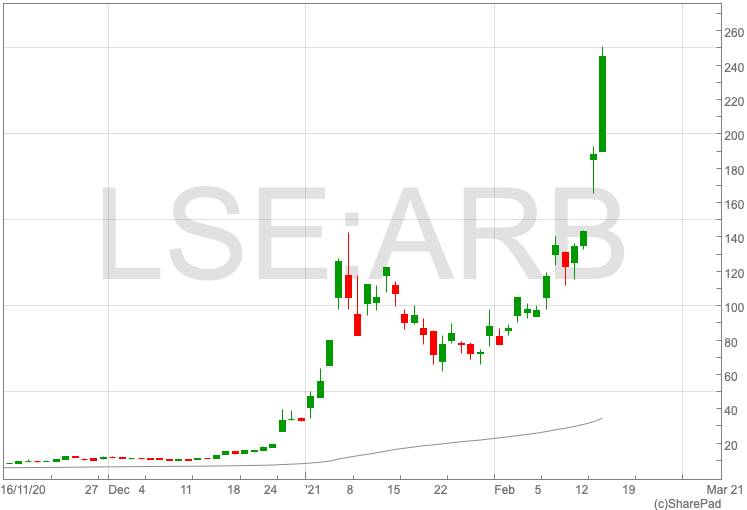
Argo Blockchain’s share price reached new heights of 252.68p today as bitcoin rallied past $50,000 for the first time ever. The rise of the crypto-mining service provider has coincided with increased institutional adoption of bitcoin, as Tesla, Mastercard and JP Morgan, among others, made respective announcements over recent weeks.

The mining company, founded in 2017, is currently one of the UK’s most popular stocks with retail investors. The company is listed on the London Stock Exchange Main Market. Argo Blockchain mines cryptocurrencies, including bitcoin and Zcash, through a combination of its hydroelectric powered machines and expertise. Institutional investors are able to invest in cryptocurrencies by buying them directly without having to go through an exchange.

Argo Blockchain share price (LON:ARB)

Argo Blockchain (LON:ARB) year-to-date share price

Since the turn of the year, Argo has seen a sharp upturn in the value of its stock. On the 31 December 2020, the mining company’s shares were priced at 33p. Within a week, Argo Blockchain had more than trebled to 125.5p, in line with spikes in the value of bitcoin. Now, as of February 16, Argo’s share price has soared up to 249.5p per share, over a 750% increase on the year-to-date.

Argo Blockchain buys stake in crypto venture capital firm

At the beginning of February the mining company announced it had bought a 25% stake in Pluto Digital assets, a crypto venture capital and technology company that connects decentralised technologies to the global economy.

Peter Wall, CEO of Argo Blockchain, commented: “Argo believes not just in Bitcoin, but in the entire cryptocurrency ecosystem. We have always been extremely bullish on how cryptocurrencies will transform the global financial system. Our early stage investment into Polkadot in 2019 was a perfect example of this belief and we are now excited to be using that same investment to buy a significant stake in Pluto, who are actively looking for projects with high yield potential.”

Argo Blockchain more recently announced plans to open a 200-megawatt facility in Texas.

UK considering rapid testing to allow return of mass gatherings

0

Vaccine passports ‘unlikely’ for those remaining in the UK

The UK government is looking at its options around rapid testing for coronavirus as a route to reopening venues where social distancing is unfeasible.

“Quick turnaround testing is part of a plan to get mass gatherings back,” one insider said, according to the Financial Times. 

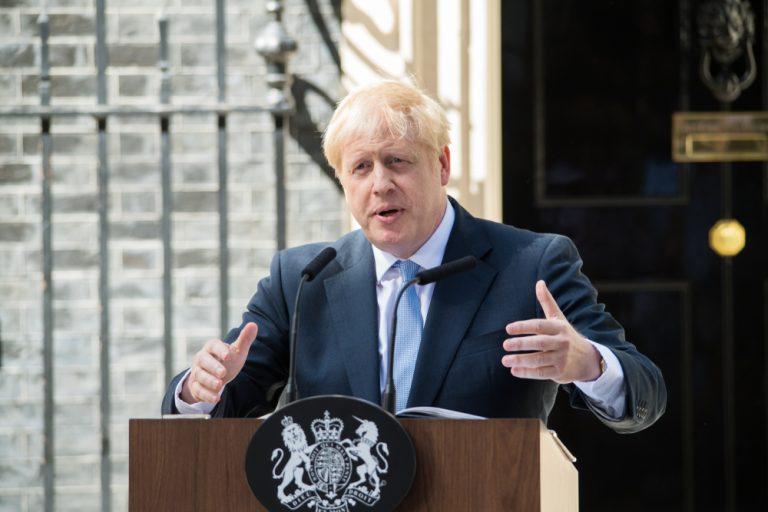
Prime Minister Boris Johnson has said rapid testing is the best route to opening up venues and events where people typically gather in the largest crowds.

Allowing people to safely return to entertainment values is the “toughest nut to crack”, according to the Prime Minister.

Boris Johnson has also said, while vaccine passports may be required for international travel, they would be unlikely for those remaining in the UK.

“Some countries clearly are going to be wanting to insist people coming to their country have evidence of a vaccination, just as people insisted in the past you had evidence you were vaccinated against yellow fever,” Johnson said.

“What I don’t think we will have in this country is — as it were — vaccination passports to allow you to go to, say, the pub or something like that.”

The Government is weighing up plans for a “test with a ticket” scheme, where attendees will receive a quick turnaround test for coronavirus as part of attending a mass gathering, such as a concert. 

“Those kind of things can really help us open up things with bigger numbers, where social distancing affects their ability to operate in an economic way,” a source told the Financial Times.

The World Health Organisation’s special envoy on coronavirus, supported the approach as a means of returning the UK to a form of normality.

“The secret to getting life back to some degree of normality for most of us is going to be the availability of really reliable, super-quick tests,” he told Good Morning Britain.

House prices up 0.5% despite stamp duty holiday coming to an end

0

House prices expected to fall in April

UK house prices rose this month as house buyers were unphased by the pending expiration of the stamp duty holiday.

Following a 0.3% dip in January, average house prices coming to the market increased by £1,511, or 0.5%.

Although the stamp duty holiday is yet to end, buyers coming to the market now are unlikely to complete by the deadline on the last day of March.

Rightmove’s director of property data, Tim Bannister, suggested working from home is motivating people to seek more suitable properties.  

“Last year the market was unexpectedly buoyed by buyers’ determination to move and satisfy their new lockdown-induced housing needs,” Bannister said. 

“We may well be seeing a continuation of that this year. Rightmove’s early 2021 buyer data shows that despite the imminent end of the stamp duty incentive, all of the key buyer metrics are ahead of early 2020, itself an active period as the market was boosted by the post-election ‘Boris bounce’.”

Lockdowns also limited supply, as people decided against selling. This created upward pressure on house prices.

“As well as the current lockdown motivating buyer demand again, the restrictions have also been a factor in limiting new supply, leading to some modest upwards price pressure. These are strong signs that new buyer demand is not facing a cliff-edge after the 31st of March, said Bannister.

“It remains to be seen if this momentum will be enough to make up for the removal of the stamp duty savings that are benefitting many buyers and have been adding a sense of urgency to the whole market,” Bannister continued. 

A question remains over the sustainability of this demand as the removal of stump duty comes into play. Reallymoving, the home moving company, forecasted house prices in England and Wales to fall by 4.1% in April, the month after the stamp duty holiday comes to an end.

Mast Energy Developments: Sustainable high growth power plants in the UK

The UK Investor Magazine Podcast is joined by Louis Coetzee, Non-exec Chairman of Mast Energy Developments. Mast Energy Developments is set to IPO on the London Stock Exchange in the coming weeks and we discuss Mast’s plans for supporting the UK grid with their Reserve Power plants.

Mast Energy Developments has a series of shovel-ready projects to begin work on after their IPO and Mr Coetzee outlines the investment case for Mast as they roll out their sustainable power generation business.

Mast Energy Developments are holding an IPO presentation This Thursday 18th February at 10.30am, please register here.

Risk Warning:

Investments in IPOs involve a high degree of risk and are not suitable for all investors. Capital is at risk.

FTSE 100 index reaches one month-high

0

The FTSE 100 creeped forward again as the market opened on Tuesday, adding 0.2%, or around 10 points. At 9am the FTSE made it as high as 6,792, its highest point in over a month. 

“It was a fairly predictable start from the FTSE, following up Monday’s blowout gains – spurred on by the UK speedily reaching a key milestone in the race to vaccinate the nation – with a timid, contemplative open,” said Connor Campbell, financial analyst at Spreadex. 

Today was a big day for corporate results as mining giants, Glencore and BHP announced positive dividend news on the back of surging commodity prices. 

FTSE 100 movers

Glencore (3.58%) capped its positive dividend news by leading the early morning trade on the FTSE, closely followed by HSBC (3.14%) and Rolls-Royce (2.64%), Tuesday’s next biggest risers so far. 

At the other end, Compass Group (-1.67%), Just Eat (-1.28) and Pearson (-1.04), were the biggest fallers during Tuesday morning’s trade. 

BHP

BHP, the mining giant, has revealed a record $5.1bn interim dividend as its profits half way through the year climbed to a seven-year high. The FTSE 100 mining company, which removed its last dividend in an effort to reduce swelling debt, has put forward a shareholder payout of $0.12 per share. 

If the price of the company’s two main commodities – iron ore and copper – remain stable, then BHP will again surpass its debt target of $12-17bn. This could pave the way for another large dividend payment at the end of the fiscal year, according to analysts.  

Glencore

Glencore has today announced it will reinstate its dividend having reduced its debt levels. The FTSE 100 mining company, which removed its last dividend in an effort to reduce swelling debt, has put forward a shareholder payout of $0.12 per share. 

Following a close at 282.3p a share following Monday’s trading, Glencore opened up on Tuesday at 290p, following the company’s financial results announcement. Having dipped as low as 112.5p in March 2020, Glencore’s share price has recovered steadily since.

BHP pays out record dividend thanks to commodities boom

0

BHP profits hit seven-year high

BHP, the mining giant, has revealed a record $5.1bn interim dividend as its profits half way through the year climbed to a seven-year high. 

BHP’s ‘very strong’ results came on the back of a surge in the prices of iron ore and copper.

Copper and iron ore, two of BHP’s most important commodities, saw 33% and 28% respective year-on-year price increases during the half. 

Shareholders will receive an interim dividend of $1.01 per share, up from $0.65 at the same point one year ago. BHP pays out a minimum of 50% of its underlying profit as a dividend in line with company policy. 

Russ Mould, investment director at AJ Bell, says the dividend payout is a signal of a wider trend in the mining industry, especially compared to oil and gas.

“While a bump in the oil price has given Royal Dutch Shell and BP a lift recently, the divergent fortunes in the resources sector between oil and gas firms and miners is evident in the record first half dividend paid by BHP not too long after the oil majors had slashed their own payouts,” said Mould.

The rise of the price of these commodities is down in part to the speedy recovery of the Chinese economy and the country’s ever-growing demand levels.

BHP reported a half-year profit of $3.8bn, down $1bn from the same period the year before. The mining giant also revealed a net debt of $11.84bn.

If the price of the company’s two main commodities – iron ore and copper – remain stable, then BHP will again surpass its debt target of $12-17bn. This could pave the way for another large dividend payment at the end of the fiscal year, according to analysts.  

“If commodity markets stay strong, as we expect, a larger capital return will be likely with full-year results in August,” said Jefferies analyst Christopher LaFemina. 

Mike Henry, chief executive of BHP, expects demand levels for the company’s goods and services to continue to rise. 

“Our outlook for global economic growth and commodity demand remains positive, with policymakers in key economies signalling a durable commitment to growth and signalling ambitions to tackle climate change,” Henry said. 

“These factors, combined with population growth and rising living standards, are expected to drive continuing growth in demand for energy, metals and fertilisers.”