
How has Ocado overtaken Tesco on the stock market?
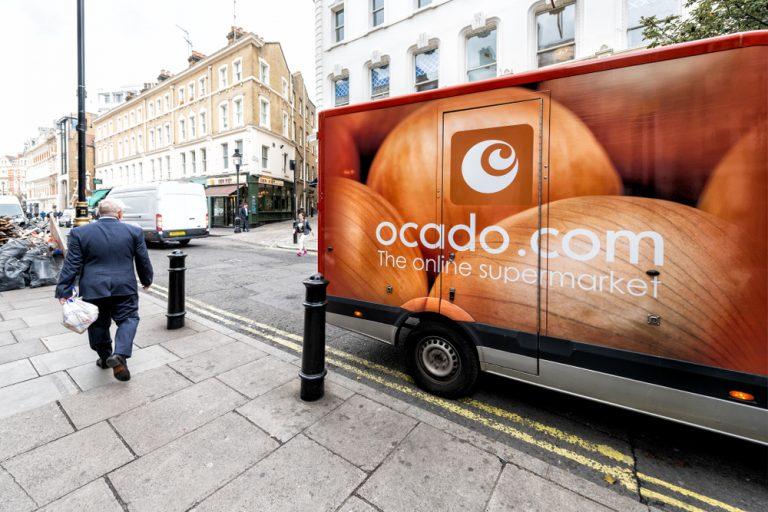
Ocado’s share price (LON: OCDO) has soared 155% since March and the retailer has overtaken Tesco as the UK’s most valuable retailer.
Thanks to its rising share price, the group is now raised at £21.7bn, £0.7bn higher than Tesco.
In the three months to the end of August, sales at Ocado soared 52%.
Neil Wilson, the chief market analyst at Markets.com, commented on the market valuation: “Ocado holds enormous promise but whether it can deliver is quite another matter, the cash burn remains and the payback from all these overseas deals is taking a very long time.”
The retailer “has rocketed this year thanks to the boom in online retail”, but a problem is “setting up fulfilment centres costs a lot and the returns are slow.”
Whilst Tesco controls 26.8% of the UK’s grocery market whilst Ocado has just 1.7%.
Ocado’s share price has particularly taken off since 2017 when the group has landed various deals with Kroger, Sobey’s, ICA Group, and Casino.
Tesco’s online sales have surged over lockdown, however, the share price has remained unfazed due to “worries about price wars”.
“We think that working from home, the collapse of [eating out] represents a step change, not just this year but ongoing,” he added about Ocado’s share price.
Shares in the group jumped after the group switched to groceries from Marks & Spencer. Sales also surged 50% in the third quarter.
Ocado shares (LON: OCDO) are trading -5.17% at 2.602,00, whereas Tesco shares (LON: TSCO) are -1.18% 210,00 (1431GMT).
Britvic shares drop 6% as it sells three bottling facilities in France
UK-based soft drinks producer, Britvic plc (LON:BVIC), saw its share price fall on Thursday as it announced the sale of three of its bottling facilities in France.
The company confirmed that having received approval from the French Competition Authority in July, it has now completed the sale of its its juice assets in France to Refresco.
The company said that the sale includes the three juice manufacturing sites, the related private label juice business and the Fruité brand.
Britvic stated that it has retained the ownership of the Pressade and Fruit Shoot brands, which it said would be manufactured by Refresco as part of a long-term partnership.
It continued by saying that this transaction will not impact its Teisseire and Moulin De Valdonne brands, or the private label syrups business, all of which are made at its production site in Crolles. The company’s statement continued by saying that:“This transaction supports our stated strategic priority to improve operating margins in our Western European markets, while also enables our teams to focus on growing our soft drinks portfolio of local favourite and global premium brands.”
Following the update, the company’s shares dipped by 6.27% or 51.50p, to 769.50p a share 01/10/20 13:00 GMT. This is shy of analysts’ consensus target price of 880.91p a share, which would represent a 14% upside on its current level. At present, the Marketbeat community has a 54.23% ‘Underperform’ stance on the stock, with the company’s p/e ratio standing at 13.73, just above the consumer defensive sector average of 13.64.Bahamas Petroleum shares drop 21% as it raises £9.5m through placing

Bahamas Petroleum Company (AIM:BPC) saw its shares lose the gains it earned the previous week, as its placing of 475 million new ordinary shares diluted the price.
The company noted that the share placing had been a success, with £9.5 million being raised through shares issued at a price of 2.00p apiece.
Bahamas Petroleum stated that the proceeds from the placing would enhance its funding capacity, and would help cover the costs of its Perseverance #1 well. Which, as we previously reported, is set to by spud before the end of the year, with a resource target of 0.77 billion barrels of oil.
The company added that its rational for the recent placing was its continuing effort to optimise its funding strategy, with a push towards lowering the cost of capital, along with less aggregate dilution and greater certainty.
Based on the placing proceeds, existing cash balance, and conditional convertible notes, the company said that it doesn’t expect it will have to draw further on its previously announced £16 million zero-coupon, second ranking convertible bond facility – unless changes occur to the cost of Perseverance #1.
Investor notes
Speaking on the company’s drive to have the sufficient funds necessary to fulfil its technical objectives, Group CEO, Simon Potter, commented:“Today’s placing is another milestone in the implementation of that funding strategy. The placing proceeds, being certain, immediately available and at a known dilution compared to other existing funding options, give us the opportunity to simplify the capital structure of the business whilst leaving us in a much stronger overall financial position. With the success of the placing we are also able to materially reduce the need to rely on other previously announced financing instruments, without affecting our overall ability to proceed with Perseverance #1 or other aspects of our recently enlarged business.”
“At the same time, with a view to continually seeking to strategically enhance the overall financial and operating capacity of the Company, we continue to consider a wide range of other funding options. Many of these are newly available to us consequent on the broadening of our asset base in recent months.”
Investor notes
Following the placing, Bahamas petroleum shares dipped by 20.98% or 0.59p, to 2.21p apiece 01/10/20 12:00 GMT. This is up from its yearly nadir of 1.20p in March, but far short of its recent high of 3.53p in June. The company currently has a p/e ratio of -9.33, and was given a 55.65% ‘Underperform’ rating by Marketbeat‘s community.Connect Group shares jump 20% on “good progress”

Connect Group shares (LON: CNCT) jumped over 20% on Thursday’s opening as the group revealed a trading update.
The final quarter of the group’s fiscal year had been stronger than management had anticipated.
Underlying earnings for the fourth quarter ending August 29 came in at £10m. As a result, Connect Group now expects to deliver underlying earnings for the full year of between £38.5m and £39.0m. This is above the top-end of the previous guidance announced earlier this year.
Commenting on the latest trading update, Jonathan Bunting, Interim Chief Executive Officer, said:
“The Group has made good progress in the delivery of its core objectives in the period, continuing to drive efficiencies in Smiths News while completing the strategic review of the Tuffnells business and its subsequent disposal on 2 May 2020. The removal of the drag on profitability and cash, and the alignment to our core expertise, will strengthen and focus the Group going forward. The COVID-19 pandemic will clearly have a material impact on the Group’s performance in the second half of the year, the quantum of which remains unclear.
“However, our markets and business model are well placed to recover as lockdown restrictions ease. In the current environment, we are applying that same focus to our vital role in supplying our retailers and their communities across the UK. Colleagues across the Group have been steadfast in their commitment to these goals; their safety and wellbeing, together with that of our customers, remains our top priority at this time,” Bunting added.
Connect Group shares (LON: CNCT) are currently trading +21.34% at 22,60 (1045GMT).
Halfords shares surge 20% on raised profit forecast

Halfords shares (LON: HFD) have surged over 20% on Thursday morning after the group raised its profit forecast.
Thanks to the recent boom in cycling, the group has raised profit forecast from £35-40m to over £55m.
Halfords’ cycling division saw a 46% growth in the five weeks to 25 September 2020, which reflected “the strength of our unique proposition and continual improvement in supply to meet unprecedented levels of demand.”
In the same five-week period, the motoring division grew by a modest 7.5%.
The group, however, is remaining “cautious” over the second half of the year due to the growing number of Coronavirus cases. It said in a statement:
“The potential impact of second waves of COVID-19 now seems more pronounced than just a few weeks ago, and the economic impact of an end to the furlough scheme and the outcome of Brexit negotiations remains very uncertain. We are well placed to address any headwinds we may face and capitalise on the tailwinds as they arise. Our balance sheet and liquidity position remain strong.”
Interim results will be reported on 18 November 2020.
Commenting on Halfords’ raising profit forecast, equity analyst at Hargreaves Lansdown, Nicholas Hyett, said: “Halfords’ sales have continued to motor despite the end of the summer holidays.
“The continued strength in cycling stands out, probably reflecting the public’s reluctance to get back on public transport and government restrictions on other forms of exercise.
“Some caution about what the future holds is only natural given both the pandemic and Brexit continue to loom large over the UK economy, however we think the group is demonstrating that it has what it takes to survive the car crash engulfing much of the retail sector.”
Halfords shares (LON: HFD) are currently trading 18.92% at 215,72 (1008GMT).
Rolls-Royce shares plummet on cash-call

In an attempt to rebuild its balance sheet, Rolls-Royce (LON: RR) has revealed plans to raise £2bn from shareholders.
The aircraft engine-maker will be raising a total of £5bn through shareholders, a £1bn bond offering, and £3bn worth of loans.
Rolls-Royce shares plummeted 8% on Thursday morning. They have fallen 80% since January as the group has been battered by the effects of the pandemic.
For the first half of the year, Rolls-Royce revealed a £5.4bn loss.
Shareholders will vote on the 27 October.
Warren East, the chief executive at Rolls-Royce, said in a statement: “We are undertaking decisive and transformative action to fundamentally restructure our operations, materially reduce our cost base and improve our financial position. The capital raise announced today improves our resilience to navigate the current uncertain operating environment.
“By raising additional capital now, we will improve our liquidity headroom and reduce our level of balance sheet leverage, while supporting disciplined execution and investment to ensure we maximise value from our existing capabilities.”
The company is offering shares at a discounted price. They are being sold at a 41% discount to Wednesday’s closing price of 130p per share.
On Rolls-Royce’s plan to raise money through shareholders, Susannah Streeter, a market analyst from Hargreaves Lansdown, said:
“Rolls-Royce reckons going cap in hand to shareholders to raise £2bn is the least worst option, to help it deal with the crushing impact the pandemic has inflicted on its core business. This should all give Rolls Royce a lot more room for manoeuvre to help it navigate the Covid crisis.”
Rolls-Royce shares (LON: RR) are currently trading -10.12% at 116,85 (0932GMT).
UK economy shrivels in record second quarter GDP free-fall
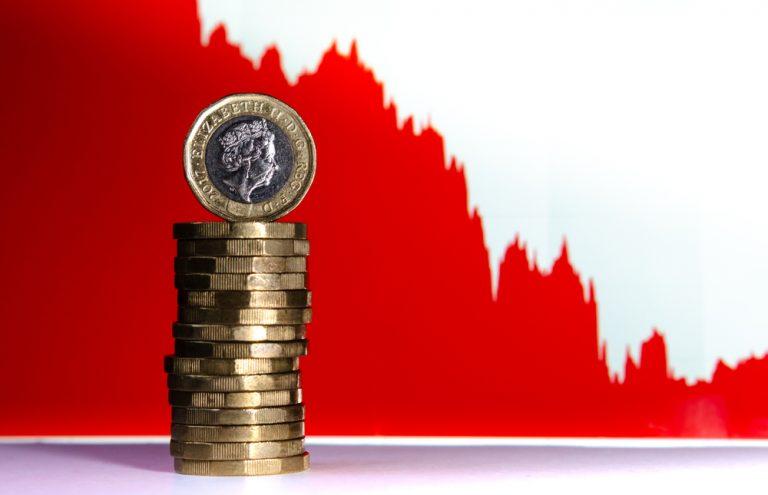
New figures from the Office for National Statistics (ONS) have consolidated suspicions that the UK economy suffered its largest quarterly fall on record between April and June this year due to the impact of the coronavirus pandemic.
Gross domestic product – GDP – fell by 19.8% in the second quarter of 2020, in what has now been confirmed to be the largest decline on record. The figure is, however, marginally lower than the previous estimate of 20.4% that the ONS initially put forward in June, citing the “significant shock” of lockdown on the fragile economy.
The almost 20% free-fall is the largest since records began in 1955, but the Bank of England’s chief economist, Andy Haldane, warned against the temptation to slip into “contagious pessimism” about the UK’s chances of recovery.
He warned that “catastrophising” the fall earlier in the year was detracting attention from the economy’s bounce back in recent months.
“Averting an economic anxiety attack calls for a balanced and flexible approach to the words and actions of businesses and policymakers. Encouraging news about the present needs not to be drowned out by fears for the future”.
Haldane added that he was not personally in favour of introducing negative interest rates to further boost the UK economy, as speculation rises that the Bank of England may implement new measures as equities waiver over fears of a second wave.
Douglas Grant, director of Conister – a business and personal finance bank owned by Manx Financial Group (LON:MFX) – commented on the latest ONS figures, expressing concern for small and medium-sized businesses (SMEs) in the increasingly competitive environment, driven by both Covid-19 and long-standing Brexit grievances:
“The confirmed sharp decline of the UK’s GDP reflects the tough landscape faced by many UK businesses, especially SMEs who are having to work particularly hard to stay afloat.
“For the SME sector, which is entering the final quarter with the challenges of 2019 and 2020 – Brexit and Covid-19 – bundled into one, it is vital that we continue to open new channels for distributing much needed liquidity.
“SMEs have shown a great deal of adaptability and resilience in the face of changing consumer behaviour and as such it is critical that the government schemes – working in partnership with specialist lenders – continue to support the sector so that we can return to pre-crisis growth levels as soon as possible and avoid the downward spiral of output and job losses”.
TSB shares unfazed as 164 stores shut, 1,000 jobs cut
TSB – owned by Spanish firm Banco de Sabadell (BME:SAB) since 2015 – has seen its shares emerge unscathed on Wednesday afternoon despite the news that the bank plans to shut 164 branches and cut up to 1,000 jobs across the UK.
Blaming the decline in customers visiting high street banks on the coronavirus pandemic, TSB announced that the store closures were a reflection of the shift in customer attitude towards the more efficient and easy-access online banking systems.
TSB is just the latest in a slew of high street brands to post job losses and store closures this year, following in the footsteps of John Lewis (LON:JLH), Pizza Express (HKG:3396), and WH Smith (LON:SMWH).
The retail sector was hit especially hard by the pandemic as lockdown measures forced thousands of companies to close their doors to customers between March and June. Even as stores reopened over the summer, high street footfall is still well below average for the time of year – 33% less year-on-year according to data collated by the British Retail Consortium (BRC) and Shoppertrak.
High street banks, in particular, have faced mounting competition from online operations, which proved a lifeline for millions in managing personal finances during the peak of the pandemic when access to in-store customer service was reduced.
TSB noted that it has been registering some 4,000 new customers per day on its digital app, compared to just 1,200 before the pandemic, and has seen more than 90% of its transactions handled digitally this year.
Chief executive Debbie Crosbie commented on the company’s announcement:
“Closing any of our branches is never an easy decision, but our customers are banking differently – with a marked shift to digital banking.
“We are reshaping our business to transform the customer experience and set us up for the future.
“This means having the right balance between branches on the high street and our digital platforms, enabling us to offer the very best experience for our personal and business customers across the UK”.
The Unite trade union, which represents TSB employees, stressed that it was not just the bank’s workers, but also its customers, that would be hit by the planned closures.
Dominic Hook, a Unite national officer, warned The Guardian on Wednesday:
“The financial services industry has a social responsibility not to walk away from its local customers who continue to need access to banking in bank branches”.
The job cuts and store closures are not expected to be finalised until next year, but TSB has assured that 94% of its customers would still be located within 20 minutes of a high street branch.
Shares at TSB’s parent company Banco de Sabadell have remained surprisingly resilient despite the announcement, up 4.80% to 0.30 EUR at 14:45 BST, but still down from a monthly high of 0.39 EUR earlier in the month.
Banco de Sabadell has not managed to escape the pressure of the pandemic entirely, however. Its shares have slipped considerably from a peak of 1.07 EUR at the start of 2020, but investors may be comforted in the knowledge that they appear to have levelled out in recent months, staying roughly within the range of 0.26-0.35 EUR.
Tertiary Minerals share price yet to catch up with progress at Nevada Projects.

AIM listed Tertiary Minerals (LON:TYM) is a mineral exploration and development company building and developing a multi-commodity project portfolio of precious metals and base metals in Nevada, USA, plus it holds some industrial mineral assets in northern Europe.
In an update on progress with its projects today, the company said that following unsuccessful metallurgical testwork, it had decided to terminate the lease agreement on the MB Fluorspar Project in order to fully focus on its expanding gold and base metals project portfolio.
Based on the progress with these projects, this looks to be a shrewd move on the part of management ahead of a series of drone magnetic surveys scheduled this week for the company’s key Peg Leg Copper and Paymaster, Silver, Lead and Zinc Projects.
The surveys will provide 3D imaging of the underlying geology and strata, to help determine future drill targets.
Recently Tertiary completed a drone survey at the Mount Tobin Silver Prospect, and now intends to undertake a soil sampling programme to define drill targets.
Soil sampling will also be shortly underway at the Pyramid Gold Project to extend and confirm historic gold-in-soil anomalies for drill targeting.
With such an intense schedule of activities underway, Tertiary has its work cut out for the remainder of 2020. Despite the challenge presented by COVID 19, work continues apace, with any positive data likely to act as a strong catalyst for a share price that is yet to catch up with events.
Tertiary Minerals shares traded at 0.24p in mid afternoon trade on Wednesday.
Shell to axe 9,000 jobs due to “tough” year
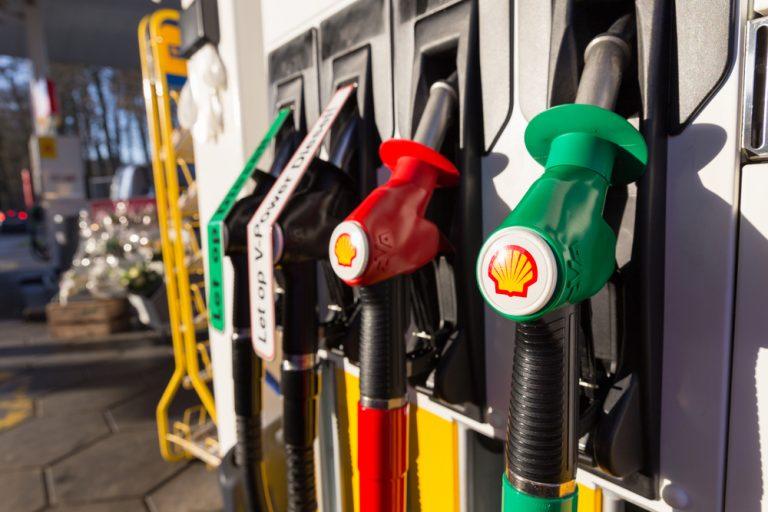
Royal Dutch Shell (LON: RDSA) will cut 9,000 jobs as part of a new cost-cutting drive.
The oil giant has suffered amid the pandemic, where the price of oil plummeted.
In the update, the group’s chief executive also revealed plans that push the oil company towards a net-zero emissions energy business in the next 30 years.
“It is very painful to know that you will end up saying goodbye to quite a few good people. I know I, and many others in Shell, will be saying goodbye to people we know well and really like and who have great loyalty to the company. But we are doing this because we have to, because it is the right thing to do for the future of the company,” said Ben van Beurden.
“We have to be a simpler, more streamlined, more competitive organisation that is more nimble and able to respond to customers.
“COVID-19 has shown we can work very effectively in ways we did not think we were ready for yet. But a large part of the cost saving for Shell will come from having fewer people.
“We do not have an exact figure because the details are still being worked out, and we have never had a target to reduce a particular number of jobs. But we can say that, because of the efficiencies we expect to gain, we will reduce between 7,000 and 9,000 jobs by the end of 2022,” added van Beurden.
In the update, van Beurden also said that Shell expects output in the third quarter to drop to 3,050 barrels per day due to the pandemic and hurricanes that forced offshore platforms to close.
It’s been a tough year for Shell, which saw profits plummet in the second quarter by 82% to $638m.
Royal Dutch Shell (LON: RDSA) shares are trading +1.38% at 997,35 (0848GMT).