DW Sports collapses – 1,700 jobs at risk

1
DW Sports, the sports retailer and gym group, has collapsed and will enter administration. The company, which was founded by Dave Whelan, has 73 gyms and 75 shops in the UK. The closures will risk 1,700 jobs. After stores and gyms were closed during the lockdown, the group’s income plummeted and plans to appoint insolvency specialists. “As a consequence of Covid-19, we found ourselves in a position where we were mandated by Government to close down both our retail store portfolio and our gym chain in its entirety for a protracted period, leaving us with a high fixed-cost base and zero income,” said Martin Long, DW Sport’s chief executive.

“Like many other retail businesses, the consequences of this extremely challenging operating market have created inevitable profitability issues for DW Sports.

“The decision to appoint administrators has not been taken lightly but will give us the best chance to protect viable parts of the business, return them to profitability, and secure as many jobs as possible.

“It is a difficult model for any business to manage through without long-term damage, and with the limited support which we have been able to gain.

“Having exhausted all other available options for the business, we firmly believe that this process can be a platform to restructure the business and preserve many of our gyms for our members, and also protect the maximum number of jobs possible for our team members,” he added.

The group was hit hard during the lockdown. Whilst DW Sports previously had a £15m income every month, it plummeted to zero overnight whilst still having £3m wage bills. Fitness First is the group’s sister company and will remain unaffected by the closures.

Seeing Machines shares rally 7% with results consistently ahead of guidance

AI-powered operator monitoring systems producer for the transport sector, Seeing Machines Limited (AIM:SEE), saw its shares rally on Monday as it had booked full-year fundamentals well ahead of consensus guidance – despite what it described as the ‘difficult COVID-19 backdrop‘.

Touting itself as a rare 2020 success story, the company boasted a 30% year-on-year bounce in total income, up to an anticipated A$42.6 million.

This headline figure was accompanied by strong progress in revenues, which were expected to be $39.7 million – some 8.5% ahead of its A$36.6 million consensus guidance. Further, Seeing Machines stated that its cash position at period end stood at A$38.7 million, which represented a 22% step ahead of the consensus guidance figure of A$31.8 million.

The company added that by the end of the year finishing 30 June 2020, the number of connected Guardian units – its commercial transport monitoring system – stood at 23,415.

Seeing Machines response

Company CEO, Paul McGlone, restated his approval of the company’s performance, especially during what he described as an acutely difficult period for the transport sector. He added:

“Guardian connections have increased in FY2020 by more than 46% despite the limitations posed by grounded transport companies and pressure on commercial fleets to work around the clock to deliver supplies across vast geographies. As global economies return to some semblance of normality, we expect connections to accelerate through our growing distribution network.”

“In the Auto sector, Seeing Machines has much to look forward to in the coming months as we await the launch of two production vehicles featuring our DMS technology. The continued and reinforced regulatory momentum in Europe and North America is already having additional, positive impact across our Automotive and Fleet opportunities, and while the Aviation industry remains under more economic pressure than most, our ongoing negotiations remain intact.”

Investor insights

Following the news, Seeing Machines shares rallied 7.02% or 0.22p, to 3.32p per share 03/08/20 12:00 GMT. This is down from its lockdown-recovery-high of 3.50p on the 26 June 2020, but up from its recent dip to 2.70p on July 21 2020.

Fortune 500 data scientist backs tech rally but gold and bitcoin could see volatility

Trying to manage money during a global pandemic is challenge enough, but trying to position yourself as an investor in an uncertain climate is an even greater cause for sleepless nights. The predominant issue here is uncertainty. Not necessarily over what the virus will do next, but the week-by-week adjustments in political policy that are made in response to the spread of the illness, and how this affects different parts of the economy. Acting as a voice of reason, Dr Richard Smith gives us his two cents on the outlook for politics and investment, including the tech surge which he says is here to stay. Dr Smith is a Berkeley Mathematician and PhD in System Science. Dubbed ‘The Doctor of Uncertainty’ by his academic colleagues, Dr Smith is the CEO of The Foundation of the Study of Cycles, a Fintech entrepreneur and advisor to the US government and Fortune 500 companies (including Pfizer and Johnson & Johnson). His software, which focuses on course-correcting irrational tendencies and cognitive biases during investment, has served in excess of 25,000 investors, and helps steward more than $20 billion in assets.

The Big Picture on COVID, Central Bank Spending & Tech

Giving us his overview of things as they stand, Dr Smith said, “I believe that the Covid-19 risk has been well-integrated into the market calculations of investors.” He says that, having been front and centre for over six months, the downside risks associated with COVID are still present, but have already been priced into the markets. He did say though, despite being optimistic about the pandemic situation being resolved, he has been discouraged by how politically divisive it has proven for society. He believes that political polarisation on both sides, along with ‘drive-by’ media, has severely impaired the abilities of many countries to resolve the crisis decisively. He hopes, however, that the upside of the crisis could be a return to more centrist politics, and leadership more able to unite than divide societies. Expanding on political policy during the pandemic, Dr Smith believes that a core tenet of market stabilization has been a willingness by Central Banks – led by the US – to inject liquidity into economies and financial markets. Though, he believes this will come at a cost: “There will eventually be a price to be paid for all of this money printing, but that reckoning is not likely to come in 2020 given the pending U.S. presidential election and the need for the Federal Reserve to not be perceived as having tipped the scales of the election.” Finally, in his overview of the thus-far pandemic-focused 2020, Dr Smith takes note of the unsurprising tech sector bounce. Perhaps also unsurprisingly, he asserts that COVID did not cause the increased pace of the rise of tech, but merely accelerated what we were already seeing. He continues: “For example, it’s true that services like Zoom facilitate social-distancing, but it’s even more true that for many many meetings, remote video is just more efficient than in-person meetings requiring travel. People are not likely going back to pre-Covid-19 levels of in-person meetings even after Covid-19 is in the rear-view mirror.”

The Winners & Losers in commodities, financial instruments & stocks

Going sector by sector, Dr Smith gave us his views on the biggest potential rises and falls. On Commodities, Smith delivered the timeless adage that precious metals will prosper as people flock to gold and silver as safe havens during times of uncertainty and unprecedented money printing. He did say, however, that while sentiment was currently strong for precious metals and alternative commodities such as Bitcoin, “sentiment is frothy and there is likely to be some volatility to attempt to shake-out weak hands. He adds that corrections to energy prices were ‘overdone’ but that energy will not recover to pre-COVID levels for a while, in large part due to the fact that people just aren’t travelling as much as they did before, and won’t do for some time. On Bonds, Smith’s view is that prices will continue to hold their current levels or even rise in developed countries. He states that, “Central bank actions are likely to keep interest rates artificially low during this latest round of QE. We could well see wider adoption of negative short-term rates as a consequence.” On Emerging Markets, he is largely pessimistic. In his view, emerging markets will suffer as the supply of US dollars will become more sparse, and in turn the costs of their USD-denominated debts will rise. He adds that while he may have hope for a return to centrist politics, the situation as it stands – with nationalism and protectionism being predominant – are likely to only slow the global economy, and in turn prove injurious to emerging markets (though, this situation may change if Trump loses the election). On Stocks, he believes – by-and-large – they will either maintain or improve upon their current levels during the remainder of 2020, as Central Banks expand their balance sheets and investment volumes begin to pick up. Going through each of the major sectors, Smith believes the outlook is positive for stocks in; tech, healthcare, consumer discretionary, materials and GDX/GDXJ. However, he is relatively neutral in his stances on consumer staples and utilities, while factoring in some potential downside for financials and energy stocks.

Words for the investors of tomorrow

When asked his views on new investors and how they should navigate their entry into the world of investment, Dr Smith commented: “It’s wonderful to see so much new interest in the financial markets from young people. If history is any guide, however, new investors today will have a similar experience to new investors of yesterday – initial euphoria followed by bitter disappointment (think dotcom boom and bust)”. “What would be truly wonderful is if we could learn from the past and leverage new technology and past experience to truly offer a sustainably positive experience for all the new investors who are getting their first taste of the wonders of financial markets!” “That’s a dream that is within reach, if we choose to exercise the wisdom to make it happen.”

Twitter hack on celebrity accounts nets cryptocurrency scammers $113k

Twitter (NYSE:TWTR) stated that the large-scale hack which took place two weeks ago on its platform, was perpetrated by fraudsters looking to peddle a cryptocurrency scam from the accounts of genuine politicians and celebrities. The hack was carried out via ‘spear-phishing’, whereby Twitter staff open bogus emails which snatch their personal credentials, and allow criminals to use staff support tools to hijack the accounts of dozens of genuine high profile personalities. In a statement, Twitter said: “Not all of the employees that were initially targeted had permissions to use account management tools, but the attackers used their credentials to access our internal systems and gain information about our processes,” It added that, “This knowledge then enabled them to target additional employees who did have access to our account support tools.” The company said some 130 accounts were targeted in the hack, with the fraudsters managing to Tweet from 45 of those targeted, while accessing the direct message inboxes of 36 and downloading data from seven. The accounts of politicians, entertainers, businesses and executives were among those targeted, including Elon Musk, Kanye West, Bill Gates, Barack Obama, Uber and Apple. From the attacks, it is expected that fraudsters made away with some $113,500 in scammed proceeds.

What to look out for with crypto-fraud and API scams

In this recent scam, criminals posted Tweets from hacked accounts, offering to double the account of Bitcoin that victims sent to their enclosed address. Offering their insights on the attack, cryptocurrency exchange company Bitfinex stated that the incident, “throws a spotlight onto emerging online security threats and the importance of robust cyber security.” It continued, saying that the key threat to look out for as online consumers is API extraction attacks. The company said that, “These attacks start with supposed ‘trading consultants’ – who are really criminals – reaching out to traders by means of social media. These attackers convince unsuspecting victims to hand over their trading account’s API credentials under the pretext of helping them make better trades and earn higher trading revenues.” Bitfinex stated that what actually happens is that attackers use their own accounts on the same trading platform to trade against their victims’ accounts. Fraudsters force a sale position n their victim’s account while at the same time placing a buy order of an equivalent amount on the attacker account. Then, in a subsequent trade, the fraudsters will forcibly sell their newly acquired cryptocurrency back to the victim’s account at a higher price, a process which essentially hands money from a legitimate trader’s account, into the hands of a trickster. Speaking on the recent attack, Bitfinex CTO, Paolo Adoino stated: “The recent hacking incident on Twitter saw fraudsters prey on the naivety of their victims who unwittingly parted with their Bitcoin,” “It was not an attack that showed any vulnerability in Bitcoin whatsoever, or the wider digital asset space. In fact, Bitcoin’s success has been built on an inherent anti-fragility that is resistant to hackers and fraud”, he added.
A victim of an API extraction attack also spoke out about their experience: “My advice is simple. Do not believe in miracles and do not give an API key to outsiders.”
Since the attack, Twitter appears to have since disabled the ability to share cryptocurrency trading addresses on its platform.  

New Northern England lockdown could exacerbate inter-regional inequality

On Thursday evening, Health Secretary Matt Hancock announced that renewed lockdown measures would be implemented in Northern England, including the Greater Manchester, East Lancashire and West Yorkshire regions. These recently reimposed restrictions ban separate households from meeting each-other at their homes, and follows resurgences in COVID-19 cases in each of the respective areas. The reminder that this announcement presents – also following the rise in cases in Spain – is the prospect of a second, if partial, reimposition of lockdown measures across regions of the UK.

What does lockdown mean for businesses in Northern England?

In a survey of small businesses conducted by IW Capital, a second lockdown was the number one concern for SMEs, with 47% of respondents citing this as the worst case scenario, ahead of cashflow issues (44%) and debt (20%). The effect of quarantining, however, are felt most acutely by SMEs in Northern England. While London was initially hardest hit, it is expected that activity in the English capital will recover far more quickly than in other cities such as Manchester and Bradford. London is not only the most tech-enabled and ‘business-ready’ city in the UK, but garners the most political attention and investment from overseas businesses. With the loss of EU funding set to most adversely effect non-London regions going forwards, the renewed lockdown measures in Northern England will do little but increase existing disparities, unless the government focuses financial support on areas outside of its Golden Goose.

IW Capital reported that since the beginning of lockdown, SMEs have borrowed over £12 billion in government-backed loans, with the company’s statement finding that, “This support network demonstrates the vital importance of this sector”. Currently, SMEs employ in excess of 16 million people in the UK, and provide 52% of private sector turnover. Going Forwards, IW Capital states that more generous allowances for growth finance are needed – perhaps focusing such initiatives on regions such as Northern England would provide a much-needed boost.

IW Capital invests in the North

Speaking on the company’s commitment to invest in Northern England in spite of the prospect of renewed lockdown measures, IW Capital CEO and Founder, Luke Davis, comments:

“This period has been incredibly difficult for businesses up and down the country but it does seem to have impacted businesses in the regions harder than many in the capital. One of the key points in economic recovery in the next year or so is to allow every region of the UK to come roaring back with confidence and the right support in place.”

“As private finance providers, we have a responsibility to try and bridge this gap. There are fantastic businesses in the North of England with a huge amount of growth potential that may be slipping through the net as lockdown measures ramp up. This is why we are actively looking to invest in these regions and are seeking to employ investment directors specifically for the regions.”

“IW Capital has already started to encourage development in regions outside of London, and has invested in Impact Recycling – a company revolutionising the plastic recycling process based in Newcastle – and Billian – an innovative road-mending firm founded in Sheffield.

Octopus Renewables continues buy-ups with £53m spend on 14 solar assets

On Friday Octopus Renewables Infrastructure Trust (LON:ORIT) announced that it had signed a Share Purchase Agreement acquire a 100% interest in a portfolio of operational French solar assets. The deal means Octopus Renewables will add 14 solar PV assets to its portfolio, with a combined capacity of 119.5MW. The acquisition cost the company £53.4 million, with the assets located across France, in; Var, Bouches-du-Rhône, Gironde, Alpes de Haute Provence and Saône et Loire. All of the solar facilities began their operating lives between 2013 and 2015, and at the time of the sale have 12.7 years remaining on their Feed-in-Tariff contracts, as well as 27.3 years remaining on their life expectancies. The company said that the portfolio, which has €99m of existing project finance from Hamburg Commercial Bank, is being acquired from a Samsung Securities-backed renewable fund and another minority investor. It added that as part of the agreement, it will receive ‘all economic benefit of all cash flows’ from the portfolio dating back to January 1 2020.

Today’s news follows a previous but fairly recent acquisition made by Octopus Renewables, of the Ljungbyholm Wind Farm in Sweden. The previous acquisition took place in March, costing £59 million for 12 wind farms, with a total capacity of 48MW.

Octopus Renewables comments on its solar power push

Speaking on today’s agreement, company Chairman Phil Austin stated:

“I am delighted to announce the acquisition of this portfolio of subsidised French solar farms, expected to produce enough electricity to power the equivalent of 48,000 French homes annually. With this acquisition we have now committed c.75% of the funds raised at IPO and have opened up a third market for ORIT, marking a further step towards building a diversified portfolio of renewable energy assets. It is particularly pleasing that the Octopus Renewables team have been able to continue originating and transacting on high quality deal flow throughout the COVID crisis.”

Company Investment Director, Chris Gaydon, added:

“As one of the UK and Europe’s leading investors in renewables, Octopus Renewables has long considered the French market as having favourable conditions for growth and investment. Octopus Renewables already has a strong presence in France and so were delighted to be able to secure this acquisition for ORIT. It builds on our ambition to accelerate the clean energy transition and create a legacy for the next generation to mitigate the effects of climate change.”

Investor insights

Despite the seemingly positive news, Octopus Renewables shares dipped 1.31% or 1.50p, to 113.00p on Friday 31/07/20 13:27 BST. This is fairly consistent with its trend for the year so far, with the price moving between 100.00p and 115.00p, with the exception of its freakish dip in mid-March.

BT shares slide with half-year profits contracting 13%

Multinational telecommunications company BT (LON:BT.A) saw its share price dip on Friday, after posting an unsurprising but hardly uplifting set of half year financial fundamentals. While being praised by Ofcom for its provision of services during the lockdown period, BT listed the pandemic as a key contributor to negative impacts on its financial results. This was reflected in both its revenues and adjusted EBITDA, both down 7% year-on-year. Its revenues fell from £5.53 billion to £5.25 billion, while its adjusted EBITDA contracted from £1.96 billion to £1.81 billion. This led to a fall in the company’s profits before tax, which were down 13%, from £642 million, to £561 million. Similarly, the company’s net debt grew by £352 million, from £17.81 billion, to £18.16 billion. Operationally, the company said that it had re-opened the majority of its stores, and that repair activity and the roll-out of FTTP had resumed.

BT response

Commenting on the results, Chief Executive, Philip Jansen, stated:

“Openreach resumed provisioning and repair activity in customer premises, we re-opened the majority of our retail stores, and we saw the restart of the Premier League on BT Sport. Enterprise has today launched the BT Small Business Support Scheme, which will boost cash flow, connectivity and confidence among this critical segment of the economy over the coming months.”

“Throughout this crisis we remain focussed on delivering against our strategic goals to deliver long-term value for shareholders. We reached an important milestone with 3m FTTP premises now passed, welcomed Ofcom’s consultation on our rural FTTP build proposal, and have now deployed 5G to 100 towns and cities. Together with continued improvements in customer experience and our modernisation programme, we are positively positioned for the future.”

“Although uncertainties remain, we are now able to provide an outlook for this financial year. Despite our strong operational performance in the first three months of the year, it is clear that Covid-19 will continue to impact our business as the full economic consequences unfold. Beyond this year and based on current expectations, we expect to return the business to sustainable adjusted EBITDA growth, driven in part by the recovery from Covid-19.”

Investor insights

Following the news, BT shares dipped 3.51% or 3.78p, to 104.07p per share 31/07/20 12:41 BST. This is below its current consensus target price of 153.13p per share, and far off of its February highs exceeding 162.00p per share. The company’s p/e ratio is 4.59, its dividend yield stands at 4.43%.

IAG launches €2.75bn capital raise as COVID-19 safety net

IAG, the owner of British Airways, has launched a €2.75bn rights issue in an effort to ensure the airline group emerges from the coronavirus in a strong financial position. The announcement came alongside the release of the airline’s half year report that confirmed a sharp drop in the number of passengers during the coronavirus lockdown. The IAG share price (LON:IAG) sank on the news, with shares down over 9% at midday on Friday. IAG’s revenue for the six months to 30th June fell 55% to €5.3bn as most aircraft remained grounded in the second quarter. The significant drop in revenue meant that IAG’s profit was obliterated in the period as a profit of €806m in 2019 swung to a €3.8bn loss. IAG also provided insight as to when they think the industry will recovers suggesting the airlines profitability may take sometime to bounce back. “We continue to expect that it will take until at least 2023 for passenger demand to recover to 2019 levels. Each airline has taken actions to adjust their business and reduce their cost base to reflect forecast demand in their markets not just to get through this crisis but to ensure they remain competitive in a structurally changed industry,” said Willie Walsh, CEO of IAG. To help maintain IAG’s competitiveness, the airline has launched a rights issue to increase cash totalling €2.75bn. IAG’s largest shareholder, Qatar Airways, has already given the capital raise their blessing. Qatar Airways owns 25.1% of IAG. “Our industry is facing an unprecedented crisis and the outlook remains uncertain. However, we strongly believe that now is the time to look to the future and strengthen IAG’s financial and strategic position,” said Willie Walsh, CEO of IAG. “While we have had to make tough decisions on both people and costs, these actions are the right ones to protect as many jobs and serve as many customers as feasible and put IAG in the strongest position possible. The industry will recover from this crisis, though we do not expect this to be before 2023, and there will be opportunities for IAG to capitalise on its strength and leadership positions.”

Shell shareholders feel the pinch with earnings per share diving 310%

Following a torrid half-year that hit oil prices hardest, oil and gas extraction and production company Shell (LON:RDSA) saw its share price dip slightly on what was likely an already priced-in set of woeful half-year trading results. The company reported that income attributable to shareholders had flipped from an $8.99 billion profit for H1 2019, to a loss of $18.16 billion loss for H1 2020. According to its results, this turnaround represents a negative 302% shift year-on-year. Similarly, the company’s CCS (not taking into account the changes to oil prices) earnings attributable to shareholders dived 288% on-year, from an $8.32 billion profit to a $15.62 billion loss. It added that its adjusted earnings had fallen 60% from $8.76 billion to $3.49 billion year-on-year, while its cash flow from operating activities fell 11% and its ROACE on a net income basis flipped from 8.4% to negative 2.9%. If you’re looking for anything to celebrate, the company’s expenses narrowed on-year, during the half-year period. Its cash capital expenditure fell slightly from $10.94 billion to $8.59 billion, while its underlying operating expenses fell 12%, from $18.34 billion, to $16.11 billion. Though, these drops in expenditure were likely a result of reduced production activity and staff costs due to the pandemic. The situation was equally bleak for Shell shareholders, with basic EPS falling 310% and turning from a $1.11 income to a $2.33 loss per share. Similarly, dividends dropped 66%, from $0.94 to $0.32. Between the half-year end 2019 and 2020, the company’s gearing widened from 27.6% to 32.7%.

Shell looks ahead

Speaking on macro conditions and its expectations looking forwards, the company’s statement read: “As a result of COVID-19, there continues to be significant uncertainty in the macroeconomic conditions with an expected negative impact on demand for oil, gas and related products. Furthermore, recent global developments and uncertainty in oil supply have caused further volatility in commodity markets. The third quarter 2020 outlook provides ranges for operational and financial metrics based on current expectations, but these are subject to change in the light of current evolving market conditions. Due to demand or regulatory requirements and/or constraints in infrastructure, Shell may need to take measures to curtail or reduce oil and/or gas production, LNG liquefaction as well as utilisation of refining and chemicals plants and similarly sales volumes could be impacted. Such measures will likely have a variety of impacts on our operational and financial metrics.”

Investor insights

Following the news, Shell shares dipped 2.53% or 31.00p, to 1,195.80p per share 30/07/20 13:20 BST. This price is down over 52% year-on-year for the same day. The company’s p/e ratio stands at 8.08.

Lloyds share price ravaged by COVID-19 costs as profit wiped out

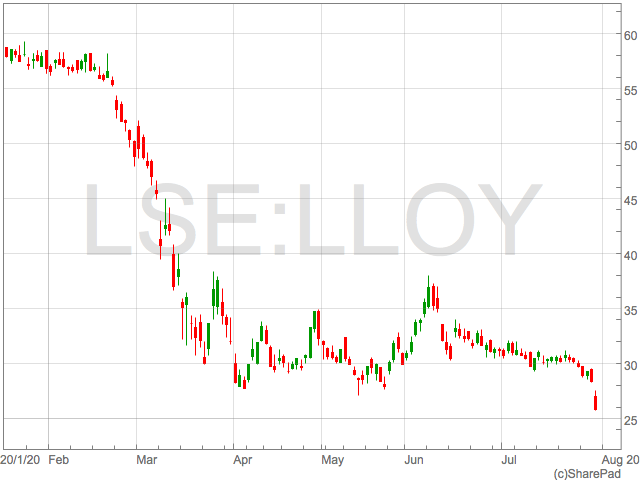
The Lloyds share price (LON:LLOY) sank on Thursday as the bank released their first half report that highlighted the scale of COVID-19 related costs. Lloyds profit before tax was completely wiped out as the bank’s profit for the period swung from a £2.9bn in the half year in 2019, to a pre tax loss of £602m in the six months to 30th June. Lloyds managed to produced a net profit of £19m only after the impact of a £621m tax credit. Lloyds shares fell over 8% in early morning trade on Thursday. The further provision of £2.4bn in the latest quarter means Lloyds has set aside a total of £3.8bn to deal with the impact of coronavirus. Increased provisions for bad debts, coupled with income falling 16% to £7.4bn, were the main drivers behind the destruction of profit at Lloyds. Lloyds drop in income was in contrast to Barclays who reported an increase in revenue, largely driven by higher investment banking income. Lloyds Bank has a greater focus on retail and business banking such as mortgages, credit cards and loans which saw reduced activity during the coronavirus lockdown. However, the introduction of government schemes such as the Bounce Back Loan helped Lloyds maintain a relatively steady loan book as mortgage activity fell sharply. “The impact of the coronavirus pandemic in the first half of 2020 has been profound on the way we live our lives and on the global economy. We remain fully focused on helping our customers and the UK economy recover, in collaboration with Government and our regulators,” said António Horta-Osório, CEO of Lloyds. “I want to express my sincere gratitude to all my colleagues across the Group for their dedication and persistence which have allowed us to deliver vital banking services to our customers effectively throughout the pandemic.” “Although the outlook is uncertain, the Group’s financial strength and business model allow us to help Britain recover and play our part in returning our country to prosperity. Our customer focused strategic plan remains fully aligned with the Group’s long term strategic objectives, the position of our franchise and the interests of shareholders.”

Lloyds share price

Lloyds shares fell sharply on the news taking the Lloyds share price to the lowest level since 2012. Lloyds is also now the worst performing UK bank in 2020 with shares down 58%. NatWest Group comes in a close second trading 55% lower on the year.