
Anglo American see diamond sales fall across second 2020 sales cycle
Sustainable Investment vs Coronavirus: stay the course & think long-term
“Seeing your money drop in value can feel uncomfortable. But with long-term investing it’s important not to focus too much on the short-term noise.”
“The market goes up and down each day. No one knows where it will be tomorrow. However, what history can tell us is that so far, 100% of corrections and crashes have always been followed by a recovery that comfortably offsets those losses.”
“[…] Even if you had invested in the US Stock Market (the S&P 500 to be exact) in the weeks prior to the 2008 crash (the largest financial crash since 1930), in the 10 years following you would’ve netted a +7-8% average annual return. That’s not bad going seeing as the 2008 crash wiped out ~50% of value from the S&P 500.”
What we can perhaps take away from this, is that we should perhaps temper our emotions and stay the course.
Sustainable investment is facing challenges like every other sector, but its natural tendency towards long-term holdings gives investors the opportunity to sit tight for now, and wait for sunnier skies in the months and years to come.
After enjoying impressive returns of around 7.12% over the three months to February, I’ve personally seen my Tickr portfolio’s growth narrow to 1.12%. Clean Energy is down 11.31% and Global Water by 11.64% this week alone, as the Coronavirus tightens its grip.
Regardless, I will echo Chris Tanner’s optimism, and Matt Latham’s advice. I think we need to be patient. It is better, in my opinion, to weather the storm in a long-sighted asset class, then flock worriedly to one investment or another, or capitalise on others’ losses.
Can investing in fine wine see us through market uncertainty?
General notes on fine wine investment
Giving attendees a rough overview of the investment wine space, Daniel told us only 1% of all wine globally contains the necessary characteristics to be considered investment wine. While naturally trying to create a positive impression of the field, he described fine wine as an ‘alternative investment’. Not a field to be invested in exclusively, but rather as one part of a healthy spread of investments. He then reiterated the advice of renowned business magnate Warren Buffett, who said at least 1% of everyone’s portfolio should be in wine. At the end of his presentation, Daniel reminded us of the very real demand for fine wine investment, and the presence of high net worth individuals ready to pay a premium for the right bottles. He cited the sale of one bottle in particular: a 1777 Chateau Lafite from the Jefferson collection, which sold for over a quarter of a million pounds.Why does wine investment attract sophisticated palates?
According to OenoFuture, the main attractions of wine investment are threefold. First – wine collection lets you keep more of your gains. Unlike some other forms of investment, wine collections aren’t taxed, and the profits accrued from collecting wine are exempt from tax in many countries. Second – it has offered reliable growth in recent years. Aside from the bounce caused by high-net-worth Chinese investors entering the market at a rapid pace, the last decade or so has seen fine wine investments appreciate by around 10% per annum. During 2018, OenoFuture reported that its Private Investor accounts yielded average returns of 11.93%. Third – it lets us escape the risks that affect most equities and conventional asset classes. Now more than ever, this characteristic makes wine investment appear like a particularly virtuous asset. While other sectors are dragged or fuelled by market corrections and rallies, the success of fine wine is dictated by the simple tenets of supply and demand. It might seem intuitive, then, to think that consistent appreciation in fine wine prices over time is only natural. Save for a sudden decline in demand for wine consumption or collectability, the steady decline in stocks of any particular bottle of wine correlates directly to an increase in its respective value. In a succinct summary on its website, OenoFuture states: “Against a backdrop of market turbulence and uncertainty, the fine wine market has performed exceptionally in recent years. Since 2005 fine wine has seen growth of 198%, making it a very attractive safe haven for investors keen to diversify their portfolio.”Being on the nose: what is the OenoFuture user experience?
The company stated that its standard investment ranges sit around the £10k, £25k and £50k marks, for different sizes and time frames of wine collections. At the lower threshold, the company said £10k covers an entry level diversified portfolio. The aim of this kind of undertaking would be to provide returns over the short-to-medium term, which Daniel Carnio estimated would be between one to three years. At the £25k and £50k levels, Daniel said the company would look to introduce ‘iconic’ wines to an investor’s portfolio. At this level, we can assume there is scope for long-term holdings, with offerings targeted towards attracting buyers willing to pay above market rates for the right bottle of wine. Regarding the nitty gritty practicalities of the company, OenoFuture said all wine collections are stored in a bonded warehouse, and should any misfortune befall your bottles, insurance payouts cover the cost of the wine at the point of damage (with price appreciation), not the original purchase price. Finally, Daniel outlined the company’s attractive fee structure. OenoFuture takes no upfront fee. In exchange for its individually tailored advisory services it only takes 10% of any profits made at the point of liquidation. Coming away from the evening, I got the impression that wine investment isn’t just a quaint idea, but an effective way to diversify a portfolio and counteract the risks posed by mainstream market mechanisms. Investing with OenoFuture means we only pay fees when we win, and even if we’re faced with abject failure, drinking your investment will at least help us forget momentarily.Impromptu Fed rate cut compensates for lack of G7 Coronavirus action plan
“It looked like the G7’s brightest and best financial minds had failed to deliver – and then the Federal Reserve went and announced an impromptu rate cut.”
“After a conference call between its central bankers and finance ministers – they daren’t actually meet in person, duh – the G7 issued a statement, via Jerome Powell and Steven Mnuchin, reaffirming the group’s commitment to combating the coronavirus without actually announcing any concrete measures.”
“It looked like that was all the markets were going to get – disappointing, yet pointing well enough in the right direction to broadly preserve the day’s gains.”
“But Powell had an ostensible ace up his sleeve. His arm no doubt twisted by a dovish Donald Trump, the Fed slashed interest rates by half a percentage point to 1%-1.25%, taking the number of FOMC cuts to 4 since July last year.”
“The Dow Jones didn’t actually move that much higher after the announcement. Instead it largely just reversed its triple digit decline, at best climbing another 0.3%. That’s because the rate cut is more justification for yesterday’s record-breaking rebound than an impetus for a fresh surge this Tuesday.”
“As for Europe, the region’s indices remained off their intraday highs despite the Fed intervention. It might simply be that anything other than a co-ordinated action plan from the G7 was going to disappointment, especially following the Dow’s insane gains on Monday night. Then there’s the fact the pound and euro are now both up around 0.4% against the dollar.”
“The rate cut may have also acted as a reminder of just how serious the coronavirus situation is, with multiple stats – worst week since 2008, first emergency cut since 2008 – that harken back to the dark days of the financial crisis.”
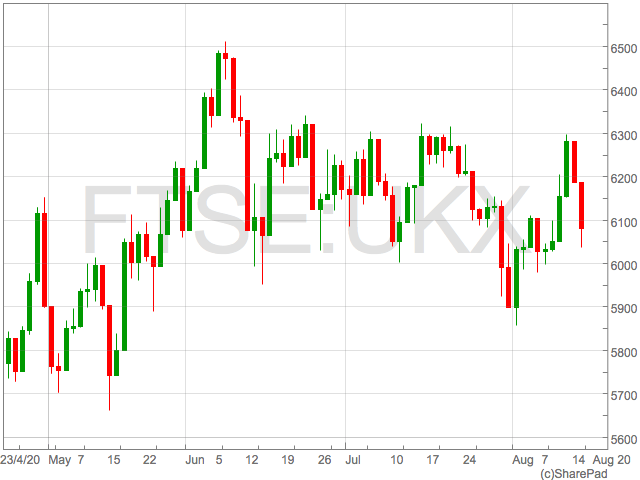
“Regardless the FTSE rose 1.9%, leaving it around 70 points shy of its 6850 peak. The DAX was up 200 points, half of its morning rise, while the CAC added 1.8%.”
Craneware books strong first half led by 30% growth in ‘new sales’
Likewise, Craneware shareholders enjoyed similar progress during H1 2020. Its adjusted basic EPS increased 3% to 31.1 cents per share, while its interim dividend grew by an impressive 5% year-on-year, up to 11.5p per share.
The company added that operationally, its new cloud Trisus solutions accounted for 10% of new sales. It also said that it saw an increase in the total value of renewals and that it enjoyed, “strong sales activity and opportunities across all classes of hospital providers”. It finished, saying its investment in research and development had risen from $9.1 million to $10.3 million on-year for the first half.Craneware reaction
Responding to the company’s performance, company CEO Keith Neilson commented:“We are pleased to report on a positive sales performance in the first half of the financial year, with new sales over 30% ahead of the first half in the prior year, reflecting the considerable amount of activity that has taken place across the business since the summer. Whilst this increase will take time to flow through into our reported financials, we are confident that momentum is now back in the business and the size of the opportunity ahead of us remains intact.”
“Importantly, the level of Trisus sales grew in the half, with sales of all four of our current Trisus solutions and the pipeline for these products increasing. The transition of our existing product suite onto the Trisus platform is progressing and paves the way for long-term growth, as we provide our customers with the data-driven solutions they require to address the move to value-based care.”
“The positive sales performance in the first half has continued to date, and our pipeline continues to grow, underpinned by the o ngoing transition of the US healthcare market to value-based care. The Board’s expectations for the full year remain unchanged and we look forward to a return to increased rates of growth in future years. We are focused on execution and with strong operating margins, healthy cash balances and a growing sales pipeline, we continue to be excited by the opportunity ahead.”
Investor notes
Despite seemingly positive results, the company’s shares dropped 3.14% or 61.00p, to 1,879.00p per share 03/03/20 15:18 GMT. Analysts from Peel Hunt reiterated their ‘Buy’ stance on Craneware stock. The Group’s p/e ratio is 39.12, their dividend yield is modest at 1.39%.
Three FTSE 100 listed firms that provide a measurable impact on the environment
Sainsbury’s
The supermarket industry is often cited as one of the biggest contributors to carbon dioxide and greenhouse gas emissions – however Sainsbury’s have taken the lead to cut down their environmental impact. Sainsbury’s (LON:SBRY) have made a concerned effort over the last few years to ensure that they cut their use of plastics and reduce company emissions. The firm has boasted some interesting statistics on their environmental policies – notably the British supermarket brand has zero waste to landfill since 2013. 7,992 tonnes of carbon dioxide have been saved through their colleague behavior change project ‘Greenest Grocer’ and the firm has used one billion litres of water less than the equivalent in 2005/2006. Sainsbury’s have signed up to Courtauld 2025, which is an ambitious voluntary agreement to ‘make food and drink production and consumption more sustainable’. The FTSE 100 listed firm has made an active effort to work with farmers, to reduce food waste across the whole supply chain, and when surplus food supply occurs – these are sent to charity food donation partners. An interesting statistic to note is that 1,164 food donation partnerships have been agreed across Sainsbury’s entire store portfolio.BT
BT (LON:BT.A) are another high profile firm who have been put under the spotlight over recent years for environmental issues. As a telecommunications firm, BT are looking to set the trend within the industry – to set an example for all telecommunications firms to cut down energy and wastage. BT are one of the first firms in British industry to really focus on environmental policies. In 1992, they were the first big name to set a carbon reduction target – and since then their policies and ambitions have only grown. The British firm add that environmental policies form part of the firms’ responsibility and they have a significant impact on the environment. To manage this impact, BT now have installed the Environmental Management System (EMS). Here, issues such as energy consumption and carbon emissions are considered. The telecommunications giant have also expressed their stance in saying that they want to help customers reduce their carbon footprint by at least three times the end-to-end carbon impact of their business by 2020, which is called the “3:1 Ambition”. Through these actions, the company promises the responsible use and disposal of plastics throughout their business operations through the plastics policy within their EMS.Unilever
Unilever plc (LON:ULVR) have already owned the implications of their activity on the environment and climate change. Following this acknowledgement, Unilever derived their environmental vision which is: “To grow our business, whilst decoupling our environmental footprint from our growth and increasing our positive social impact.” As Unilever are a major multinational firm, and operate within a range of markets including food and health products – there is more a generic focus in terms of their environmental policy. Unilever now refresh their materiality assessment periodically, which considers current and future climate issues. Along with this, there is an emphasis within their environmental policy to set targets for continuous improvement and put in place safety and sustainability programs. The firm also engages with suppliers to reduce environmental impact, which is derived from their ‘Responsible Sourcing Policy’. This allows the addressing of issues which affect farmers within the agricultural market. These issues include improvements in supply chains, legal compliance, no deforestation, soil and water management, pollution and biodiversity. Finally, looking at product use – Unilever consider their environmental impact through designing of products, which makes recycling easier. The firm are also currently working with global governments to ‘create an environment that enables the creation of a circular economy’ – which includes the necessary resources to collect and recycle materials.Rotork shares rally on boosts to its profits and dividend cover
Rotork response
Reacting to its positive results, company Chief Executive Kevin Hostetler, commented,“Our Growth Acceleration Programme is on track and progress in 2019 was very encouraging. The year was about margin improvement, cash generation and laying the foundations for sales acceleration. We made excellent progress on all pillars of the Programme, including sales force re-alignment to end markets, lean initiatives, purpose and values launches and our IT solution design. We remain committed to delivering sustainable mid to high single digit revenue growth and mid 20s adjusted operating margins over time.”
“Looking ahead, it is too early to assess fully the potential impacts of COVID-19. Absent these, we were planning for modest sales growth on an OCC basis and margin progress in 2020, driven by further benefits of our Growth Acceleration Programme albeit with margin progress more gradual, reflecting our investment plans.”
Investor notes
Following the company’s announcement, its shares rallied 7.40% or 20.70p during Tuesday trading, up to 300.60p per share 03/03/20 14:49 GMT. Analysts from Peel Hunt reiterated its ‘Buy’ stance on Rotork stock. The Group’s p/e ratio is 22.21, their dividend yield is modest at 1.96%.Serabi Gold give operational update on Sao Chico
Serabi Gold see positive few weeks
In January, the firm told the market that it had seen a productive fourth quarter. Production in Q4 was up to 10,223 ounces, which topped off annual production at 40,101 ounces, which represented a 7% improvement year-on-year, from 37,108 ounces during 2018. The company added that during the quarter, it mined a total of 44,092 tonnes of gold at 6.69 g/t of gold, as well as completing 2,908 metres of horizontal development. Operationally, it stated that it had undertaken electrical and mechanical testing of an ore sorter, which was in the ‘final stages’ of installation between the Group’s crushing and milling sections. Serabi’s year-end cash holdings stood at US $14.3 million, it anticipates full-year production in the region of 45,000 and 46,000 ounces.Begbies Traynor rallies 10% with trading in line with expectations
“continued to trade well in the quarter with results showing strong growth in revenue and profit compared to the prior year.”It said this performance, alongside its positive first half, left it feeling confident about achieving full-year results ‘at least in line’ with expectations.
Begbies Traynor said its property advisory, transactional services and new acquisitions had all been trading in line with expectations, and that the integration of the Ernest Wilson business sales agency was ongoing.
It added that its recovery and financial advisory business performed will, benefiting from both organic growth and contributions from its current year acquisitions. The company said the insolvency market remained favourable, with a year-on-year increase of 7%, to 17,196 for 2019.Begbies Traynor response
Executive Chairman of the company, Ric Traynor, reacted to the results:“The group has delivered strong organic growth, complemented by good performances from our recent acquisitions. This, combined with continuing favourable UK insolvency market conditions, gives us confidence in delivering results at least in line with current market expectations for the full year. “
“We continue to increase the scale of our business recovery practice and extend our property services offering, and our strong financial position leaves us well placed to further build upon our track record of organic and acquisitive growth.”