Maestrano shares dip as fintech partnership is scrapped

Provider of software for master data management and business analytics Maestrano Group (AIM: MNO) has seen its share price dip following news that the platform it had delivered to an Australian banking client was to be decommissioned, as a result of ‘a change customer priorities’. As opposed to being a purely banking platform, the platform they designed offered applications for a ‘specific vertical market’. Following the implementation of the platform, the Australian banking client decided to change its approach to the vertical market. Based on this strategic shift, the custom shift will be decommissioned on 30 August 2019. Maestrano said the projected subscriber income for the platform wasn’t significant and thus the impact on its revenue forecast would be minimal. The Company said it will concentrate on developing solutions for clients in the distribution and accounting verticals, and is discussing meger and acquisition opportunities.

Maestrano comments

Andrew Pearson, company CEO, commented:

“We are seeing an established pattern across our industry of banks discontinuing what are termed “Marketplace as a Service” platforms, where 3rd party applications are offered to bank clients. We now believe that banks assumed a faster digitalization of small businesses than is happening in practice. There remains no doubt in our mind that this digitalization will eventually occur, but we are now taking a conservative view of the timing and focusing on established markets where our technology can add value today.”

Ian Buddery, Chairman of the Board, said,

“This development confirms the decision made in May to explore opportunities to acquire complimentary products and teams, where clear opportunities existed to accelerate shareholder value. We have identified some interesting opportunities and will make further announcements when possible.”

Investor notes

The Company’s shares dipped 13.79% to 1.30p a share at market close 12/08/19. The Group’s market cap is currently £1.00 million. Elsewhere in the tech sector, there were updates from; Vitec Group plc (LON: VTC), TT Electronics (LON: TTG), SDL plc (LON: SDL), Dialight Plc (LON: DIA) and Seeing Machines (LON: SEE).

European indices halted by recession fears, pound avoids decade low

After struggling to keep pace during morning trading, the FTSE and pound both trundled along in much the same manner in afternoon trading. The pound avoided remained flat and avoided emulating the erratic movement of its counterparts, narrowly dodging the decade-low benchmark. Meanwhile, more analysts joined the recession fanfare with the Sino-US back-and-forth appearing no closer to resolution. The affect this had on larger European indices was an abrupt halt to their morning rallies. Markets appear at the mercy of the largest players; the UK awaits the long-prophesied Brexit collapse that may not come. Reflecting on market and currency movements through the day, Spreadex financial analyst Connor Campbell commented, “A strong start from Europe somewhat dissipated in the face of a less than enthusiastic open from the Dow Jones.”

“After Goldman Sachs (NYSE: GS) warned of the rising risk of a US recession due to the ongoing and increasingly hostile trade tensions between America and China, the Dow Jones had little reason not to unravel on Monday. This meant that the index dropped more than 130 points as the bell rang on Wall Street, taking it back under 26200.”

“This Dow decline had the side effect of undermining Europe’s initial giddiness. The DAX and CAC, which at points this morning were both up more than 1%, saw their gains reduced to just 0.3% and 0.2% respectively. The FTSE, meanwhile, was left with just a handful of points, the UK index once again trapped below 7250.”

“Though it avoided a return to the scary 10-year nadir struck in the early moments of the session, the pound’s early rebound against the euro gradually waned as the day went on. Instead it was left up a paltry 0.1%, leaving it perilously close to that aforementioned decade low. A 0.2% from cable, meanwhile, put a few millimetres between sterling and levels last seen 32-months ago.”

“Desperately searching for a bit of good news, the pound will be praying for a strong wage growth figure on Tuesday, even if any positive headlines not related to Brexit are merely a plaster where emergency surgery is needed.”

Other market and macro financial updates have come from; the Monday morning market roundup, UK GDP during the second quarter, the London Stock Exchange Group (LON: LSE), the US-China currency manipulation debacle, and analysts’ outlook for markets and currencies.        

UK sees familiar grey skies, FTSE follows suit

After an exciting – if not positive – start to last week, the tale of the tape for markets on Monday appears decidedly more dull. With little on the calendar and the FTSE predictably lagging behind mainland European indices, onlookers will be holding their breathe for the next tweet from Trump and the anticipated announcement of a snap election, courtesy of Boris Johnson. With updates further prophesying the death of the highstreet and China releasing fundamentals today, Spreadex financial analyst Connor Campbell commented on the outlook for markets and currencies,

“The markets were determined to start what is looking like an otherwise quiet Monday by putting their best foot forward.”

“Despite still having plenty to worry about, from the trade war to Brexit – the impact of which may be evidenced by the week’s data, including a UK jobs/inflation/retail sales relay and a data-dump from China – the European indices sprung out of the gate.”

“Leaping 130 points higher, the DAX once again crossed 11800, pushing it back above 11800 and leaving it at its best price since the market-wide plunge suffered this time last week. The CAC was in near enough the same situation; a 1.1% rise put the French bourse at 5375, though that remains around 300 points off of where it was at the end of July.”

“Hampered oh so slightly by the pound’s futile attempts at a comeback – while cable’s unchanged at a 32-month nadir, against the euro sterling is up 0.3% – the FTSE couldn’t quite match the giddiness of its Eurozone peers. Nevertheless, a 50 point climb put the UK index within touching distance of 7300, around 100 points shy of where it opened last Monday.”

“Calendar-wise, Monday is a bit of a dust bowl, leaving the stage free for a rebound-disrupting tweet from Trump or growth-undermining statement from Beijing. The rest of the week, however, should make up for the quiet start.”

So, I won’t be smiling while I take out Euros for my holiday this week, but realistically nothing dramatic has happened. Our best advice going forwards would be to trade cautiously but not to ‘chase the story’ (so to speak) on markets, whether the next doom and gloom candidate be Brexit or a recession. There is always potential for catastrophe but by no means is it ever under-represented by media outlets and chat forums. Other market and macro financial news has come from; UK GDP during the second quarter, the London Stock Exchange Group (LON: LSE), the US-China currency manipulation debacle, and analysts’ outlook for markets and currencies.  

Valeura Energy posts ‘positive’ Inanli-1 appraisal well results

Turkey-focused upstream natural gas supplier Valeura Energy Inc. (LON: VLU) today posted mixed financial and operational results for the second quarter of 2019, alongside ‘positive’ production test results for its Inanli-1 appraisal well. For the second quarter of FY19, the Company noted that production had dipped 9% compared to Q1, and was down 5% on a year-on-year comparison for the second quarter. Its operating income of $1.8 million for Q2 was 21% lower than its figure for the previous quarter, but up 20% on Q2 2018. Its average realised gas price of $8.54/Mcf was 7% lower than in Q1 FY19, but up 15% on-year for the same period. The Company’s net working capital surplus also dropped during the quarter, from $56.1 million on March 31, to $52.3 million on June 30 2019.

Operationally, Valeura Energy told investors that it had completed drilling operations at the Devepinar-1 project within budget.

Further, it reported that it had successfully flowed natural gas from a 21 metre gross interval that it had stimulated at its Inanli-1 appraisal well. The well has been flowing since August 3 2019 and gas flow is stable, with production for the first eight days averaging

Valeura Energy comments

Investor notes

The Company’s share price last closed at 2.41 CAD, after rallying over 5% during trading. The Company’s p/e ratio is currently unavailable, their market cap stands at £136.37 million. Elsewhere in the oil and gas sector, there have been updates from; Eco Atlantic Oil and Gas Ltd (AIM: ECO), President Energy PLC (LON: PPC), Mosman Oil and Gas Limited (AIM: MSMN), Nostrum Oil and Gas PLC (LON: NOG) and Reabold Resources PLC (LON: RBD).

Eco Atlantic O&G announces oil discovery at Orinduik Block

Today the oil and gas exploration and production company Eco Atlantic Oil and Gas Ltd (AIM: ECO) announced a ‘significant’ oil discovery on the Orinduik Block, offshore Guyana. The Company said that the Jethro-1 exploration well was drilled to a depth of 4,400 metres in approximately 1,350 metres of water, by the Stena Forth drillship. Jethro-1 is the first discovery on the Orinduik licence; the Group encountered 55 metres of net high-quality oil pay in lower Tertiary sandstone reservoir. Eco Atlantic said the well has been cased and is awaiting further evaluation to determine appropriate appraisal activity.

Eco Atlantic Oil and Gas comments

Gil Holzman, CEO and Co-Founder of the Company, stated,

“We are thrilled to report this exceptionally exciting discovery. This is a revolutionary moment for Eco. It has been a long path of hard work for our team, and with today’s announcement we feel our first rewards have justified our journey. We have been very confident in the prospects of the Orinduik since we first decided to make a licence application in February 2014, based on a strong recommendation from our team at Kinley Exploration.”

“I always believed that Eco would create exceptional stakeholder value, for our shareholders, and the people of Guyana alike, and I am so proud that we have made this exciting discovery.”

“This is a transformational event for the Company, and we now need to strategically plan for an even brighter future. With multiple targets to consider, and Joe as the next prospect to be drilled, we will now pursue our evaluation of the timing for wells to develop the Jethro field and to expediently bring it on production. We are funded for at least six additional wells.”

“I want to thank the small but amazing team at Eco, the Board of Directors of Eco Atlantic, our extremely professional partners in Tullow and Total, our investors and shareholders, and the Government of Guyana for their support to date and hopefully into the future as we continue to strive to generate value for all of our supporters and partners.”

Investor notes

The Company’s shares have dipped 0.87% or 0.01p to 1.14p a share 12/08/19 16:00 GMT. The Company’s p/e ratio stands at 27.25 and their market cap is £250.85 million. Elsewhere in the oil and gas sector, there have been updates from; President Energy PLC (LON: PPC), Mosman Oil and Gas Limited (AIM: MSMN), Nostrum Oil and Gas PLC (LON: NOG), Reabold Resources PLC (LON: RBD) and Trinity Exploration and Production PLC (LON: TRIN).

Menzies finding it difficult to take off

John Menzies (LSE: MZNS) is focused on aviation services since it sold its distribution business. However, the remaining business has its problems and a trading statement last month led to downgrades ahead of its interims on 13 August.
Cargo traffic has been hit by worries about global trade. EMEA appears to be weak, while North America is holding up better. The interims will provide further information about trading in the different geographic regions.
Some airlines have had their financial problems and Boeing is not in a good place following plane crashes. That could hamper any improvemen...

How boohoo has overtaken ASOS

Online fashion retailer boohoo (LON: BOO) has not always been an investor favourite, but in little more than five years it has leapfrogged rival ASOS (LON: ASC) in market capitalisation terms.
The acquisition of the online assets of Karen Millen and Coast for £18.2m has broadened the range of brands owned by boohoo, which is on course to increase pre-tax profit from £76.3m to £93.9m in the year to February 2020.
boohoo is valued at £2.74bn, which compares with £2.03bn for ASOS, which is not much more than one-third of its market capitalisation when boohoo joined AIM. At that time, ASOS was t...

Hidden attractions of nmcn

Even when it was called North Midland Construction, nmcn (LON: NMCN) was not a well know fully listed company yet it has probably been listed for longer than most of the other companies on the premium list.
Management is starting to raise the profile of the Nottinghamshire-based business and the company should start to attract the attention of investors that the much-increased dividend and the share price performance in the past three years warrants.
Employing Progressive Research to write analyst reports on the company broadens the information available to investors.
Some people turn their...

UK GDP contracts 0.2% during Q2 in its first dip since 2012

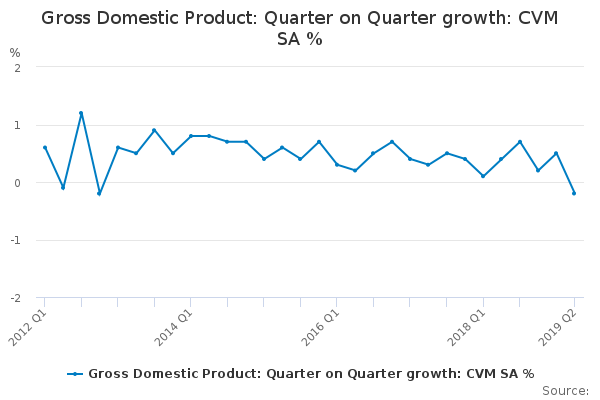
Source: Richards, C. (2019), Office for National Statistics With discussion of a looming recession gaining traction with weakness in growth indicators, fundamentals and bond market inverted yield curves, today’s announcement from the Office of National Statistics has if anything compounded already tentative market sentiment. UK GDP (‘economy’) contracted by 0.2% against analysts’ predictions, making it the UK economy’s equal worst performance – with Q4 2012 – since the financial crash. Consecutive economic contractions signify a recession, and there are three reasons this contraction is significant. First, there was surprising growth in the first quarter; second, growth in the second quarter was expected to be stagnant rather than negative; third, the political climate makes the next quarter’s prospects dubious at best.

ONS and Analysts’ thoughts

Head of GDP at the ONS, Rob Kent-Smith, said both the manufacturing and construction sectors weakened. “Manufacturing output fell back after a strong start to the year, with production brought forward ahead of the UK’s original departure date from the EU,” He added, “the often-dominant service sector delivered virtually no growth at all”. The ONS then said, “The path of GDP and some of its components has been particularly volatile through the year so far, largely reflecting changes in timing of activity related to the UK’s original planned exit date from the European Union in late March.” BBC Economic Editor, Faisal Islam, stated, “The economy has contracted over a quarter for the first time since 2012, raising the risk that the UK might be in a technical recession.” “This figure though is set to be the worst in the G7. The UK should avoid a recession if expectations of growth in this quarter are fulfilled, but that is not guaranteed. It is not the welcoming present that a new chancellor and PM would have wanted.”

UK GDP Outlook

Today’s data do contain factors such as stockpiling and premature shutdowns, which flatter the first quarter and reflect badly on the second. However, macro scale forces such as poor global growth and mediocre volumes of investment, will weigh on wider market sentiment and are outside of the UK’s control. Alpesh Paleja, CBI Lead Economist, summed it up best, “Growth has been pushed down by an unwind of stockpiling and car manufacturers shifting their seasonal shutdowns.” “Nonetheless, it’s clear from our business surveys that underlying momentum remains lukewarm, choked by a combination of slower global growth and Brexit uncertainty.”
“As a result, business sentiment is dire.”
The CBI said today’s news was “concerning”. The problem is we’re not sure how seriously the UK is taking this news. That may sound like a ludicrous suggestion but realistically; political tit-for-tat has not halted as it normally does during a time of real economic turmoil, the news may be blamed on the reactionary behaviour of companies who feel unstable due to Brexit, and put bluntly, those who would support the uncertainty of a no-deal scenario are not opposed to a degree of economic turmoil (recession is bad for the general populace but provides an exciting investment opportunity – some Conservative members have already shorted failures in British companies). Other market and macro financial news has come from; the FTSE and Sterling, the London Stock Exchange Group (LON: LSE), the US-China currency manipulation debacle, and analysts’ outlook for markets and currencies.  

FTSE muted as Brexit warnings weigh on Sterling

With suggestions of a potential resistance being mounted against Boris Johnson’s likely no-deal Brexit trajectory, Sterling gained slightly yesterday morning. Unfortunately, this gain perhaps dampened FTSE prospects of joining in yesterday’s rally (until later in the afternoon), at least to the same extent as other European indices. Speaking on market opening movements and his predictions for the morning, Spreadex financial analyst Connor Campbell stated,

“Europe was pretty tame after the bell on Friday, with the UK markets bracing themselves for what could be a rather depressing data dump.”

“Though still above 7250, the FTSE slipped 0.2% as trading got underway, roughly in line with the performances of the DAX and CAC. It could have been worse; the UK index’s mining and banking stocks are all down around 1%, losses that were somewhat compensated for by a 7% rise from WPP, which insisted its turnaround is on track despite a 43.5% slide in full year pre-tax profit.”

“Sterling was similarly muted. Against the dollar it was flat at $1.2135, while against the euro it dipped under €1.084 following a 0.1% decline. The pound is likely saving its energy for the data workout it is set to undergo this morning. The UK’s Q2 GDP is expecting to have flat-lined, a sharp drop-off from Q1’s 0.5% increase; the monthly figure, meanwhile, is forecast to drop from 0.3% to 0.1%.”

“On top of this, the currency is facing a big about face from the manufacturing sector, with production for June estimated at -0.1% against May’s 1.4% increase. Though the pound has been politically-focused of late, it’s hard to see this selection of pre-Brexit warning signs allowing sterling a happy end to the week.”

Since then, sterling has dropped against the euro and dollar, following news that the British economy shrank during the second quarter. This was driven by car makers pulling forward their scheduled shutdown periods, which drove manufacturing growth to its biggest rolling three-month fall since the financial crash. Further losses should not be ruled out, with the FTSE set for a tasking morning with two GDP readings. Other market and macro financial news has come from; the London Stock Exchange Group (LON: LSE), the US-China currency manipulation debacle, and analysts’ outlook for markets and currencies.