Cineworld shares (LON: CINE) plummetted over 57% on Monday’s opening.
The group announced that it would be temporarily closing all of its US and UK cinemas after delays to the new James Bond film.
The cinema closures will begin this week and will risk 45,000 jobs across the US and UK.
“As major US. markets, mainly New York, remained closed and without guidance on reopening timing, studios have been reluctant to release their pipeline of new films,” said Cineworld in a statement.
“In turn, without these new releases, Cineworld cannot provide customers in both the US and the UK – the company’s primary markets – with the breadth of strong commercial films necessary for them to consider coming back to theatres against the backdrop of COVID-19.”
The delay of the new James Bond blockbuster has been blamed for causing havoc on the industry.
Philippa Childs, head of the arts union Bectu, said: “The announcement that the release of No Time to Die, the 25th film featuring the secret agent, would be delayed again has left cinemas facing financial obliteration because of the absence of other forthcoming blockbuster films…..
“According to industry sources, the cinema industry is caught in a Catch-22 situation. Movie studios are reluctant to release blockbuster films until they are sure that audiences will return – and cinema owners are unable to prove they can lure back audiences given the absence of blockbusters.
“The stark reality is that without new releases it is unlikely that footfall will increase to a level that makes opening financially viable,” said Philippa Childs, head of the arts union Bectu.”
The closure of Cineworld cinemas in the UK risks 5,500 jobs.
The group has struggled this year as cinema closures led to the company posting losses of £1.3bn for the first half of 2020, compared to profits of £110m a year earlier.
Cineworld shares (LON: CINE) plummeted 57% this morning to 17p. In January 2020, before the pandemic, shares at the company were worth 220p.
Mulberry (LON: MUL) has reported a £14.2m loss in the year ending 28 March.
Due to the impact of the pandemic and a “challenging UK market”, the group reported a 10% fall in revenue to £149.3m – down from £166.3m the year previously.
Mulberry said that was on track to reach profit before the UK’s lockdown forced the group to close stores.
International retail sales increased by 4% from £31.3m to £32.4m. International sales accounted for 26% of total retail revenue.
The fashion retailer said that it will not pay a full-year dividend “in order to maintain a robust liquidity position given the uncertainty and duration of COVID-19.”
The group remained positive and said that trading since the start of the financial year is ahead of expectations.
Thierry Andretta, the group’s chief executive, said: “The Group has made strategic and operational progress during the most challenging market conditions in the history of the brand. Prior to the impact of the Coronavirus pandemic we were performing well and on-track to record a pre-tax profit in the second half of the year.
“This was due to progressing our fourpillar growth strategy: our omni-channel distribution, our international development in Asia, a drive for constant innovation, and sustainability. The Group has been able to withstand some of the pressures that we, and indeed the entire retail industry, have been faced with.
“Post year end, the Group has continued to benefit from its long-term strategic focus with initial sales ahead of our early expectations. However, we cannot escape the reality that British luxury and UK cities face a very uncertain future, hampered by necessary but dramatic social distancing measures and alarmingly low levels of footfall, as well as the pressures of high rents and business rates and the upcoming changes to tax free shopping.”
Mulberry shares (LON: MUL) opened 3% lower and are trading at 161,00 (0818GMT).
Restore (LON: RST) has been resilient this year and remains highly profitable. The share price does not reflect this because it does not take account of the recurring revenues generated by document storage, which is a long-term requirement whether or not offices are open.
Shredding, scanning services and office moves operations are more dependent on office activity, so they have been harder hit. Management says that shredding is the only part of the business where recovery has still some way to go.
The document storage operations are set to grow this year. Overall, group revenues are running a...
With the likes of Amazon, Netflix and Disney Plus hungrily vying for viewers’ attention, the recent announcement that the next instalment of James Bond will now be delayed until April 2021, could well be the final nail in the coffin for ailing cinemas.
Odeon (LON:ODE.F), Vue, and Cineworld (LON:CINE) have all posted reflecting what has been a torrid half-year of trading for film outlets relying on physical attendance. The hope since then, has been that much like restaurants, bars and even the housing market, consumers would be keen to release the pent-up demand created by lockdown.
And, while social distancing has certainly constrained capacity utilisation (to around 30%), the main issue is that there simply isn’t a product worthy of bringing back cinema-goers in droves. The 2020 slate already looked fairly bland, but with Tenet receiving mixed reviews, family film ‘Soul’ skipping cinemas and moving straight to on-demand streaming services, and now the James Bond mega title ‘No Time to Die’ being postponed, the next few months look entirely dire for the already-struggling cinema sector.
James Bond giving Cineworld a licence to be killed
Of the UK’s big cinema chains, Cineworld, stands at the front of the pack in terms of being absolutely blindsided by the James Bond delay.
Having already booked a £1.3 billion loss, The Times reported that the cinema is drawing up plans to close all 128 of its UK theatres, which would raise serious concerns over the future of the company’s 5,500 staff.
It is likely that staff will be asked to accept redundancy, with some potential for incentives to rejoin, should theatres reopen in the new year.
In its statement, Cineworld said: “We can confirm we are considering the temporary closure of our UK and US cinemas, but a final decision has not yet been reached.”
“Once a decision has been made we will update all staff and customers as soon as we can.”
The news followed attempts by the cinema to entice viewers by lowering ticket prices to as low as £4, and writing to the prime minister to say that the industry has become ‘unviable’ because of the James Bond delay – with the previous franchise release grossing £80 million at the UK box office.
Legal and political failures could spell the end of a cultural and social institution
Many have been quick to condemn the lack of support by the UK government, to protect the jobs of staff at cinemas such as Cineworld. And indeed, this criticism is deserved.
However, we should also condemn both legislation changes, and lack thereof, in the US, which have seen studios take chunks out of the cinema industry with nothing given back in return.
Between the AMC-Universal deal shortening the theatrical window (allowing streaming sites to show new releases sooner), the overturn of the 1948 Paramount Consent Decrees (preventing studios from buying cinemas), and a lack of action preventing studios such as Disney from releasing their big titles exclusively on their online platforms, cinemas have been dying a slow death for well over a year.
Aside from lamenting the plethora of Western political failures, spanning over years and likely to see viewers at the behest of behemothic online companies, we should also mourn the potential collapse of cinema as a cultural and social institution within society.
If Cineworld goes and the Culture Recovery Fund fails to prop up enough of the country’s theatres, we could see towns that once had a playhouse and a cinema culturally emptied out in the space of a year.
Looking at the situation as it stands, Third Bridge senior sector analyst, Harry Barnick, comments:
“Now more than ever support from landlords and the UK government will be essential for the survival of cinemas.”
“The announcement confirms what we already know: cinemas can’t exist without compelling content.”
“This has a number of broader implications for the sector, for instance: how will competitors like Odeon and Vue respond and will scheduled releases such as Soul move directly to PVOD.”
“Whilst national chains like Cineworld have suffered due to the pandemic, smaller independent chains have felt the downturn just as harshly. It appears Cineworld intends to re-open sites in the new year, but can smaller operators afford another 6 months of closures and does this spell the end of the independent cinema sector in the UK.”
The British Beer & Pubs Association (BBPA) has warned that unless the government acts now, 300,000 jobs are at risk of being lost.
Due to the reduced capacity in pubs and restaurants and the 10 pm curfew, a new report by the by consultancy Oxford Economics found that 291,000 are at risk.
“The 10pm curfew should be removed if demonstrably not working as intended or adjusted to provide for gradual dispersal and avoid the unintended consequences for the wider sector including cultural activities now impacted,” said the BBPA in a letter to Boris Johnson.
Weekly sales in pubs are down 23% on the same period last year as the new “rule of six” and local lockdowns are taking effect.
BBPA chief executive, Emma McClarkin, said: “It’s important to remember that outside of the current circumstances our sector is a thriving one – and when this epidemic ends it will be key to driving the economic bounce-back we will desperately need.”
“For that to happen though the government must invest in it now to ensure its still here to play that role,” she added.
The pressure is mounting on the government to take drastic measures and protect the UK’s hospitality sector.
The hospitality sector in cities with local lockdowns have been worst hit. Council bosses from Liverpool, Leeds, and Manchester have warned that the local lockdowns will “result in mass-market failure, huge levels of redundancies and depleted and boarded up high streets.”
In a letter they wrote: “The stark reality is that these businesses are facing the prospect of a complete decimation in trade, not just in the short term but as we look ahead to the sector’s traditional lifeblood of the Christmas period and almost certainly continuing into spring/summer of next year which we know with certainty will result in mass-market failure, huge levels of redundancies and depleted and boarded up high streets.”
Whilst Rishi Sunak revealed a new job support scheme, there are calls for the government to do much more to protect jobs after the furlough scheme ends.
Moonpig is exploring the idea of floating on the London Stock Exchange.
According to Sky News, the online greeting cards retailer is in talks with investment banks and looking into a public listing.
The privately-owned company is said to be in the early stages of talks.
Moonpig has grown over the pandemic and the group said that over lockdown it added an additional one million customers.
Sales this year have surged 44% this year to £172.8m whilst pre-tax profit has surged 137% to £33m.
“As a high growth company we constantly evaluate our funding options, and regularly meet with advisers on this subject,” said a spokesperson.
Moonpig’s boss is Kate Swann, who has previously led WH Smith and SSP Group.
Guild Esports has gone public on the London Stock Exchange.
The e-sports company, which is co-owned by David Beckham, listed today after earlier this week offering 250m ordinary shares for 8p.
Beckham holds a 4.78% stake in Guild Esports.
It is the first e-sports company to go public on the stock exchange and has a valuation of £41.2m. The industry has experienced significant growth in recent years.
Jamie Peel, director at corporate finance at Zeus Capital, said: “The gaming industry has exploded in popularity, with esports quickly becoming a mainstream form of entertainment. This is only expected to accelerate in the coming years, and with a hugely experienced and high-quality management team, the firm has already generated significant investor appetite.”
Time to invest in e-sports?
Hiran Adhia, who is a client manager at global branding and design agency Landor, believes the e-sports sector will continue to grow in the coming years.
“[This float] has certainly got the international community talking and major players and investors have no choice but to now pay close attention,” said Adhia.
“[After] having perceptually trailed behind traditional sports franchises for the last 20 years, out of the limelight, e-sports has built a mammoth international fanbase,” they added.
According to games market insight company, Newzoo, the e-sports sector is set to grow by 42% to $1.56bn
Advanced Oncotherapy (AIM:AVO), developer of proton therapy systems for cancer treatment, recently announced several areas of progress which will help realise its goal of ‘democratising proton therapy’.
First, it stated that it had seen ‘strong advancement’ in its proton treatment technology, over the last six months. Its LIGHT system, upon completion, is set to be the first of its kind to be capable of accelerating protons at 230 MeV. The company states that it is on track to deliver its breakthrough technology to consumers in 2021, providing access to a type of treatment previously reserved for a select few.
In service of this end, the company’s second update was also promising. It announced that it had successfully delivered all of the high-precision accelerating structures for the LIGHT system to its Daresbury assembly site; that it had manufactured the hardware necessary for the patient positioning system; and had delivered all of the technical files for the certification process.
Further, it announced that at its Daresbury site, it had been developing the infrastructure necessary to support the assembly of future machines. In short, it is another step closer to bringing its technology to the public.
Then, to help with the costs of research and production, Advanced Oncotherapy celebrated several new sources of funding. These included a successful equity fundraise of £14.9 million pre-expenses; the option of accessing £42 million courtesy of VDL and Nerano Pharma; and a drawdown of $10 million from an ‘interest-bearing secured convertible facility’ with Nerano Pharma.
Finally, to assist in rolling out its treatment to patients, the company announced that it had signed ‘multiple’ commercial partnership agreements with stakeholders, including The London Clinic, The Mediterranean Hospital of Limassol and University Hospital Birmingham NHS Foundation Trust
Commenting on these areas of progress made over the last six months, Advanced Oncotherapy CEO, Nicolas Serandour, said:
“We are delighted with the progress achieved over the past sixmonths despite the impact that COVID-19 has had on our business. As previously announced, we have added more focus on and made excellent progress with the documentation and software development. During the half year under review, we also signed a number of significant collaborations with partners for further LIGHT systems to be constructed at world leading hospitals, and we look forward to updating the market in due course on the progress of these agreements.”
“We are pleased to have recently resumed activities at the Daresbury site, and are expecting to be in line with our operational plan for completion of the first LIGHT system in 2021. We will be holding a virtual Investor Day in October when we will update the market on our patient-centric business model, the broader strategy and operational deliverables for the next year, including our LIGHT system being fully conditioned and generating a full-energy beam that is necessary to treat patients with our clinical partner, the University Hospital Birmingham NHS Foundation Trust.”
Findings published by the Centre for Research on Multinational Corporations (SOMO) reveal that German coronavirus test manufacturer, and biotech giant, Qiagen (NYSE:QGEN) has dodged millions of euros in tax since 2010, owing to tax avoidance constructions in Ireland, Luxembourg, Malta and the US.
SOMO said in its report that Qiagen acts as a leading producer of Covid test kits, and currently benefits from mass orders made by ‘governments around the world’ – including being one of the major suppliers to the US.
Speaking on the findings, SOMO tax researcher, Jasper van Teeffelen, said: “The global healthcare sector is under enormous financial pressure due to the coronavirus crisis. It is distressing to see that precisely a company like Qiagen is avoiding tax on a large scale and depriving governments of much-needed income.”
How have Qiagen gotten away with it?
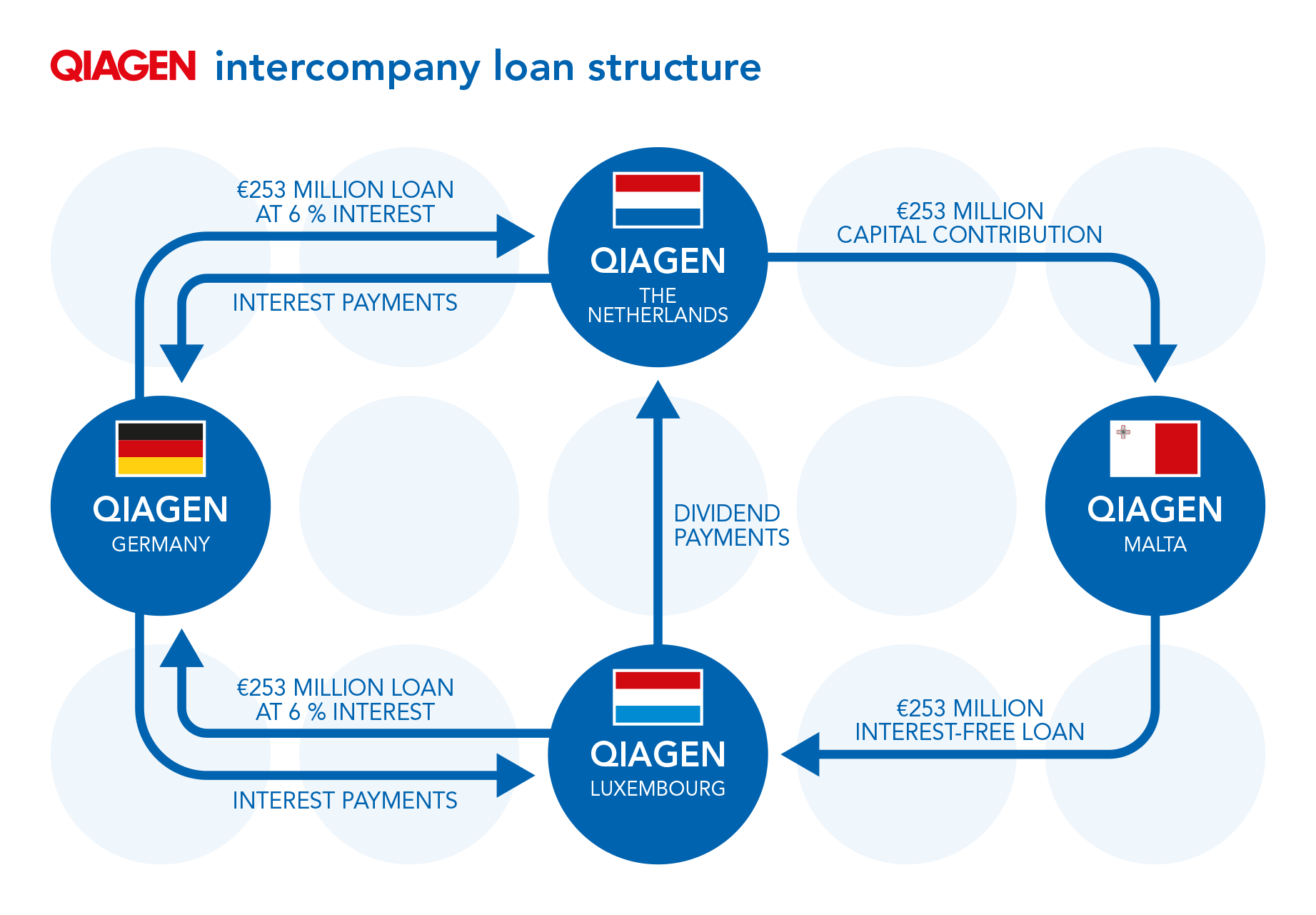
The company itself has an operational HQ in Germany, but is officially headquartered in Venlo, the Netherlands. Having boasted second quarter profits of €77 billion – double the level of the same period the previous year – SOMO revealed that the company had not paid proportionate tax on these gains. Instead, SOMO described Qiagen’s tax structure as a ‘network of letterbox companies’ in European tax havens (listed above), which it uses to avoid tax via internal loan-giving between subsidiaries.
In essence, it downplays the true nature of its taxable profits – which might differ from the profit figure it uses as a public performance indicator – by transferring its earnings to lower-tax jurisdictions such as Luxembourg. These transfers occur via loans, with the main company paying letterbox or subsidiary companies disproportionate interest payments. Much like ‘facilitation payments’ replacing bribery in the past, bogus ‘interest rates’ are just a form of euphemism to mask an unsavoury, but financially prudent, transaction.
Qiagen loan structure, SOMO graphic
According to SOMO’s estimates, Qiagen has avoided paying €93 million in tax, along with an accumulated tax deduction of €49 million. SOMO adds that this is a conservative estimate, given that not all of the potential avoidance structures have been accounted for. This report focused on intercompany loans but also mentions tax avoidance on interest income from Qiagen loans to the US.
Reacting to what the research group have uncovered, SOMO tax researcher, Vincent Kiezebrink, commented:
“It is shocking to see how hard this biotech giant is trying to avoid tax. We call on Qiagen and the EU to put an end to such tax avoidance schemes.”
Taking from the public and not giving back their fair share
Alongside not paying an equitable tax on their profits, Qiagen has received large sums of public funds from both the US and Netherlands governments, among others. For instance, it received €511,000 from the US Department of Health, to help accelerate the development of a new Covid test. The subsequent test is now being produced and procured on a massive scale, again using public money, by the Netherlands, US and other countries around the world
SOMO’s view is that government’s must intervene, with this just the latest in a catalogue of brazen tax avoidance schemes by large companies, who are happy to benefit from the countries they operate in, without feeling any duty of reciprocity towards the people who have facilitated their success.
It says that organisations such as the EU and the Netherlands government must now implement rules that are more exacting with the allocation of public funds, and tighter on tax avoidance infrastructure, such as subsidiaries being used to offshore profits made in a company’s places of operation.
Wemos, a Dutch non-profit, global health lobbyist group, published its own study on public funding of medicines in 2019, underlines the recommendations of the SOMOS report.
Ella Weggen, global health advocate for Wemos, said: “Transparency about public investments is desperately needed. Conditions must be attached to this public funding in terms of affordability and accessibility, so that people actually benefit from medicines and medical devices developed with their taxpayers’ money.”
The UK government has released a statement confirming a £200 million investment in the Port Infrastructure Fund, as part of its drive to “ramp up preparations for the end of the transition period” and build new facilities along the coast designed to “handle new customs requirements under the new Border Operating Model” proposed back in July.
Primarily targeting ports which already have “the space to build new border infrastructure on their current sites”, the funding will be put towards a “range of vital port infrastructure – from warehouses and control posts to traffic management systems” as well as inland customs facilities in areas which are not suitable for additional port infrastructure.
In a statement on its website, the UK government said that new port facilities will be necessary regardless of the outcome of ongoing Brexit negotiations with the European Union:
“New infrastructure at ports will be needed whether or not the UK secures a negotiated agreement with the EU as we are leaving the Customs Union and Single Market and new procedures will be coming into place”.
The post-Brexit fund will see construction commence “for the end of the year” and “give industry confidence that all required infrastructure will be delivered on time”.
Secretary of State for Transport, Grant Shapps, welcomed the government’s Friday announcement:
“Our ports are a point of pride for the UK, contributing to our success as a global trading nation and helping bring vital goods into the country each and every day. This investment will not only ensure our borders are fully operational at the end of the transition period, but will also support the UK’s fantastic businesses as they trade across Europe”.
Tim Morris of the UK Major Ports Group, the trade association for the UK’s largest port operators, added:
“Today’s announcement is a welcome step in ensuring that [port] capacity can be maximised and UK supply chains can be more resilient. Time is short and it is vital that UK businesses prepare for new border arrangements. We will work urgently with the Government on the all-important detail and related regulations”.
Last month it was a revealed that the government’s reasonable worst-case scenario (RWCS) prediction involved 40-70% of trucks travelling to the EU “not being ready for new border controls” and warned that a “lack of capacity to hold unready vehicles in France, or turn away freight prior to boarding in the UK, could reduce the flow rate to as low as 60-80% of normal levels, which could lead to queues of up to 7,000 vehicles in Kent and maximum delays of up to two days”.
With the outcome of Brexit negotiations still unclear, the fund is a welcome relief in ensuring that cross-border trade – along the coast, at least – is handled as efficiently as possible, whatever the outcome of the talks.