
Sirius seek investment for new project

Sirius Minerals PLC (LON: SXX) are seeking for a $600 million investment for a new flagship project from investors after reviewing plans, for financing its North Yorkshire potash mine, the largest project of its type in the world.
Shares of Sirius rallied 15.77% after the Monday morning announcement, and are trading at 3.7p. 11/11/19 10:25BST.
After seniority reviewed the project back in September, the conclusions that were reached meant that a $600 million investment was needed.
In order to achieve a production capacity of 10 million tonnes per annum, the project will require $2.5m in capital expenditure.
Commenting on the update, Neil Wilson, chief markets analyst for Markets.com, said that the plan would “require significantly less capital than the previous incarnation.”
He added: “A possible way out of the mire, but needs to be picked over in more detail.”
The mine will consist of a two 1.5km shafts drilled below the North York Moors National Park to access the world’s largest deposit of polyhalite, which is used in fertilisers.
The minerals and mining sector has been varied by firm, where Serabi (LON: SRB) saw their shares rally after a strong third quarter, London listed Antofagasta (LON: ANTO) have not been so successful after tough political conditions.
Additionally, big time Thor Mining (LON: THR) reported that their shares slipped even after a new discovery, showing the inconsistency in the market.
Group managing director and chief executive Chris Fraser welcomed the approach, saying:“The value of Sirius is unlocked by reaching production and delivering POLY4 to our customers around the world.
“This approach allows us to achieve that with less upfront capital while retaining the significant return opportunity it presents for our shareholders and stakeholders.”
Earlier this year, the project was thrown a curveball when Sirius was forced to scrap a $500m bond sale and pay back $400m from a separate sale to investors.
Chris Fraser said that an uncertain market, including concerns over Brexit, had impacted the company’s ability to raise the money it needed.
Greggs rolls through high street gloom, shares soar
Shares in Greggs (LON:GRG) soared on Monday after it raised its expectations for full year profit following a “very strong” trading performance in the fourth quarter.
Shares in the UK’s largest bakery chain were up 17% during Monday morning trading.
For the six weeks to 9 November, total sales were up 12.4%.
Additionally, company-managed shop like-for-like sales increased 8.3% over the six week period.
The retailer’s strong results beats the gloomy trading conditions to hit the UK high street.
“Trading performance in the fourth quarter to date has continued to be very strong, despite the strengthening comparators seen in 2018,” Greggs said in a trading update on Monday.
“Sales growth continues to be driven by increased customer visits and has been stronger than we had expected given the improving comparative sales pattern that we saw in the fourth quarter last year,” Greggs continued.
“Operational costs remain well controlled and, whilst the comparative sales become stronger still in the balance of the year, the Board now anticipates that full year underlying profit before tax (excluding exceptional charges) will be higher than our previous expectations,” Greggs said.
Greggs has over 2,000 retail outlets across the country.
At the beginning of October, the bakery chain said that it had continued to see very strong trading throughout the third quarter and its autumn menu has now hit the shelves.
Its vegan sausage roll, specifically catering for those following a vegan diet, has been very popular. Greggs said earlier this year in March that the launch of its vegan sausage roll helped boost an exceptional sales performance.
The vegan-friendly product is made from meat substitute quorn and was launched at the start of the year as part of the Veganuary campaign.
Shares in Greggs plc (LON:GRG) were up on Monday morning, trading at +16.32% as of 09:59 GMT.
SNP offer ‘progressive alliance’ with Labour
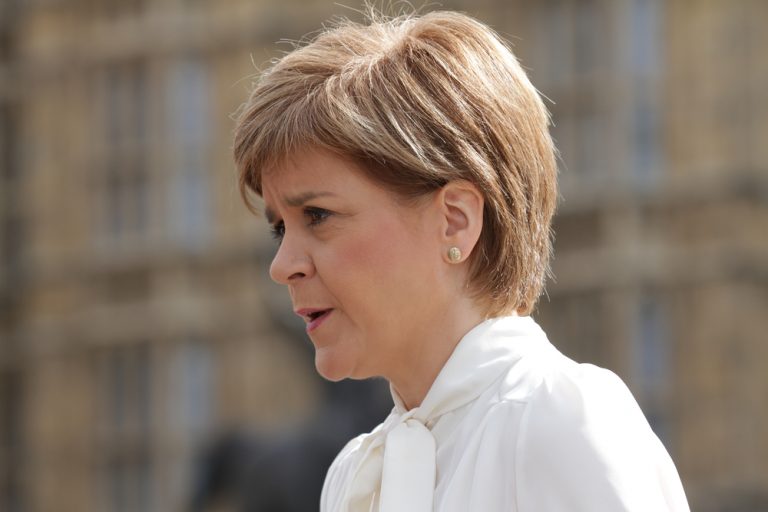
Launching her party’s campaign today in Edinburgh, Nicola Sturgeon said that while the SNP have ruled out the idea of entering into any formal coalition, they would entertain the possibility of a ‘progressive alliance’ with Labour, in the event of a minority government or hung Parliament.
“If there’s a hung parliament … SNP MPs will seek to form a progressive alliance to lock the Tories out of government,” Sturgeon said.
Any alliance however, would be contingent on a long list of conditions to do with anti-austerity economics, environmental issues, and the most difficult one to ameliorate: a second independence referendum.
“The SNP is not going to be giving support to parties that do not recognise the central principle of the right of the people of Scotland to choose their own future,” she said.
She said that in the two decades since the devolution of powers to a Scottish government. However, she claimed that “many of the gains of the last 20 years and the promise of a better future” were being threatened by what she sees as “hardline Brexit ultras” within the Conservative Party.
SNP creating a stir
“Scotland’s vote to remain in the EU has been ignored.” she said. Sturgeon thinks that the Conservative government had, to date, ignored the wishes and needs of the Scottish electorate, and expects this trend to continue going forwards. “The Conservative Party has ridden roughshod over the Scottish Parliament. For the first time ever the UK government has chosen to legislate on devolved matters without the consent of Holyrood. “With so-called ‘moderate’ Conservatives in full retreat and the hard-line Brexit ultras on the march, that is surely only a taste of what is to come.” She continued by lambasting a slide towards the ‘hardline’ extreme of Conservative politics, and said a vote for the SNP would be a vote to “escape Brexit” and to “take Scotland’s future out of the hands of Boris Johnson and a broken Westminster system”. Because of the SNP’s “cast-iron” mandate for another referendum, Sturgeon said Westminster has “no right to block the democratic wishes of the people of Scotland”. Aside from, of course, the authority to call and deny referenda as part of the system of devolved power. Further, Sturgeon added that the SNP would launch a bill at Westminster aimed at protecting the UK-wide NHS from privatisation and post-Brexit trade deals. During trade deal talks, the NHS Protection Bill would block any UK government scheme to use the NHS as a “bargaining chip” or fodder during trade talks.Responses to today’s launch
Reciting his well-rehearsed party politics line, Michael Gove offered the following insight, “That would mean there would be two referendums next year – one on Europe, and one on Scotland’s independence. It’s the last thing this country needs.” “We need to get Brexit done and get on with the people’s priorities, but the SNP and Labour instead want more misery as two referendums consume all the air in our political system.” We can only assume Mr Gove sees referenda as a greater cause of ‘misery’ than unaffordable healthcare, but we can be thankful he has a great idea of what this country needs. Weighing in with his own party’s position and responding to the possibility of a second referendum, Kier Starmer said Labour wouldn’t be doing deals with any party. “The Labour party is in this election for real change and we’re in it to win it, and therefore we’re not in the business of talking about deals with other parties.” So, the expected show of strength for now. We’ll see if they revise their position further down the line. What we can say is that the pound isn’t enjoying the uncertainty rekindled by the general election and the uninspiring offerings of both major parties. UK indices’ woes were compounded this week by disappointing updates from Lloyds Banking Group (LON: LLOY) and Deutsche Bank (ETR: DBK) and Donald Trump antagonising trade talk progress.Thomson Reuters makes Board of Directors appointment
Canadian multinational media and financial data conglomerate Thomson Reuters Corp (TSE: TRI) announced that it had appointed Kim M. Rivera to the Company’s Board of Directors.
Elsewhere, Phoenix Group Holdings (LON: PHNX) appointed a new Chief Executive, GVC Holdings Plc (LON: GVC) appointed a new non-executive chair and Angling Direct PLC (LON: ANG) and WPP (LON:WPP) both appointed new CFOs.
Company Chairman David Thomson commented on the appointment,
“Kim’s successful background managing a global legal function, coupled with her broad experience in corporate strategy, operations and governance, will enable the Board to focus ever more intently upon our customers’ needs and the future,”
The Company’s statement continued,
“Ms. Rivera, 51, currently serves as HP Inc.’s (NYSE: HPQ) President, Strategy and Business Management, and Chief Legal Officer. In this role, she leads corporate strategy and development, customer support, indirect procurement, real estate and workplace functions. In addition, Ms. Rivera manages HP Inc.’s worldwide legal organization, including all aspects of legal and government affairs, brand security, compliance and ethics.”
Prior to working for HP Inc, Ms Rivera held roles as; Chief Legal Officer and Corporate Secretary for DaVita HealthCare Partners, Chief Compliance Officer and Head of International Legal Services at The Clorox Company, Chief Litigation Counsel for Rockwell Automation and General Counsel for its Automation Controls and Information Group.
Entering Thomson Reuters, Ms. Rivera joins the Company’s Audit Committee.
Markets stayed in the red as Trump pokes the patient dragon

The hubris of Donald Trump knows no bounds. Today the POTUS seemed intent on antagonising Chinese leader Xi Jinping, with his next instalment of unnecessary waffle surrounding the hows and whens of a potential first phase of trade war resolution. Similarly, in the UK, the equally uninspiring candidates on both sides have offered little recourse for dwindling investor enthusiasm, as general election day nears the month-away mark. The overall response of markets has been one of gradual slump. Nothing earth-shattering, but a climb-down from the progress made at the end of October by the pound, and a slowdown on the Dow’s bounce on Monday.
Speaking on the uninspiring events of the day, Spreadex Financial Analyst Connor Campbell stated,
“Friday’s mixed trade deal signals continued, unsurprisingly, once Trump got involved.”
“The President said he has not agreed to roll back tariffs, as China claimed on Thursday, going on to claim that Beijing wants the deal ‘much more’ than he does. He also stated that the agreement would be signed in the USA, a detail that no doubt won’t go down well with Xi Jinping and co.”
“Though this didn’t spark mass panic, it did ensure that the markets remained in the red as the session went on. At the end of a week that has seen it repeatedly strike fresh all-time highs, the Dow Jones trickled 0.2% lower, returning to 27600 in doing so.”
“The DAX shed 50 points, taking it under 13230, while the CAC missed out on 5900 as it lost a handful of points. Weighed down by its commodity and banking stocks, the FTSE was the worst hit, falling as much as half a percent as it abandoned 7400.”
Low moments from the week included disappointing Lloyds Banking Group (LON: LLOY) results and Deutsche Bank (ETR: DBK) reporting losses during the third quarter.“Each day takes us closer to December 12th’s general election, a fact not lost on the pound. The week has seen it gradually unwind the gains seen at the end of October, this chipping away leaving cable at a 3-week-plus low of $1.2807. Against the euro, meanwhile, sterling fared far better, spending much of early November the right side of €1.1162.”
Charles Taylor shares rally on takeover offer

Charles Taylor PLC (LON: CTR) shares have rallied after a takeover offer was agreed with Lovell Minnick, the proposed fee was higher than the bid originally received in September.
Directors of the insurance support services provider gave the green light on a 315p per share offer from US private equity firm Lovell two months ago.
However, Charles Taylor has revealed today that the offer has been increased to 345p per share after the initial bid brought rival suitors into the fray.
The global insurance industry has seen a tough trading period, where the big names have seen shrinking profits and attempts to reduce costs.
Aviva (LON: AV), one of Charles Taylor’s heavyweight competitors announced in June that they had plans to cut 1,800 jobs.
Additionally, Lloyd’s (LON: LLOY) reported a drop in their third quarter profits at the end of October,
The board said it had received “a number of unsolicited approaches” from other interested parties but these had been terminated following the initial announcement with Lovell.
However, the higher bid submitted by Lovell seemed to appease stakeholders at Charles Taylor, which allowed negotiations to gain momentum.
The acquisition is one that will benefit both parties, giving access to a wider client base and the opportunity to seize a market which is in apparent decline.
After the previous announcement, Charles Taylor chief executive David Marock said the company owed its achievements to the staff, innovation and client service.
“I am confident that this acquisition by Lovell Minnick, a highly regarded investor with experience in our markets, will provide Charles Taylor with the opportunity to continue to deliver on its existing growth strategy,” he said.
As the deal gains momentum, regulatory approval will still be required. The offer remains conditional on shareholder approval at an upcoming general meeting, and gaining approval from the UK Financial Conduct Authority, Prudential Regulation Authority and insurance market Lloyd’s of London.
Subject to approval from Isle of Man and Bermuda authorities, the deal is expected to be completed in the early months of financial 20.
Standard Chartered cut CFO and CEO pension allowance
Standard Chartered PLC (LON: STAN) have announced that the pension allowance for their Chief Financial Officer and Chief Executive Officer will be cut following discussions with shareholders.
Bill Winters and Andy Halford who are CEO and CFO respectively, will see their pension allowance cut after shareholders informed the board of their concerns in the Annual General Meeting in May.
The leadership of Winters and Halford has produced success, as Standard Chartered reported strong third quarter gains at the end of October.
This was a particularly impressive achievement considering the state of the global banking industry
Where competitors such as Lloyds (LON: LLOY) and HSBC (LON: HSBA) saw their third quarter profits sink, Standard Chartered and Bank of Ireland (LON: BIRG) made steady headways.
At the AGM, 37% of shareholders voted against the resolution to approve the Asia-focused bank’s remuneration report, while all other resolutions were passed with 90% or higher votes in favour.
After discussions with concerned shareholders, the Committee has made several changes to the remuneration of certain executive directors.
This includes changing the contractual terms for Winters and Halford, reducing their pension allowance from 20% of salary from 10% of salary with effect from the start of 2020.
Winters’s pension allowance will be reduced by 50% to £237,000 from £474,000, while Chief Halford’s pension allowance will also be cut by 50% to £147,000 from £294,000.
“I would like to thank Bill and Andy for their willingness to agree to these changes and to thank our shareholders and their representatives for engaging constructively with the Remuneration Committee, and for the strong support that they share with the board for our executive directors. The changes we are making will align the current executive directors’ pension allowances with other UK employees with effect from January 1, 2020,” said Christine Hodgson, chair of StanChart’s Remuneration Committee.
Shares in FTSE100 (INDEXFTSE: UKX) dipped 0.38% to 730p as a result of this announcement. 8/11/19 13:24BST.
Phoenix Group announce new senior appointment

Phoenix Group Holdings (LON: PHNX) have announced that the will be appointing a new Chief Executive in a statement released on Friday morning.
The big time insurance firm said that current Group Chief Executive Clive Bannister would be replaced by former Aviva (LON: AV) boss Andy Briggs next year.
Mr Bannister announced today that he will retire on March 10, 2020 after nine years with the business.
The FTSE100 (INDEXFTSE: UKX) listed insurance company expressed their gratitude to Bannister, who held a successful tenure in his role.
During his time at Phoenix, Mr Bannister oversaw a series of acquisitions, including the £2.9bn purchase of Standard Life Assurance (LON: SLA) in 2018.
This move gave Phoenix the market status that they needed, after becoming a FTSE100 listed company.
He also achieved a total shareholder return of 179% at the company, and grew assets under management by 263% to £245 billion, according to Phoenix.
This was a particularly impressive accomplishment considering the current state of the finance market.
Big players such as Lloyd’s (LON: LLOY) have seen their profits sink in the most recent quarter, and other names such as AIG (NYSE: AIG) have struggled to gain ground after testing trading conditions.
Additionally, the firm also increased the number of policy holder to 10 million whilst he was in his role, seeing an increase of 67%.
Mr Briggs will join the company as chief executive officer on January 1 to ensure a smooth handover, subject to regulatory approval.
Briggs, has a wealth of experience in the industry having worked at Friends Life and be a managing director of pension provider Scottish Widows.
Nick Lyons, Phoenix Group chairman, said: “Clive has worked with great passion and energy during his nine years as CEO. He has led Phoenix in a period of sustained growth and success to its current position as the largest life and pensions consolidator in Europe and he leaves us, as a business, confident and assured.
“Phoenix, its customers, colleagues and investors will benefit from the smoothest of successions between two great industry leaders and, with Andy as our future CEO, we will be in the best position to leverage the broad strategic platform that Clive has delivered.”
Shares of Phoenix Group are trading at 431. 8/11/19 13:09BST.
REC: “modest” rise in demand for staff, uncertainty prevails

October saw a “modest” rise in the demand for staff across the UK, new data revealed on Friday.
The UK Report on Jobs data, by KPMG and the Recruitment and Employment Confederation (REC), shows that the rate of vacancy growth was the slowest to occur since January 2012.
Demand for both permanent and short-term workers were weak.
The data revealed that an uncertain outlook also weighed on candidate availability during the month of October. Indeed, total candidate numbers dropped at the sharpest rate in four months.
“These figures underline why this needs to be a jobs election,” Neil Carberry, Recruitment and Employment Confederation Chief Executive, commented on the data.
“The labour market is strong, but permanent placements have now dropped for eight months in a row, and vacancies growth has fallen to its lowest level since January 2012. One bright spark is the temporary labour market, which continues to provide flexible work to people and businesses that need it during troubled times,” Neil Carberry continued.
Neil Carberry said: “Ending political uncertainty and getting companies hiring again is vital – but we must also look to the long term future of work. Jobs must be front and centre during this election campaign, and we will be launching our REC manifesto for work next week. We will be urging all political parties to run on policies which support and enhance the UK’s flexible labour market – allowing businesses to create jobs, employees to build careers and the economy to grow.”
The UK was supposed to depart from the European Union at the end of October, but it was granted yet another extension to the deadline.
Parties are now preparing for the general election at the end of this year.
“Businesses are still waiting to hear that starting gun, and until there is some certainty around Brexit and now the election, employers continue to stall on creating vacancies and making permanent hires,” James Stewart, Vice Chair at KPMG, also commented on the data.
James Stewart said: “The IT and computing sector threw caution to the wind last month as the best performer in vacancy growth. Meanwhile, the medical sector is not far behind, and we also saw a sharp increase in the demand for temp staff in this sector.”
News emerged only yesterday that the Bank of England expects a weaker economy over the next three years following the nation’s departure from the European Union.
With Brexit uncertainty prevailing, what will the future hold for employers and their staff?
IAG cut medium term profit and capacity expectations
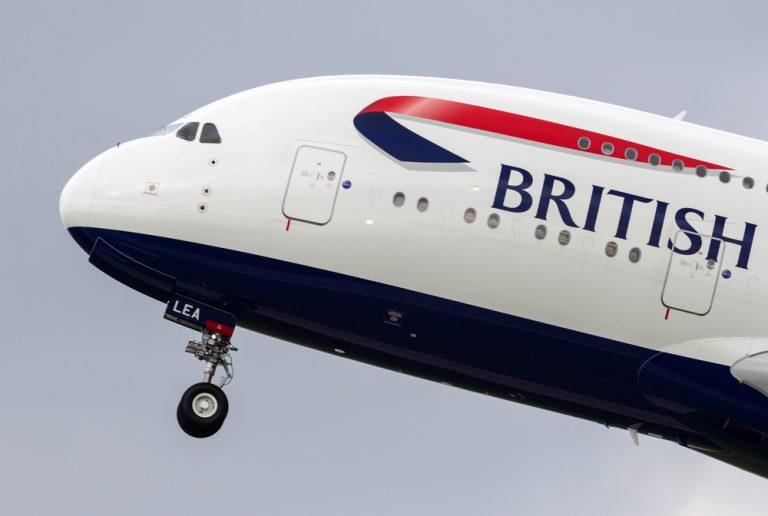
International Consolidated Airlns Grp (LON: IAG) owners of British Airways, have cut their expectations for medium term profits and capacity in a statement released on Friday morning.
Shares of IAG dipped 0.26% as a result of this update, to trade at 543p. 8/11/19 11:06BST.
The heavyweight airline company scaled back profit and capacity forecasts for the next three years, hitting its outlook for earnings per share but potentially providing relief for rivals in a weak global economy.
On Monday, it was reported that IAG were set to purchase rivals Europa Air which alerted competitors such as Ryanair (LON: RYA) and easyJet (LON: EZJ) to report this deal to market watchdog’s for investigation.
Even after this acquisition, IAG are not as optimistic about future outlook in the medium term.
IAG said available seat kilometres, a measure of passenger-carrying capacity, was estimated to grow by 3.4% a year between 2020 and 2022, compared to a previous forecast of 6% growth a year for the 2019-2023 period.
The airline group, which also owns Iberia, Aer Lingus and Vueling, said the capacity growth cut would lower its forecast for growth in earnings per share to 10%+ a year from a previous forecast of 12%+ a year.
Chief Executive Willie Walsh said last week that he expected global macroeconomic toils to continue in 2020.
The company has also taken a hit from industrial action at British Airways, which has knocked its outlook for profits this year.
The airline industry has become increasingly saturated over the years, and has led to fierce competition in ticket prices and on flight facilities.
Additionally, Ryanair have also slashed their medium term forecasts as it is set to grow at its slowest rate in seven years in the year to March 31, 2021.
Ryanair expect further delays to its Boeing (NYSE: BA) 737 MAX deliveries and may be without the jets next summer.
The delays in delivery will come as a worry to IAG, who recently ordered 200 new 737 planes to expand their flight routes whilst compensating for health and safety regulation.
Even with the new acquisition of Europa Air, there is still much ground to be made up for IAG as they look to fight off stiff competition in an ever saturated airline market.