Mulberry shares (LON: MUL) opened higher after the group posted reduced half-year losses in twenty-six weeks ended 26 September 2020.
In the latest trading update, the luxury retailer said that sales were hit by the most recent lockdown and fell by 19% in the eight weeks to October.
As store closures and reduced demand amid the pandemic hit the retailer, revenue was down by 29% to £48m. Digital sales increased by 68% from £13.9m to £23.4m.
Mulberry chief executive, Thierry Andretta, said:
“I am proud that in spite of the devastating effects of the global pandemic, we have made further progress on our long-term strategy to build Mulberry as a sustainable global luxury brand. This is focused around: a truly omni-channel network and market leading digital platform, increased presence in Asia, and a relentless focus on innovation and sustainability, offering our customers beautiful products, made to last in our Somerset factories.
“This strategy enabled us to withstand some of the pressures that we, and indeed the wider retail and hospitality sectors, have been faced with. In particular, using our market leading global digital network to replace retail sales with digital wherever possible, achieving high growth in China and Korea, and reacting quickly to flex our agile supply chain, enhancing market reactivity and reducing lead time, to match the increase in digital demand.
“In spite of all of these self-help measures, we cannot avoid the fact that the damage the coronavirus has caused to business, decimating high streets and the tourism industry, is severe. For this reason, in order to ensure that the business was able to navigate through this difficult time, we took the painful decision to implement a far-reaching cost reduction and optimisation programme.
“As we look to the future, we remain confident in our strategy and in the relevance and durability of the Mulberry brand. There are of course many obstacles ahead, not least the upcoming changes to tax-free shopping in the UK that could hamper the wider retail and economic recovery, but we are grateful to be able to open our doors again in England on 2 December and to be able to trade across all our platforms in this crucial Christmas trading period. I would like to take this opportunity to thank my colleagues for their resilience, their hard work and their dedication to Mulberry.”
Mitchells & Butlers (LON: MAB) said today that it has cut 1,300 jobs this year after the group reported a £123m pre-tax loss for the year to 26 September.
The pub and bar operator, which owns chains including Toby Carvery, All Bar One, and Harvester. The group said that store closures and lower levels of sales amid the pandemic led the group to swing from a £177m profit in the same period a year ago.
Earlier this year, Mitchells & Butlers said that it would close 20 of its 1,700 sites across the UK.
“Throughout a very uncertain and challenging year our businesses and teams have adapted quickly, creating a safe environment for guests and putting us in a strong position to benefit when consumers are able to eat out again. We saw direct evidence of this from a strong trading period in July and August before further restrictions came into force,” said chief executive Phil Urban.
“With our great estate, balanced portfolio of brands and proven management team, we remain optimistic that we will be able to regain the momentum previously built and continue to achieve sustained market outperformance, when the current operating restrictions are eased.”
This year has seen the rise of hydrogen fuel cell backers such as Nikola Corp and Plug Power, and recent entries from forward-thinking blue chips like Hyundai. In fact, the latter is committed enough that in October, it announced that it would use around 70,000 ounces of platinum per year in its fuel cell stacks by 2030 – with this demand alone being equal to the total annual production of one of South Africa’s biggest platinum mines.
This commitment, though non-binding, may well be a sign of things to come. Though Nikola Corp investors are nervously awaiting confirmation of a $2 billion deal with GM, the idea that hydrogen fuel cells could operate a considerable portion of non-fossil-fuel market share within the next decade is not out of the question.
Indeed, this week marks the first ever European Hydrogen Week, which is designed to showcase the role of hydrogen fuel cells within achieving the EU’s ‘Green Deal’ objectives. Under the deal, there is an initiative which roadmaps new jobs and sustainable growth under a new, hydrogen ecosystem, which includes a pledge to install at least 40GW of hydrogen electrolysers by 2030. With this goal in mind, the EU plans to produce around 10 million tonnes of ‘green’ hydrogen per year.
The greatest limiting factor of hydrogen fuel cells – other than the process of achieving scale – is the initial shock factor of costs. Fortunately, the Platinum World Investment Council just reported that a more efficient and cost-effective platinum-iridium catalyst has just been developed.
The new technology requires 90% less iridium than previous Proton Exchange Membrane electrolysers, while performing ‘up to three times better’. According to the Platinum World Investment Council, the new technology: “not only reduces costs, making green hydrogen production at the scale envisaged by the EU’s Hydrogen Strategy more affordable, but also removes concerns about the availability of iridium, of which only a small amount is produced annually, ensuring PEM electrolysers remain at the forefront of electrolyser technology as the market expands.”
With the new catalyst technology, and its reduced iridium requirements, PEM electrolysers stand a better chance of widescale adoption – and in turn, this would bring increased demand for platinum. In fact, FTSE 100-listed chemical specialists, Johnson Matthey, believe that PEM electrolysis could achieve 30-60% market share.
The Platinum World Investment Council concluded by saying that: “Platinum’s role in the hydrogen economy is crucial both throughout the EU and beyond; it is used in fuel cells for fuel cell electric vehicles, as well as in the production of green hydrogen. The global platinum demand impact of announced green hydrogen policies is clearly sizeable over the longer-term; current EU and China green hydrogen generation capacity targets alone would require, cumulatively, between 300 koz and 600 koz of platinum by 2030.”
Following the commencement of the EU’s Hydrogen Week, platinum prices rose by 0.94% on Wednesday, up to over £725 per ounce.
On Wednesday, Chancellor Rishi Sunak set out his spending review detailing how much will be spent on public services, lamenting the “economic emergency” that the UK government faces as the coronavirus pandemic rages on. He explained the measures the government is putting in place to “protect people’s jobs and incomes”, with a £280 billion pledge to see the UK through this year alone.
What are the main points to take away from the spending review?
Kevin Courtney, Joint General Secretary of the National Education Union, stated that public sector employees were owed a pay rise by the government for their service during the coronavirus crisis:
“This is a predictable attempt at divide and rule in the middle of a pandemic. Police officers, prison officers, school support staff, teachers, head teachers, DWP workers, hospital ancillary staff, have all put their lives on the line this year and they all deserve a pay rise. So should the delivery drivers for big supermarkets. We are supposed to be all in this together as working people”.
Mr Sunak did, however, guarantee that 2.1 million public sector workers earning below the median wage of £24,000 will receive a £250 pay rise – although this is well former Labour leader Jeremy Corbyn’s proposition of a 10% pay rise for public servants, to “begin to make up the ground they’ve lost over the last ten years”.
More than 1 million NHS staff will reportedly be eligible for a raise.
In addition, the minimum wage – now rebranded as the National Living Wage – will see a 2.2% (19p) increase to £8.91 per hour for those aged 23 and over.
While Mr Sunak did not comment on the much-anticipated tax hike to accommodate extra government spending, the threat has by no means disappeared. Research by the Interactive Investor shows that most think it is still firmly on the cards.
What do investors make of a potential tax rise?
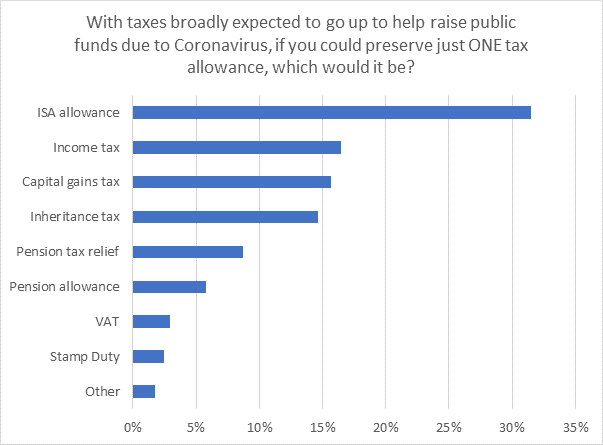
A snap poll orchestrated by the Interactive Investor – the UK’s leading flat-fee investment platform – ahead of the spending review’s release found that just under a third (31%) said that if they could preserve just one tax allowance, it would be the ISA allowance. Income and capital gains taxes settled in joint second place (16%), and inheritance tax (15%) in third.
Only 9% of investors said that they would prioritise pension tax relief from efforts to help raise public funds, 6% the pension tax allowance, 3% VAT, 2% Stamp Duty, while another 2% of respondents cited other forms of taxation.
When asked who should pay for any new wealth taxes to raise public funds, just over two-fifths (22%) said “those with assets worth £1 million or more”, while 20% believe the starting threshold should be £2 million, and 9% said “over £500,000”. Only 5% said that the new tax should apply to “those with assets worth £150,000”, and fewer (4%) prefer the £250,000 threshold.
However, the largest percentage of respondents (34%) said that they were opposed to “any form” of wealth tax. The remainder (5%) said that they didn’t know.
Research and chart courtesy of Interactive Investor, 25 November 2020.
Research and chart courtesy of Interactive Investor, 25 November 2020.
Becky O’Connor, Head of Pensions and Savings at Interactive Investor, commented on the findings:
“With so many question marks around where the money will come from for this gigantic multi-billion pandemic bailout, investors will be waiting with bated breath for next year’s Spring Budget to see where the axe will fall.
“This could be a good time to make sure investments are as tax-efficient as possible, using ISAs and SIPPs and maximising any allowances if that’s possible – and with unemployment set to soar further, it’s time to start shoring up your finances if you haven’t yet started. If you can’t save more, it’s worth looking at areas where you can save money, by shopping around for better deals in all aspects of your life”.
Myron Jobson, Personal Finance Campaigner for Interactive Investor, added that the government’s ambitious measures will inevitably trickle down into the public pocket:
“Savers and investors will be breathing a sigh of relief as the much-mooted ‘wealth tax’ failed to materialise in the Spending Review. However, it is surely a question of when, not if a tax hike will be announced as part of efforts to address the Government’s WW2-sized public borrowing bill for its Covid-19 economic support packages.
“The extent of the economic uncertainty means that the Chancellor focused on the direction of public spending for the next 12 months. A cocktail of spending cuts and tax rises to get the UK economy back on an even keel from the damage done by the coronavirus crisis remains on the cards. The announced public sector pay freezes is a tell-tale sign of the difficult measures to come”.
House prices will likely fall early next year when the stamp duty holiday ends and the furlough scheme winds down.
The Office for Budget Responsibility has said the current boom since the first lockdown will come to a close as the UK will see a spike in unemployment.
“House prices fell briefly as the pandemic struck, but recent indicators suggest they have subsequently recovered quite strongly,” said the Office for Budget Responsibility.
“This follows the easing of public health restrictions and the stamp duty holiday for residential property transactions that took effect on 8 July 2020. House prices are expected to fall back in 2021, driven by end of the stamp duty holiday and the hit to household incomes from the labour market adjustment that we assume will follow the end of the Coronavirus Job Retention Scheme.
“Despite a steady recovery from 2022 onwards, the level of house prices remains around 17 per cent lower at the forecast horizon compared to our March forecast,” it added.
However, the housing boom is expected to continue into the first three months of 2021 before the stamp duty holiday and furlough scheme ends.
The property website Zoopla has estimated a further 100,000 houses to be sold in the first three months of next year. The number of new sales is currently 38% higher than it was a year ago.
Richard Donnell, director of research and insight at Zoopla, explained: “It has been a rollercoaster year for the housing market which is ending on a strong note with demand and sales agreed still more than 30% higher than this time last year.”
Calnex Solutions shares (LON: CLX) surged over 20% on Wednesday after the group revealed results for the six months ended 30 September 2020.
The group reported strong demand over the period and saw revenue grow 37% whilst pre-tax profit increased by almost 69%.
Due to the reduced travel and events costs amid the pandemic, Calnex Solutions was able to see increased profitability and cash generation from from the higher revenue.
Due to the “favourable” telecoms market conditions, the group is expecting continued growth into the second half of the year. Calnex Solutions said in a trading update that it will be ahead of current market expectations and revenue and adjusted profit will be broadly in line with the H1 update.
Tommy Cook, the chief executive and founder of Calnex, said: “We are delighted to report on another strong period of trading, delivered in the lead up to our IPO on AIM, in which we experienced continued strong demand across all our product offerings. Our successful IPO, completed in early October, has provided us with the springboard to execute on our growth strategy.
“The strength of our relationships within the telecoms sector, breadth of customer base and established market position, provide us with a strong platform for future growth. We will continue to invest in business development and R&D to capitalise on the opportunities arising from the evolution of the telecoms market and look to the future with confidence. “
FTSE 100 listed water management company, United Utilities (LON:UU), published its half-year results on Wednesday, illustrating a challenging period of pandemic trading.
While reported profit after tax rose from £158.6 million to £162 million, the company’s reported operating profit fell 16.84% to £318.5 million, while its underlying profit after tax dropped 16.02%, from £207.2 million to £174.0 million.
These profit figures were led by a 4.59% decrease in the company’s revenues, down from £935.5 million, to £894.4 million, and an increase in its net regulatory capital spend, up from £255 million to £276.4 million.
It wasn’t all doom and gloom, though. United Utilities enjoyed a 1.47% dividend increase, up to 14.41p. Similarly, the company helped 142,000 customers through support schemes during the period, and reduced users’ average household bills by 7% for the 2020/21 year.
Speaking on the results, United Utilities CEO, Steve Mogford, commented: “Despite the pandemic, our operational performance in this first year of the new regulatory period is on track. We are accelerating our capital expenditure to bring forward benefits and help support 17,700 jobs in the supply chain. We recognise the role that we can play in a successful society, economy and a thriving natural environment and are confident in our ability to deliver our AMP7 plans to achieve this.”
“We now have a clearer understanding of the impact of COVID-19 on our business which remains robust and supported by a strong balance sheet. This, together with a stabilised inflation outlook supported by central bank policy and government actions, gives us the confidence to reaffirm our responsible AMP7 dividend policy of growth in line with CPIH inflation.”
Following the announcement, United Utilities shares rallied by 3.33%, to 926.00p a share. This price is short of its post-pandemic high of 978p seen in June, and analysts’ consensus target price of 1,005p a share. Analysts have a consensus ‘Buy’ rating on the stock; it has a p/e ratio of 57.45; and the Marketbeat community has a 54.34% “underperform” stance on the company.
Research by Astons – a leading international real estate expert on residency and citizenship through investment, offering bespoke residence and citizenship solutions in the UK, EU and Caribbean through property investment – has found evidence of a growing trend amongst foreign investors bulk-buying properties across the UK in order to capitalise on the current stamp duty holiday before foreign surcharges are introduced in April next year.
At the moment, foreign buyers benefit from the same stamp duty holiday reductions as domestic UK buyers, which has seen a surge in activity across the housing market in recent months. However, with the 2% surcharge for foreign buyers sitting ominously on the horizon in the spring, those that complete their transactions now can essentially escape the additional charge.
And, with a weak pound and strong signs of an imminent market recovery, many foreign buyers are looking to bulk-buy UK real estate while profit potential is at its highest. By purchasing six or more residential units in one transaction, foreign buyers are able to secure non-residential stamp duty rates starting at just 2% between £150,001 and £250,000, and 5% above the £250,000 threshold.
One such transaction which Astons recently oversaw was a six-unit purchase in London acting as staff accommodation from a Hong Kong-based buyer which sold for £6.988m. Due to “regional instabilities” and the option to apply for British citizenship from January, the buyer opted to invest in the London market “due to the liquidity and growth the capital presents”.
With the traditional residential path to purchase, the buyer would have paid £946,991 in stamp duty according to current regulations, making a considerable saving of £338,914 compared to purchasing post-April 2021 when the foreign buyer surcharge is due to be implemented.
However, as the buyer purchased these same six units as a non-residential investment, the stamp duty tax bill actually totalled at just £338,914 – a whopping £608,077 less than the current residential rate, and £762,842 lower than the residential rate with the incoming additional 2%.
Managing Director at Astons, Arthur Sarkisian, commented on the emerging trend:
“A whole host of global influences are spurring foreign interest in the UK property market at present. While the residential stamp duty holiday has helped boost this interest, we’re now seeing many invest above and beyond a family home to lay far stronger foundations for their personal and professional future in the UK.
“By ‘bulk buying’ in the residential market, they are able to secure a far lower rate of stamp duty and with the weaker pound, investing now is making very good business sense. While the residential rush from foreign buyers will no doubt dissipate come April, we expect this higher level of investment will continue as many lay future foundations in anticipation for life after Covid”.
US blue chip equities index, the Dow Jones, set a fresh all-time record, as it bounced over 440 points and hit 30,034 points.
Beating its previous record of 29,989 points booked at the end of 2019, the US index was buoyed by rallies posted by COVID-suffering equities in finance, commodities, air travel and film.
Chevron took the top spot, up 4.75%, followed closely by JP Morgan Chase and American Express up 3.74% and 3.69% apiece. Similarly, Boeing rose by 3.72%, while Disney boasted a 3.51% hike.
Unsurprisingly, tech stocks also contributed to the Dow Jones 1.5% jump. Intel rallied by 2.15%, Microsoft increased by 1.85%, and Apple enjoyed a 1.38% bounce. These big tech rises also contributed to healthy growth in the tech-laden Nasdaq, up 1.38% on Tuesday.
Speaking on US equities success and the knock-on effect on European stocks, Spreadex Financial Analyst, Connor Campbell, said on the day’s political developments: “It took the US open for the markets to really display their delight at the start of the formal transition process to the Joe Biden administration this Tuesday.”
“Relief that the Democrats can hopefully hit the ground running when it comes to tackling covid-19 in January, as well as the positive impact the pro-spending former Fed chair Janet Yellen is expected to make as Treasury Secretary, drove the Dow Jones to record highs.”
“With American investors driving stocks higher, the European markets didn’t want to be left out, doubling the gains seen earlier in the session.”
Looking ahead, the outlook for the coming weeks looks bright, according to IG Chief Market Analyst, Chris Beauchamp: “Signs of movement in the US political deadlock have combined with the steady drip of vaccine news to underpin a market that has yet to breach the highs seen earlier in the month.”
“But the trickle of good news stories has helped to hold markets near to those highs, leaving them well-placed to push higher into December.”
Record Plc shares (LON: REC) were down over 2% on Tuesday after the group shared results for the six months ended 30 September 2020.
The company posted a 4% growth in revenue to £11.8m – up from £11.4m in the same period a year earlier.
In addition, the group posted growth in clients and a strong financial position with shareholders’ equity of £25.7m.
Pre-tax profits at Record Plc fell from £3.2m to £2.6m and the group has revealed an interim dividend of 1.15 pence.
Commenting on the results chief executive, Leslie Hill, said:
“We have made tangible progress in our first half against our strategic growth initiatives; pleasing in light of the challenging backdrop presented by the global pandemic. Our business continues to show its resilience both in operational and financial terms and we have grown our customer base, including the acquisition of a new $8 billion US-based Dynamic Hedging mandate.
“Diversification through product innovation is central to our growth plan, and we’re excited about our collaboration with a European wealth manager to build and manage a Currency Impact Fund which we expect to be seeded with several hundred million in the first calendar quarter of 2021. We view this highly innovative offering as a market-first, enabling us to tap into this fast-expanding market and take the lead in our sector.
“Our reinvigorated growth strategy necessitates investment in sales capabilities, technology and infrastructure; we are investing both to add more functionality as well as to bring efficiencies.
“The extreme volatility we witnessed earlier in the year has served to underline to all market participants the benefits of a specialist risk management offering. Our new business pipeline reflects the growth opportunity and I feel confident the business will build on the positive momentum and growth investment as we progress into 2021.”
Record Plc shares (LON: REC) are trading -2.42% at 39,96 (1655MGT).