
Moss Bros shares edge up on positive trading update
Shares in Moss Bros rose on Friday morning after the group reported a better-than-expected Christmas trading update.
Sales were up by 0.6% in the period between 29 July to 5 January, however, were down by 1% on a like-for-like basis.
“Despite the improving trend in performance, we anticipate the period ahead will continue to be extremely challenging, as a result of the uncertain consumer environment, wider political backdrop and the significant cost headwinds that we continue to face from a weaker pound and further increases in business rates and employee-related costs,” said Brian Brick, the retailer’s chief executive.
“We remain debt free, with a strong balance sheet and are confident in our ability to deliver enhanced returns to our shareholders over the longer term,” he added.
The group has predicted a loss of £0.6 million, which meets the forecast.
“Moss engaged in higher levels of promotional activity than normal, impacting gross margins, although the hit was less than we had feared, meaning the outcome for the year will be better than our recent pre-emptive downgrade,” said Peel Hunt.
“We’re not going to crow about the downgrade being less than feared, but we are encouraged that Moss has been able to drive a significant acceleration in online sales and demonstrate the relevance of the offer and the Brand and see the shares responding favourably to today’s update.”
On Friday morning, shares in Moss Bros (LON: MOSB) increased by 3.2% to 27.06p. Shares are currently trading +2.67% (1035GMT).
Flybe shares crash 80% on rescue deal
Flybe shares have plummeted after the struggling airline was offered a deal just 1p-per share.
The deal made by Virgin Atlantic, Stobart Aviation and US private equity firm Cyrus Capital Partners values Flybe at £2.2 million.
The airline issued a profit warning in October, which wiped £20 million off its market capitalisation, causing shares to plummet from 48p in March to Thursday’s closing price of 16.38p.
Christine Ourmières-Widener, Flybe’s chief executive, said: “The industry is suffering from higher fuel costs, currency fluctuations and significant uncertainties presented by Brexit.”
“We have been affected by all of these factors which have put pressure on short-term financial performance. At the same time, Flybe suffered from a number of legacy issues that are being addressed but are still adversely affecting cashflows.”
“By combining to form a larger, stronger, group, we will be better placed to withstand these pressures,” she added. “We aim to provide an even better service to our customers and secure the future for our people,” she added.
Virgin Atlantic chief executive Shai Weiss, said: “Together, we can provide excellent connectivity to our extensive long haul network and that of our joint venture partner, Delta Air Lines, at London Heathrow Airport and Manchester Airport for the benefit of our customers.”
“In the near future, this will only increase, through our expanded joint venture partnership with Air France-KLM.”
The crash in Flybe shares comes following the collapse of Monarch Airlines and Primera Air.
If the takeover vote is supported by 75% of shareholders, the deal is expected to close during the second quarter of 2019.
Shares in the airline (LON: FLYB) are currently trading down 83.72% at 2,67p (1003GMT).
Supermarket Christmas sales: winners and losers
It’s been almost two weeks since we entered 2019 and the leading UK supermarkets have begun to announce their Christmas trading figures. With mixed results, what seems clear is that the British consumer has tightened their pockets this Christmas. As special sales offers drove sales for some supermarkets, and the discounters Aldi and Lidl seeing the biggest Christmas market share, the consumer is opting for the cheaper alternatives.
The leading UK supermarkets
Tesco plc (LON:TSCO) saw an increase in its sales over Christmas as a result of various Christmas sales offers. Like-for-like sales increased 2.6% across UK supermarkets. Offers on vegetables, lamb and beef joints and wine drove sales for the supermarket over the Christmas period. In contrast to Tesco, Marks & Spencer (LON:MKS) revealed a decrease in its sales over the festive period. Like-for-like sales fell by 2.2%, and food sales were down 1.2%. Clothing sales were also down, declining by 4.8%. The company’s chief executive has blamed a “very challenging trading period” as a result of mild weather. Moreover, a reduction in consumer confidence and high competition have also driven this decline. Morrisons (LON:MRW), however, announced that its total Christmas sales (excluding fuel) were up 4%. Like-for-like sales were also positive, increasing by 3.6% (excluding fuel). As for Sainsbury’s (LON:SBRY), sales fell in the run-up to Christmas as a result of the strong competition from other supermarkets. Sainsbury’s has blamed “cautious customers” for its drop in sales. Like-for-like sales slid 1.1% over the period. Grocery sales were slightly more positive, but only saw a 0.4% increase during the third quarter. The biggest winners are Aldi and Lidl. Aldi reported a record breaking week of sales during the week leading up to Christmas day. Sales soared by 10% compared to the same period from the prior year. The discount supermarket offered “Specially Selected” and “Exquisite” lines as part of its Christmas range of products. Additionally, Lidl grew by 9.4% over the Christmas period. Two-thirds of UK households visited the discounters over the Christmas shopping season. The two discounters accumulated the “highest-ever combined Christmas Market share of 12.8%,” according to the head of retail and consumer insight at Kantar. With Aldi and Lidl delivering a strong performance over Christmas, what has become increasingly obvious is the cautious spending of the consumer. Perhaps with the economic fear of Brexit, more consumers feel obliged to tighten their wallets in the event of difficult economic hardship. With their discounted prices and strong product quality, Aldi and Lidl appear to be the alternative to the traditional UK supermarkets.Premier Oil reduces net debt ahead of full year results

Premier Oil released a trading update on Thursday ahead of its 2018 Full Year Results. The UK oil company said that it has reduced its debt to $2.3 billion at the end of 2018. This figure is below its previous $2.4 billion guidance.
The estimated net debt figure of $2.3 billion is a $390 million reduction from 2017.
Full-year production was 7% higher compared to 2017, making it a record year for the company. It produced 80,500 barrels of oil equivalent per day (boepd). November and December production alone averaged 92 kboepd, remaining above forecast.
Premier Oil is an independent UK oil company with gas and oil interests in the UK, Asia, Africa and Mexico, with its headquarters in London.
Chief Executive of Premier Oil, Tony Durrant, commented on the results: “Our strong operational performance and disciplined expenditure have enabled us to reduce our debt levels ahead of forecast. At the same time, we have continued to build our portfolio for the future, sanctioning our high value Tolmount Main gas project and capturing highly prospective new acreage in Mexico and Indonesia. Looking to the year ahead, we have a strong production base which is well hedged and our priority remains to further reduce our debt levels while progressing our future growth projects to final investment decisions.” Premier Oil is expected to spend roughly $290 million on development and exploration. This includes wells in Mexico’s Zama field. Elsewhere in the oil sector, Anglo African Oil and Gas announced that they expect to raise £6 million for expansion of their pre-existing operations and drilling. Like Premier Oil, Anglo African is an independent oil and gas firm, but its operations are based in Congo. Premier oil believes that it is “well placed” to continue to decrease its debt reduction in 2019. Its improved portfolio mix, increased high margin Catcher barrels and its hedging programme places the company in a strong position to continue to deliver this debt reduction. At 10:52 GMT today, shares in Premier Oil plc (LON:PMO) were trading at +3.94%.Halfords shares crash on latest profit warning
Shares in Halfords have crashed after the retailer issued yet another profit warning.
The retailer said that expected profits have fallen from the previous estimate of £70 million down to between £58 million and £62 million this year.
Halfords said on Thursday that sales in the group fell due to weaker consumer confidence and the mild weather.
“This has been a challenging third quarter for the business, driven by exceptionally mild weather and ongoing weak consumer confidence. Together, these factors have led us to reduce our profit expectation,” said Graham Stapleton, the chief executive.
“Halfords is a robust business and we firmly believe that the strategy we outlined in September is the right direction for the business,” he added.
The group’s last profit warning came in May last year when the bike specialist said profits would come in flat. In September, the retailer said that profits would not rise in 2020.
Stapleton joined Halfords in January after the former boss left to join Marks & Spencer.
Shares in Halfords (LON: HFD) are trading down 19.45% (1009GMT).
DFS profit outlook unchanged amid Brexit uncertainty
DFS furniture announced on Thursday that it will keep its full-year profit outlook unchanged. Additionally, the company has also announced that its CFO Nicola Bancroft will retire.
For the five months to 30 December 2018, DFS has had a good underlying sales growth of 10%, despite the “challenging consumer environment“.
Additionally, it saw a like-for-like growth across all of its brands and a strong 22% growth in online sales. Reported gross sales grew 29% measured against the same period from the previous financial year.
DFS will not alter its full-year profit expectations.
The company has said that it is “mindful of the risk of near-term political and economic uncertainty,” alluding to Brexit. As a result of Brexit uncertainty, it will not alter its profit expectations despite its strong sales figures. Addressing the uncertain economic and political climate, the company said: “While we have achieved a good sales performance, helped by latent demand, we remain cautious around our full-year outlook, and as such our profit expectations for the full year remain unchanged. “ “We are mindful of the broader political and economic uncertainty and the further risk this may pose to consumer confidence and lead times for the proportion of our made-to-order products that we source overseas. However, we do expect benefits of previous and ongoing investments in our online activities, our final-mile two-man logistics and the continued integration of Sofology, together with progress being made at Dwell and Sofa Workshop, to help mitigate this challenging market environment.” “It is worth reiterating that the Group has historically capitalised on any adverse trading conditions to build our market position and we continue to believe that our cash generation and long-term growth prospects will drive attractive returns for our shareholders.” Moreover, the company has announced that CFO Nicola Bancroft will retire afte six years with the company. Elsewhere, Tesco shares were up during early trading as a result of its strong Christmas performance. At 09:51 GMT today, shares in DFS Furniture plc (LON:DFS) were trading at +3.66%.Tesco shares up on “strong” Christmas sales
Sales at Tesco grew over the Christmas period, thanks to various Christmas offers.
Tesco reported a 2.6% increase in like-for-like sales in the group’s UK supermarkets.
Dave Lewis, the chief executive, said:
“As a team, we have achieved a lot in the last 19 weeks. In the UK we delivered significant improvements in our competitive offer and this is reflected in a very strong Christmas performance which was ahead of the market.”
“In Central Europe, the reshaping of our business continues and we are confident of the outcome we envisaged. In Asia, negotiations with suppliers are concluding satisfactorily and we can see this in our simpler, clearer, more impactful offer for customers.”
“We have more to do everywhere but remain bang on track to deliver our plans for the year and as we enter our centenary we are in a strong position,” he added, in a statement.
Sales over the Christmas period were boosted thanks to offers on vegetables, lamb and beef joints and wine.
Ed Monk from Fidelity Personal Investing said: “Lamb and beef joints proved a big hit with shoppers, as did Tesco’s ‘Festive 5’ vegetable offer.”
“With the potential merger of rivals Sainsbury’s and Asda threatening to dethrone it as the nation’s biggest grocer, and German discounters snapping at its heels too, that’s good news and further endorsement of the turnaround being enacted by boss Dave Lewis.”
In other news, Marks & Spencer revealed a dip in sales over the Christmas period. Like-for-like sales fell by 2.2%. UK clothing sales declined by 4.8%, food sales were down by 1.2%.
Shares in the group (LON: TSCO) are trading up 2.31% (0924GMT).
M&S reveals dip in sales over Christmas
Shares in Marks & Spencer fell this morning as the retailer revealed a fall in sales over the Christmas period.
In the 13 weeks to 29 December, like-for-like sales fell by 2.2%. UK clothing sales declined by 4.8%, food sales were down by 1.2%.
Marks & Spencer was particularly hit abroad, where closing stores have led to a 15.1% fall in sales.
Steve Rowe, the group’s chief executive, has said that November was “a very challenging trading period” due to mild weather, a reduction in consumer confidence and high competition.
Lee Wild, who is the head of equity strategy at Interactive Investor, said: “Like all the established UK retailers, Marks & Spencer has been warning for years that online competition and discount stores are stealing business, and that’s reflected in these third-quarter results.”
“Cautious consumers, mild weather and an uninspiring offering across clothing and food haven’t helped,” he added.
Richard Lim, who is the chief executive of research analysis firm Retail Economics, blamed the fall in sales at Marks and Spencer of the retailer’s “outdated business model”.
“These results are worse than expected. It’s increasingly evident that Christmas is becoming an online event and these figures reaffirm the polarisation of shopping habits. Put simply, the retailer is burdened with too many stores, unsuitable space and … spiralling operating costs,” he added.
Shares in the firm opened 1.4% lower but have recovered and are currently trading up 1.08% at 280,70 (0903GMT).
Topps Tiles sales slip in Q1
Home wares retailer Topps Tiles plc (LON:TPT) have seen their sales dip for the first quarter of the financial year – despite positive updates during mid-2018 – amid what they have described as a ‘challenging market backdrop’.
The company’s sales are down 1.4% for the 13 week period through December 29th, but the company said it was making ‘good progress’ on the back of recruiting an experienced sales force, and said it was looking to further strengthen its team, especially in its commercial elements.
“Against a challenging market backdrop and a strong period of performance in the prior year we believe the business has performed robustly over the first quarter”, Chief Executive Matthew Williams said.
“We remain excited by both the opportunity for profitable growth that our expansion into commercial segment will bring and the continued opportunity to further strengthen our market leading position overall.”
“We are building an encouraging pipeline of future potential projects and are on track to open two new showrooms during the second quarter; bringing the total to four”.
Despite disappointing sales, Topps shares are trading up 2.22% or 1.41p at 65.11p. Peel Hunt and Liberum Capital analysts have reiterated a ‘Buy’ stance on Topps Tiles stock, while Cantor Fitzgerald reiterate a ‘Hold’ stance.
Ted Baker rallies after strong Christmas
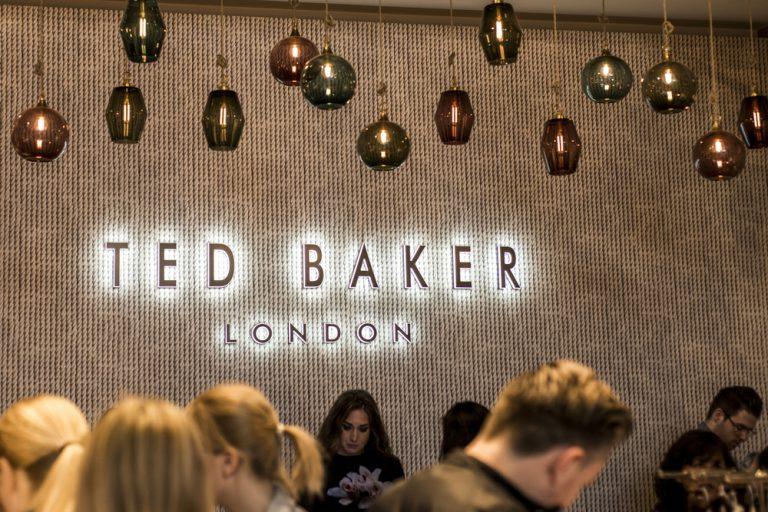
British fashion retailer Ted Baker plc (LON:TED) have emulated their 2017 success over the Christmas period, and have seen their shares rally in trading today, despite admitting that the adverse conditions experienced in 2018 are set to continue.
High street slowdown and a decline in wholesale turnover was compounded by controversy surrounding Founder and Chief Exec Ray Kelvin, which marred the company in the run-up to the Christmas period.
However, the company have bounced back with sales for the five-week period from December the second up 12.2% on-year, and up 10.5% on a constant currency basis.
Despite challenges, acting Chief Executive Lindsay Page said the company were in line to meet expectations, “against a backdrop of increased promotional activity”
“The Ted Baker brand has delivered a good performance across both our stores and e-commerce business, despite the continuing challenging external trading conditions across our markets,”
“This result again reflects the strength of the brand and the quality of our collections.”
The company owes much of its recent success to the expansion of its online retail opportunities. E-commerce sales spiked 18.7% during the period, to make up 25.7% of net sales.
Before taking a backseat, Founder Ray Kelvin noted that,
“The investment in our flexible business model ensures that the Ted customer has multiple channels to engage with the brand and underpins our long term development. Our global e-commerce business continues to grow well and is complemented by our digital marketing strategy and unique stores that showcase the brand.”
The company’s shares are currently trading up 17.2% or 278p at 1,894p per share. Without consensus – Peel Hunt analysts reiterate their ‘Hold’ stance, Liberum Capital reiterates their ‘Buy’ stance and RBC Capital Markets reiterate their ‘Outperform’ stance on Ted Baker stock.