According to reports, James Murdoch is the favourite to replace Elon Musk as the Tesla chairman.
The Financial Times reported on Wednesday that the son of Rupert Murdoch is likely to report Musk after he is forced to step down as the group’s chairman.
After reaching a settlement with the US financial watchdog the Securities and Exchange Commission (SEC), Musk and Tesla had to pay $20 million in fines each, whilst Musk also had to step down as chairman.
A person briefed on the discussions told the Financial Times: “The Tesla chairman job is perfect for James. He’s working on this fund and will be sitting next to Elon … he’s going to get access to so much deal flow.”
Murdoch is currently chief executive of 21st Century Fox however, will soon leave the role and will be succeeded by his brother. He is a non-executive director of Tesla and has reportedly said he wants the job of the chair.
Musk responded to the report published in the Financial Times writing: “This is incorrect.”
Tesla has until mid-November to find a replacement for Musk, who’s turbulent behaviour has led to shares crash 27% since he tweeted his intention to take the firm private at $420 a share.
Musk abandoned the plan just weeks later after it emerged he had, in fact, not secured funding. This led an investigation by the SES, who accused Musk of fraud.
Musk has faced many controversies this past year, including calling the British diver who was involved in saving the trapped Thai boys a “pedo” and smoking marijuana on a live video podcast.
Shares in Tesla (NASDAQ: TSLA) closed on Wednesday down 2.25% at 256,88.
British luxury car and engine manufacturer Rolls-Royce Holding Plc (LON:RR) have announced that they will be recruiting 200 new staff following an impressive round of second half sales to-date.
The company has enjoyed success with their Phantom model and the black badge range of their Wraith, Ghost and Dawn variants. Subsequently, sales for the second half through October are up 13% on-year. In addition, the firm are set for continued liquidity into 2019, with order books for the new Rolls-Royce Cullinan filled for the entirety of the coming year.
With the positive retail feedback, the company’s management have deemed it necessary to take on new personnel at their Goodwood Headquarters in West Sussex – the new staff taking its total occupancy to a sixfold increase of its opening number in 2003.
Torsten Müller-Ötvös, Rolls-Royce Motor Cars chief executive, said: “I am delighted to announce our new recruitment programme. This reflects not only the success of Rolls-Royce Motor Cars to date, but also our confidence in the future of our business. Rolls-Royce continues to strive for long-term sustainable growth and we remain fully committed to luxury manufacturing at our Home here in Great Britain.”
Further good news followed today as the firm’s civil aerospace division announced the launch of a new aircraft engine, which the firm view as a major strategic advantage – with 37,000 aircraft set to be built over the next decade expected to need the engine that Rolls-Royce specialise in.
The company’s shares are currently trading down 41.8p or 4.5% at 888p. Citigroup Analysts have reiterated their ‘Buy’ stance on Rolls-Royce stock.
After stating its commitment to the UK in 2016, it will be interesting to see if the firm keeps its word in the wake of city jobs being put in jeopardy by Brexit uncertainty.
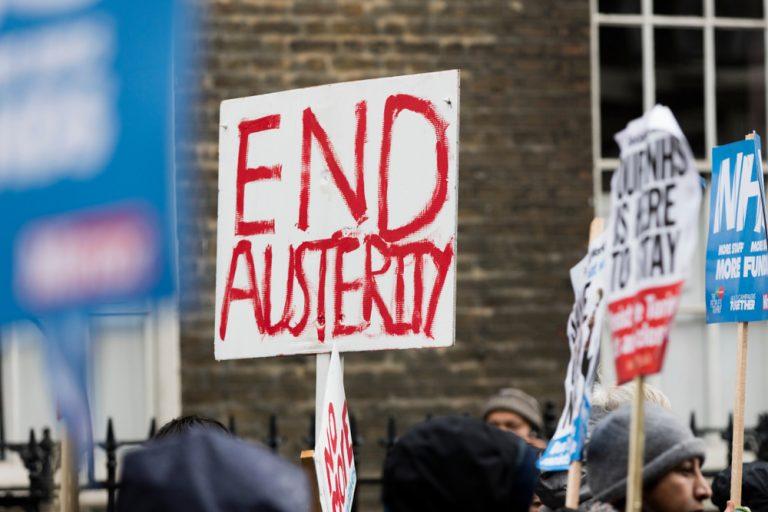
Prime minister Theresa May has once again faced a day of little solace, with her pragmatic approach to political struggles making for an amenable speech last week, but doing little to tackle the macro-political dilemmas that have proliferated her time in office. Aside from struggling to cater to all parties in drawn-out Brexit negotiations, the prime minister suffered today during PMQs due to a self-prescribed ailment – the promise to end austerity.
This issue presents a trifecta of challenges. Firstly, can the political agenda really afford to take on this kind of burden amidst the Brexit negotiations? Secondly, in a time of financial uncertainty, can the Tory party realistically hope to end fiscal retrenchment in a time when their greatest claim to electoral legitimacy is their stake as the party of fiscal responsibility? Thirdly, the £35-40 billion per year ballpark figure will merely mitigate the need for cuts to public services in the near future, and will do little to reverse the past measures of austerity, such as the hike in tuition fees or the challenge of achieving parity between mental and physical healthcare services.
On the latter issue, concerted effort and meaningful action is required, not symbolic actions or political euphemism. Secretary of State for Health and Social Care, Matt Hancock, has admitted that mental health services are failing six years after a commitment was made to improve the standard and provision of care. Similarly, the SNP Leader in Commons, Ian Blackford, pointed to a piece of research that indicated that one-in-two women taking part in the ‘work capability programme’ -introduced by the Tory party – had considered suicide. Incidentally, there is a double-edged sword. The Conservative party have failed to deliver on their promise to improve mental health services, and the combination of cuts to welfare and compulsory work skills workshops have if anything exacerbated the pre-existing problem.
In response, May says that efforts will be made to give the sector “the attention it needs”, she announces a new Minister for Suicide Prevention and then notes that the work capability programme was introduced by a previous Tory government, not hers.
With that kind of lacklustre response, it is perhaps little surprise that the public and the prime minister’s Commons opposition are both highly sceptical about how and when the promise to end austerity will come into fruition.
In response, opposition leader Jeremy Corbyn questioned, “The prime minister declared she is ending austerity. But unless the budget halts the cuts, increases funding to public services, gives our public servants a decent pay rise, then isn’t the claim that austerity is over simply a great big Conservative con?”
In rebuttal, the prime minister stated, “I’ve been very clear that there are better times ahead for people, we will see debt falling and we will see support for our public services going up. Austerity is being brought to an end. What is not being brought to an end is fiscal responsibility.”
So, without making any concrete commitments during today’s PMQs – other than continuing the fuel duty freeze – the prime minister was challenged again by Corbyn. The Labour leader asked when the public could expect to see the return of some of the 5,000 mental health nurses cut since 2010, or when tuition fees would be frozen, when benefits for large families would stop being cut and when would pension and pay for public servants would stop being chopped into by cuts? He continued by asking if austerity is over, why then is the police federation taking the government to court over issues of funding? And why has the Education Secretary been rebuked four times by the statistics watchdog this year if austerity is over for teachers?
In response, May said that fiscal responsibility is still of paramount importance, education spending is at a record high and that Conservative terms in office since 2010 were left with the thankless task of having to revamp the economy in the wake of the crisis presided over by Labour.
Overall, many could envisage this kind of point-scoring ping-pong continuing in the chamber for eternity – even outside of PMQs. But while the prime minister could be right about the costly nature of Corbyn’s proposed policy package, the general public’s immediate concern will be focused on whether May will fulfil the promises she made during her party conference speech last week.
An EU commissioner has announced plans for a new tax on technology giants, which could be implemented by Christmas.
Pierre Moscovici, the head of tax for the European Commission, has said the tech tax across Europe could raise £4.4 billion a year.
Moscovici said that good progress was being made, however, if it did not come into action this year – it could be until the end of next year before it could be reconsidered.
The technology tax would have less time to be considered next year when the dominant topic will be Brexit.
“We can lead by example,” he said. “Let’s do it now.”
Moscovici needs agreement from all EU members, including the UK. Earlier this month, UK chancellor Philip Hammond laid downs plans for a new technology tax.Moscovici’s announcement comes just after social media giant Facebook faced criticism after announcing it was paying £15.8 million tax in the UK, where total sales reached £1.3 billion.
“Those companies, those internet giants, they pay little or no tax in the EU,” said Moscovici.
“Why? Because our corporate tax system is old. It is not their fault. It is our fault. We have a tax system based on physical presence.”
“We need to reflect on digital presence. If you compare all businesses, 23% is the average corporate tax rate. For the internet, it is something like 9%. This is a problem of a level playing field.”
In terms of Brexit, it is not known how the UK will come into the new tech tax and it will have to be “improvised”.
“Clearly we need to look for a solution that is close, co-operative and friendly,” he said.
Firms like Google (NASDAQ: GOOG), Amazon (NASDAQ: AMZN) and Facebook (NASDAQ: FB) traditionally pay the highest taxes where they have headquarters, which is often in the US.
Shares in Advanced Oncotherapy (LON:AVO) soared on Wednesday morning, after the company announced it had reached a milestone in the development of its LIGHT cancer treatment system.
The company, which specialises in proton-beam cancer treatment, announced that it had successfully integrated four sections of the light accelerator.
During testing, the proton beam accelerated through all units at ‘the design-anticipated energy of 52MeV’.
The firm said that this was almost double the output energy referred to in the previous case study milestone announcement, revealed back in September.
Advanced Oncotherapy now said they would turn their efforts to add 13 more CCL modules to increase energy levels to 230MeV, which represents the level required to treat deep-seated tumours.
Commenting, Nicolas Sérandour, CEO of Advanced Oncotherapy, said: “We are delighted to have successfully achieved a further acceleration of the proton beam through the four sections of the LIGHT system and have accordingly validated the designs of the all the accelerating structures. Having fully integrated all key components of the LIGHT system, we have already achieved the most challenging aspect of constructing a new linear accelerator.”
He added: “Discussions with potential customers are now multiplying and we expect them to accelerate as we are getting closer to the next phases of our journey. We look forward to having all our accelerating units manufactured to generate a beam at full energy by the middle of next year and start the installation of the system in Harley Street when the building is ready by mid next year.”
Shares in Advanced Oncotherapy are currently trading +35.02 percent as of 14.08AM (GMT).
Google (NASDAQ:GOOGL) is appealing a record €4.3 billion fine after it was accused of utilising its Android system to “cement its dominance”.
The tech giant announced the appeal on Tuesday and it could take up several years to be resolved.
The European Commission found that the company had illegally forced phone manufacturers to pre-install its Android apps, disadvantaging its competitors.
Google also ensured Android manufacturers pre-installed its search engine and Chrome browser, in order to use Google’s app store.
Google was dealt the record fine back in July.
At the time of the announcement, EU Commissioner Margrethe Vestager, who heads the competition policy department, said:
“Today, mobile internet makes up more than half of global internet traffic. It has changed the lives of millions of Europeans. Our case is about three types of restrictions that Google has imposed on Android device manufacturers and network operators to ensure that traffic on Android devices goes to the Google search engine. In this way, Google has used Android as a vehicle to cement the dominance of its search engine. ”
She continued: “These practices have denied rivals the chance to innovate and compete on the merits. They have denied European consumers the benefits of effective competition in the important mobile sphere. This is illegal under EU antitrust rules.”
Earlier this month, the tech company was named the second-most valuable brand in the world according to a ranking by Interbrand.
Elsewhere across the tech industry, Paypal (NASDAQ:PYPL) recently agreed to pay an additional £2.7 million in UK taxes.
Similarly, it was also revealed this week that Facebook’s (NASDAQ:FB) UK tax bill had also tripled.
A City minister was warned that up to 5,000 jobs could be moved from the City of London by the time of Brexit.
John Glen has agreed with the Bank of England that thousands of financial services jobs could move to the EU by March 2019, when the UK officially leaves the EU.
“My sole objective in respect of the City is to ensure as much continuation as possible in respect of economic value able to be generated by the City,” he told a committee in the House of Lords.
“We have not seen wholesale moves of large institutions to other cities in continental EU,” Glen added.
The warning has come as the Financial Conduct Authority (FCA) published over 900 pages of preparatory work for a ‘no deal’ Brexit, consulting with two financial firms in the run-up to the UK’s departure from the EU.
Nausicaa Delfas, the executive director of international at the FCA, said: “The FCA is planning to be ready for a range of scenarios.”
“Today we are publishing two consultation papers to ensure that in the event the UK leaves the EU in March 2019 without an implementation period, we have a robust regulatory regime from day one, and to ensure a smooth transition for EEA firms and funds currently passporting into the UK.”
Glen added that there have been no calculations yet on how much in tax will be lost from financial services institutions.
“It would be pretty impossible, laden with so many assumptions, to do some meaningful calculations on that, in terms of what the different sectors’ response would be, because there’s so many live issues with respect to the deal and the regulatory certainty that we would seek to bring through the deal,” he said.
The financial sector currently generates over £70 billion in tax revenues.
Telford Homes (LON:TEF) warned of the impact of Brexit uncertainty upon housing demand on Wednesday.
The house builder said that an increasingly stagnating London property prices, alongside continued Brexit-related uncertainty had been having a negative impact upon the housing market.
Specifically, house prices in the capital have fallen sharply compared to the rest of the UK.
Average London house prices fell 0.7 per cent in the year to July, marking the third month of decline according to figures from the Office for National Statistics (ONS).
According to the trading update, Telford Homes said its interim results would show will fewer completions in the first half of the year to 31 March 2019 than in the following six months.
Pre-tax profits for the first-half of 2019 will therefore be lower than the second quarter.
Nevertheless, the company said it expects to ‘exceed the £8.7 million achieved in the six months to 30 September 2017.’
The interim dividend is also set to increase in response to growth.
Jon Di-Stefano, Chief Executive of Telford Homes commented: “Our key objective is to fulfil the ongoing demand for the homes that London needs. Notwithstanding the uncertainty surrounding the outcome of Brexit, the Group continues to perform well and is focused on increasing the scale of the business driven by the need for homes at affordable price points, in particular in the rental sector.”
Looking ahead, Di-Stefano remained optimistic. He added: “We remain confident that our approach to forward sales with increased visibility over profit recognition enhanced by our success in build to rent will enable us to deliver strong long term returns to our shareholders.”
The warning sent Telford shares down more than 13 percent.
The company was founded back in 2000, and is currently listed upon the AIM-market of the London Stock Exchange.
The company specialises in developing housing in the capital.
Shares in Telford Homes are currently trading -7.62 percent as of 12.43PM (GMT).
Sosander expects to announce a 407 percent increase in first-half revenues compared to the same period last year.
The online fashion retailer revenues for the year up to September 30 to reach £1.84 million thanks to growth in orders and customers.
“The business has made substantial progress over the first six months of the year, and we are delighted to have delivered such strong growth in revenues, orders and new customers. We have successfully raised £3 million following strong institutional investor interest in the company,” said joint CEO’s, Ali Hall and Julie Lavington in a statement.
Sosander has bucked the retail trend, where many retailers including French Connection have reported a fall in sales and profits leading to widespread store closures.
The fashion retailer has driven customer base by focusing primarily on brand appeal and brand awareness through social media platforms including Instagram and Facebook, which have seen a growth in following by 193% and 129% respectively.
The last six months have seen more frequent orders and a higher basket size, highlighting the growing customer loyalty to the fashion retailer.
Hall and Lavington added:
“Pleasingly, this has been accompanied by a growing number of repeat customers and an increased average order value, as those customers already recruited become brand ambassadors. Our clothes have become a mainstay in our customers’ wardrobes – including celebrities – and we are proud that our garments are being worn by high profile actresses, TV presenters, sports stars and social media influencers.”
“At the same time, we have been able to make key operational progress that will further enhance the customer experience and have increased the efficiency of our marketing spend. Momentum has continued into the important Autumn/Winter period and we look forward to the rest of the year confidently.”
Shares in the group (LON: SOS) are trading up 6.95 percent at 38,93 (1056GMT).
Shares in Patisserie Valerie (LON: CAKE) have been suspended after the discovery of potential fraud.
The owner of Patisserie Valerie has been notified of “significant, and potentially fraudulent, accounting irregularities and therefore a potential material mis-statement of the company’s accounts”.
Luke Johnson, the chairman and owner of a 37% stake in the group, said on Wednesday: “We are all deeply concerned about this news and the potential impact on the business. We are determined to understand the full details of what has happened and will communicate these to investors and stakeholders as soon as possible.”
The finance chief of the business, Chris Marsh, has been suspended from his role.
Shares will continue to be suspended while a full investigation is conducted.
Patisserie Valerie released its last trading update in May. The group said that half-year profits were 14.2% higher at £11.1 million.
The first store was opened in 1926 and now has over 150 stores in the UK, whilst also trading in Sainsbury’s supermarkets.
The group was listed on the stock market in 2014, with shares at 170p a share. When trading was suspended, shares were trading at 429p.
The businesses also include Druckers, Philpotts, Baker & Spice and the Flour Power City Bakery.
The statement released ahead of Wednesday trading read:
“During the course of 9 October 2018, the board of directors of the company has been notified of significant, and potentially fraudulent, accounting irregularities and therefore a potential material misstatement of the company’s accounts.”
“This has significantly impacted the company’s cash position and may lead to a material change in its overall financial position.”
“As a result the company has requested that its shares be suspended from trading on AIM while it conducts a full investigation with its legal and professional advisers into its true financial position.”
“In the meantime Chris Marsh, the chief financial officer, has been suspended from his role.”
“The company will make further announcements in due course as the results of the investigation become known.”