BP to slash $17.5 billion off oil and gas assets
BP plc (LON:BP) is to slash $17.5 billion off the value of its oil and gas assets following grim projections of the impact of the coronavirus pandemic on global oil demand. Just last week, the company announced plans to cut up to 10,000 jobs by the end of the year, representing nearly 15% of its global workforce.
In the wake of a historic few months in the oil industry – with the market trading negatively for the first time on record during April – BP has been forced to cut price forecasts by around 30% and is expecting Brent crude to average at about $55 per barrel until 2050, dropping from $70 this time last year.
Responding to the news, BP has suggested that it may have to leave some of its oil and gas discoveries in the ground if demand does not recover to previous levels. The company also plans to review future projects in light of a “growing expectation” that the coronavirus pandemic will “accelerate the pace of transition to a lower carbon economy and energy system”.
Chief executive Bernard Looney described the company’s plans to “reinvent itself” into a “leaner, faster-moving and lower carbon company” as it emerges from the crisis, citing plans to reduce operating costs – currently standing at $22 billion a year – by $2.5 billion in 2021.
Reflecting on the impact of the coronavirus pandemic in a note to employees, Looney said:
“The oil price has plunged well below the level we need to turn a profit. We are spending much, much more than we make – I am talking millions of dollars, every day. And as a result, our net debt rose by $6 billion in the first quarter”.
Looney concluded that the company is working towards “greater efforts to ‘build back better’ towards a Paris-consistent world”.
BP’s plans to streamline their system are part of a wider scheme to achieve net zero ambitions by 2050. In February, BP chairman Helge Lund commented on the company’s long-term goal:
“Aiming for net zero is not only the right thing for BP, it is the right thing for our shareholders and for society more broadly. As we embark on this ambitious agenda, we will maintain a strong focus on safe, reliable and efficient operations and on delivering the promises we have made to our investors”.
Cineworld shares rally as it announces social distancing cinema from July 10

The world’s second largest cinema chain Cineworld (LON:CINE) saw its share price bounce over 4% on Tuesday, as it announced its anticipated reopening dates for cinemas across its international operations.
The company said that with big box office candidates such as Mulan and Tenet being confirmed for release in the coming weeks, it was pleased to confirm plans to reopen some cinemas during the last week of June and all sites by the end of July.
Cineworld, which runs 790 sites across 11 countries, stated that it had, “made several operational changes and invested in new technology to ensure a safe but enjoyable cinematic experience for all our visitors.” It reiterated that its main priority remained the health and well-being of its customers and colleagues.
Among other changes, the company stated that; its new booking system would ensure social distancing throughout its auditoriums; its new film schedules would help to manage queues and traffic within and around its premises; and ‘enhanced’ cleanliness and sanitation procedures would be implemented across its sites.
The company then provided following – though notably provisional – list of anticipated reopening dates for its operations across different territories:· Unites States: July 10th
· United Kingdom: July 10th
· Poland: July 3rd
· Czech Republic: June 26th
· Slovakia: June 26th
· Israel: July 9th
· Bulgaria: July 3rd
· Hungary and Romania: TBC (anticipated for week of July 3rd)
Responding to the news, ineworld CEO Mooky Greidinger commented: “[We] are thrilled to be back and encouraged by recent surveys that show that many people have missed going to the movie theatre. With a strong slate confirmed for the coming weeks, including among others Tenet, Mulan, A Quiet Place Part II, Wonder Women 1984, Black Widow, Bond, Soul, Top Gun Maverick and many more, the entire Cineworld team remains committed to being ‘the best place to watch a movie’ “. Following the update, the company’s shares rallied by an impressive 4.61% or 3.64p, to 82.58p per share 16/06/20 11:19 BST. The company’s p/e ratio is 4.66, while its dividend yield stands at a generous 11.24%.Restaurant chains predict mass redundancies without government support
An open letter backed by 90 firms was sent to PM Boris Johnson, stating that if social distancing remains in place, they will need support in the form of tax, rent and other rebates, to avoid mass closures and job losses.
The letter was organised by Deliveroo, and was signed by partner restaurants Itsu and Pret A Manger, as well as Wagamama and Pizza Hut (NYSE:YUM). The companies run more than a thousand outlets across the UK between them, and stated that without additional support, the sector faces ‘grave damage’.
The letter reads:
“Without government support to help restaurants to generate revenue and cover costs, tens of thousands of restaurants may be forced to permanently close their doors in the coming months.”
“This crisis is far from over and the potential consequences are deeply concerning. A huge number of restaurants across the country are facing the prospect of bankruptcy.”
The companies are calling for cuts to VAT on restaurant food, as well as the continuation of the Job Retention Scheme for restaurants while social distancing measures remain in place. In addition, the companies are requesting mortgage holidays for landlords, so that this can be passed on in the form of lower rents for business outlets.
Government response
Responding to the letter, a government spokesperson commented: “We are working closely with the hospitality sector to develop safe ways for restaurants, bars and cafes to reopen as soon as we can from July.” “These businesses can continue to access our extensive package of support, including our job retention scheme which has been extended until October – meaning it will have been open for eight months and will continue to support businesses as the economy reopens and people return to work.” The spokesperson also added that these measures were in addition to the 100% business rate holidays, loan and tax deferrals. Further, the government has commissioned a review into the two metre social distance guidance – due in ‘the coming weeks’ – which the PM’s spokesperson said on Monday would, “look at evidence around transmission of the virus in different environments, incidence rates and international comparisons”. In essence – ‘you’ve had your lot’. The companies run outlets across the UK, which are likely to reopen at different times due to disparities in regional policy. Restaurants and cafes will reopen from 3 July in Northern Ireland and the day after in England, while neither Wales nor Scotland have stated dates yet.UK unemployment: 612,000 dropped from UK payrolls amid Covid crisis
The number of people on UK payrolls has dropped by 612,000 between March-May.
The Office for National Statistics and HM Revenue and Customs have released new figures showing a record low in job vacancies and the extent to which the Coronavirus pandemic has hit the economy.
Between March and May, there were 342,000 job vacancies fewer than the previous quarter – this represents the largest quarterly decrease in job vacancies since records began.
The number of those who have become unemployed since the lockdown has been kept lower due to the government’s furlough scheme, which has sustained employment.
Samuel Tombs, from Pantheon Macroeconomics’ said that whilst the furlough scheme has “succeeded in preventing massive job losses so far,” it is unsure what will happen for unemployment when the scheme ends and that rates were being held in “suspended animation”.
He warned that “a second wave of redundancies remains likely when financial support for employers who furloughed workers is wound down between August and October”.
Tej Parikh, chief economist at the Institute of Directors, also believes the economy and unemployment figures could take a greater hit in October.
“Wage support has given firms some much-needed time to regroup,” he continued. “Despite these efforts, activity will inevitably be below normal for some time as social distancing continues, and employment looks set to take a hefty hit. Salaries and vacancies are also likely to keep falling as businesses aim to keep costs down,” he said.
“As many as a quarter of firms have said they will struggle to pay anything toward furloughed workers’ pay come August. More bad news could be just round the corner, as redundancy consultation periods kick in.”
Economists expect to see the unemployment rate reach 4.7% following the end of the furlough scheme.
Those claiming Universal Credit or Jobseekers Allowance since March has more than doubled to 2.8mn.
Should retailers celebrate a busy high street post lockdown?
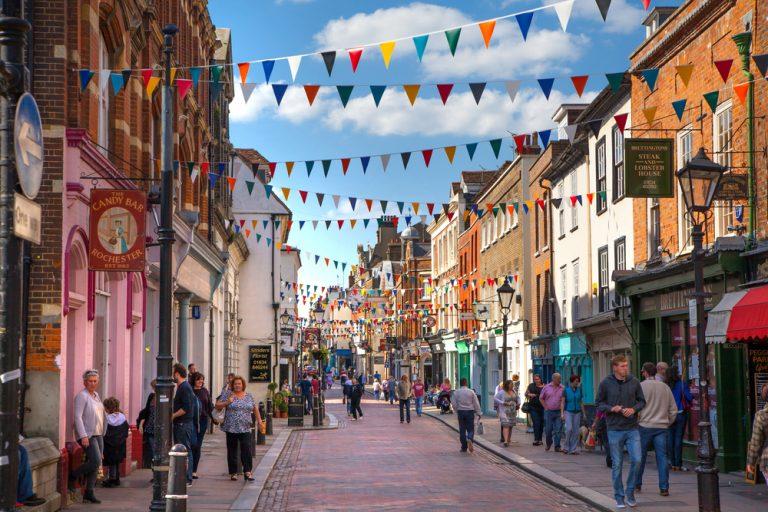
With many employees returning from furlough, and with shops opening for the first time in months on Monday, questions are being asked about the ability of high street retailers to pick up steam as lockdown restrictions are loosened.
Offering diverging accounts of the situation for companies post-quarantine were Fortnum and Mason CEO Ewan Venters, and owner of stationary company Ryman, Theo Paphitis. While they agree that a return to ‘normality’ was desirable for both companies and consumers, their visions for the coming months were greatly at odds.
On the one hand, Mr Paphitis lamented the struggles faced by high street retailers in light of the expansion of online shopping and deliveries in recent years. He stated that lockdown had – understandably – put already challenged businesses into an even more difficult spot, and that to make the high street competitive with their online counterparts, the government should either continue their business rates waiver or scrap business rates altogether, on a permanent basis.
With this stance in mind, we can imagine the situation looks pretty bleak for face-to-face shopping outlets, as lockdown has not only seen companies such as Amazon (NASDAQ:AMZN) and Ocado (LON:OCDO) expand their delivery capabilities to meet expanded demand, but has seen many previously sceptical shoppers rely on online retail opportunities for the first time – many of whom will likely seek out the convenience and cost-effectiveness of shopping online in future.
In contrast, Mr Venters was highly optimistic about shops reopening. While fresh produce and supermarket sales are expected to be steady, the main area of concern for many would be the willingness of consumers to resume their regular social habits, by visiting pubs, bars and restaurants.
In response to this, Mr Venters was very positive. He stated that Fortnum and Mason had seen strong demand for its cafe offerings, with a backlog of bookings, following the recent reopening of the company’s popular afternoon tea reservations. Venters was not surprised by this fact, and instead stated that we should expect such activity going forwards. As people gain confidence and as more eating and drinking establishments reopen, he says we can anticipate healthy trading towards the latter end of the summer, as people release their pent-up desire to reconnect with their families and friends, by going for dinner or for drinks.
The optimistic outlook seems more on-the-money so far, as shoppers took to the streets and queued down the roads frantically on Monday, to access high street retailers such as Primark (LON:ABF) and Sports Direct (LON:FRAS). If this post-lockdown trading activity becomes the norm – and people cluster in shopping and recreational outlets – then it’s safe to assume that consumers will find it difficult to observe social distancing. Going forwards, this presents the very real dilemma of a Coronavirus second wave sooner rather than later.
We may be keen to return to our usual service, however our desperation to do so will likely see us back in quarantine before winter. A second lockdown in quick succession may be too much for many high street retailers to survive, and in terms of financial support, we’ll likely learn the hard way that the government’s pockets aren’t bottomless. While the message from many may be ‘go out and support local businesses’, perhaps the best thing we can do is support in moderation. An over-zealous return to normal life could be the death knell for many small businesses.
Travis Perkins to cut 2,500 jobs & 165 stores
Travis Perkins will be closing 165 stores and cutting 2,500 jobs amid the Coronavirus pandemic.
The building materials group announced the decision, putting the closures and job cuts down to an expected weaker demand over the next two years.
“While we have experienced improving trends more recently, we do not expect a return to pre-Covid trading conditions for some time and consequently we have had to take the very difficult decision to begin consultations on the closure of selected branches and to reduce our workforce to ensure we can protect the group as a whole,” said Nick Roberts, the group’s chief executive.
“This is in no way a reflection on those employees impacted and we will do everything we can to support them during this process.”
“The group has a robust balance sheet, strong liquidity position and I am confident that these proposed changes will enable us to trade successfully through this period of uncertainty with a cost base that better reflects the environment we are operating in,” he added.
Travis Perkins said in a statement: “It is evident that the UK is facing a recession and this will have a corresponding impact on the demand for building materials during 2020 and 2021.”
The group has 2,154 branches around the country and owns brands including Wickes and Toolstation. Most of the stores that will be affected will be smaller shops – where profit margins are thin and social distancing measures are hard to ensure.
From Monday, non-essential shops are opening across the UK following the three-month shutdown.
During the course of lockdown, the group kept a third of its branches open. More branches have opened over the last month, with sales about 60% down across the month of May. However, sales have picked up since the end of lockdown.
Shares in Travis Perkins (LON: TPK) are trading down almost 3% at 1,049.00 (1355GMT).
H&M sales halved, shares fall
Sales at Hennes & Mauritz (H&M) have halved in the second quarter of 2020.
The latest figures from the clothing retailer reveal that net sales for the three months to 31 May were £2.45bn – 50% lower than the same period last year.
As H&M was forced to close four-fifths of its global stores during the Coronavirus pandemic, sales plummeted. However, as stores are reopening across the UK on Monday, sales are set to recover.
RBC analyst Richard Chamberlain said: “In many markets we expect to see customers preferring to shop locally and more pressure on urban locations more reliant on tourism and people using public transport.”
Shares in H&M closed 24% down this year on Friday.
Sales across the sector have suffered in the last quarter. Owner of Zara, Inditex (BME: ITX) reported a 44% drop in sales between February and April.
Shares in H&M (STO: HM-B) are trading at 141.75 (1203GMT).
FTSE 100 tumbles as investors fear a second wave
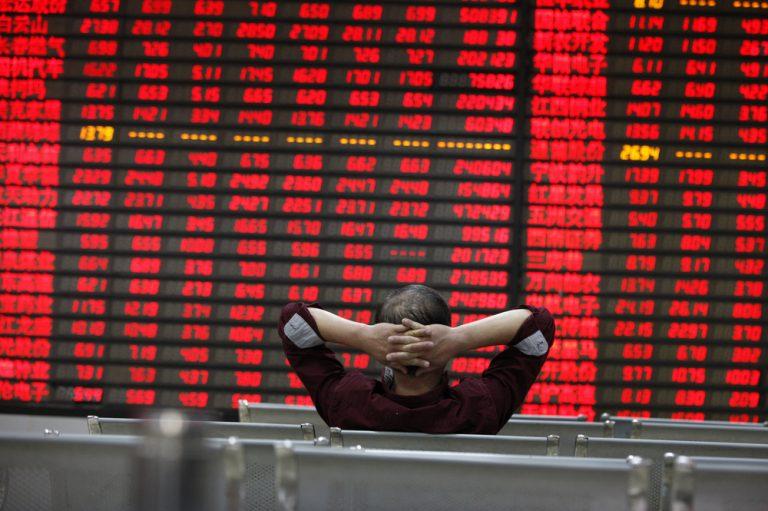
As fears of a second wave of Coronavirus outbreak grow, the FTSE 100 tumbled in Monday’s early trading.
As shops across the UK open for the first time in three months, the index of UK blue-chips fell below 6,000 points whilst the pound also dipped 0.2%.
Investors’ optimism has been dampened amid the news of a spike in Coronavirus cases in Beijing, where authorities closed a food market over the weekend.
“Reports of a new COVID-19 lockdown in Beijing speak directly to market fears that the measures taken to contain the virus so far are not enough,” said Michael McCarthy, the chief market strategist at CMC Markets.
Among the biggest fallers of Monday’s FTSE trading was oil giant BP, which tumbled 5% on opening to 306p.
The oil company said this morning that the pandemic is set to have “an enduring economic impact.”
Bernard Looney, BP’s chief executive, said: “In February we set out to become a net-zero company by 2050 or sooner. Since then we have been in action, developing our strategy to become a more diversified, resilient and lower-carbon company. As part of that process, we have been reviewing our price assumptions over a longer horizon. That work has been informed by the Covid-19 pandemic, which increasingly looks as if it will have an enduring economic impact.”
Global stocks also took a hit on Monday. Japan’s Nikkei was 3% down whilst in Europe, the CAC in Paris, German DAX and Spanish IBEX all fell around 3%.
In the UK, non-essential retailers are opening to re-start the economy. Retailers have introduced strict safety measures and social distancing rules for customers whilst shopping. Prime minister Boris Johnson has told shoppers to “shop with confidence”.