
Bellway shares fall amid Covid disruption

Bellway has released its preliminary results for the year ended 31 July 2020.
The housebuilder saw sales and profits down amid Covid-19 disruption, however, trading has picked up since restrictions eased.
The number of housing completions fell by 30.9% from 10,892 to 7,522.
The group posted a fall in pre-exceptional operating profit fell to £321.7m from £674.9m a year previously. Bellway said that there was an exceptional Covid related expense of £25.8m spent on site-based costs as well as a £9.9m cost from aborted land deals.
After exceptional costs, pre-tax profits plunged 64.3% to £236.7m.
Trading in the first nine weeks of the new financial year has been strong thanks to a boom in the housing market. The average week reservations increased by 30.6% and the forward order book increased from £1.3bn to £1.9bn.
“Pent-up demand arising from the prolonged period of lockdown inactivity, together with Government support through the stamp duty holiday and provision of Help to Buy, have contributed to this reassuringly strong performance,” said Jason Honeyman, the chief executive.
“As the country emerges from the initial extended national ‘lockdown’ and adapts to ongoing restrictions at both a national and local level, there is substantial economic damage and an ongoing threat of a more widespread resurgence in the virus.”
“In addition, we are yet to see the extent to which unemployment will rise as the unprecedented support offered by the Government’s CJRS ends and is replaced with the Job Support Scheme,” he added.
Bellway shares fell 3.88% on Tuesday.
Energy: price cap extended till end of 2021
The government has announced plans to extend the energy price cap until the end of 2021.
According to the Department for Business, Energy and Industrial Strategy (BEIS), the new cap will mean that 11 million households across the UK will save on energy over the next year.
“The energy price cap has been vital in ensuring customers do not pay too much on their bills, which is why we are keeping it in place for at least another year,” said Alok Sharma, the Business and Energy Secretary.
“Switching energy supplier to find the best value deals is still the best way to save on bills, but this government is determined to make sure all customers are treated fairly and get the protection they deserve.”
The price cap was initially introduced in January last year after Theresa May hoped to end “rip off” tariffs from suppliers. The price cap was lowered over summer as wholesale gas prices plunged to a 20-year low.
Jonathan Brearley, Ofgem’s chief executive, said the regulator would “continue to protect consumers in the difficult months ahead as we work with industry and government to build a greener, fairer energy system”.
Peter Earl is the head of energy at Comparethemarket.com. He said: “There is a real risk that the British public interpret the government’s extension to the price cap as an endorsement that the cap is an affordable price to pay for energy, when it reality it should be considered the absolute ceiling that people pay.
“There are currently 191 energy tariffs on the market cheaper than the £1,042 price cap, and as the temperature drops and people turn the heating up a notch or two, switching to a competitively priced one or two year fixed-rate deal is an effective way for households to lock-in a cheaper energy deal,” he added.
Britvic shares bounce 7% on new 20-year bottling deal with PepsiCo

British soft drink producer, Britvic (LON:BVIC), saw its shares rally during Tuesday trading, as it announced a new two-decade-long bottling partnership with American giant, PepsiCo (NASDAQ:PEP).
The franchise bottling agreement covers the production, distribution, marketing and sales of PepsiCo carbonated soft drink brands – including Pepsi, 7UP and mountain Dew – in the UK.
The deal represents an extension of a pre-existing partnership, which began in 1987 and has now been extending until at least 2040, and will also include PepsiCo’s Rockstar energy brand, for which Britvic will take responsibility from November 1 this year.
The company also announced that it intends to make all of its UK plastic bottles out of recycled plastic by the end of 2022, which is three years earlier than initially planned. This change will cover the entire UK portfolio of Britvic and PepsiCo brands, and marks a notable step towards notable household names taking sustainability seriously, and adopting the circular economy.
Speaking on the announcement, Britvic CEO, Simon Litherland, said:
“I am delighted that we have formally extended our relationship with PepsiCo in Great Britain for a further 20 years. The powerful combination of the Britvic-owned and PepsiCo portfolio offers customers and consumers a broad range of great-tasting, trusted brands for any occasion. We are excited to add Rockstar to our offering and look forward to working together to grow the brand.”
“The announcement of our intent to move to 100% recycled PET in GB by 2022 is a significant moment for Britvic and our partnership with PepsiCo, demonstrating our joint commitment to protecting the planet today and for future generations. Both Britvic and PepsiCo have sustainability at the heart of their business strategies, and we will continue to work together to deliver on our shared ambition to protect the environment and offer healthier choices in the years ahead.”
The company added that better-than-expected trading across the peak summer period means that its full-year EBIT is predicted to be ‘slightly ahead’ of current market consensus, with trading benefitting from the reopening of UK hospitality since early July. Following the update, Britvic shares rallied by 6.80% or 51.00p, to 801.50p a share 20/10/20 13:40 BST. This current price is below its consensus price target of 880.91p, and lower than its six-month high of 866.00p. Analysts currently have a consensus ‘Buy’ rating on the stock, a 54.23% ‘Outperform’ rating from the Marketbeat community, and a p/e ratio of 12.55, below the consumer defensive average of 13.91.Reckitt Benckiser shares rally with like-for-like sales rising 13%
FTSE 100 listed medical and home cleaning product giant, Reckitt Benckiser (LON:RB), added to a robust year of trading, with sales growth across all its divisions during the third quarter.
The group recorded total like-for-like growth of 13.3% during Q3, up to £3.5 billion, which meant that year-to-date growth was up by 12.4%, to £10.4 billion.
This progress was led by growth across its operational segments, with improved infant formula performance seeing its Nutrition business grow by 4.1%. Similarly, strong demand for Dettol and Durex – hopefully not at the same time – saw its Health segment rise by 12.6%.
The star of the show, though, was its Hygiene business, with strong demand for Lysol, Finish and Air Wick seeing double digit growth in most markets, and pushing its Hygiene arm up by 19.5%.
Other drivers of the company’s successful year-to-date include; Dettol and Lysol being sold in 19 new markets; Air Wick Mist rising by 50% in the US; the first polyurethane Durex being launched in China; and its ecommerce sales growing by 45% during Q3 alone.
These factors have meant that while most guidance remains unchanged, it now expects to report ‘double-digit’ like-for-like revenue growth for the full-year 2020.
Reckitt Benckiser cleans up
Speaking on the company’s booming performance, CEO, Laxman Narasimhan, commented:“Our performance has been led by an increase in Hygiene and Health volumes, led by our market-leading disinfectant brands – Dettol, Lysol, Sagrotan and Napisan. Growth has been underpinned by better customer service levels and an improved supply chain performance, together with strong momentum in eCommerce. While the revenue performance in Nutrition improved in the quarter, we remain fully focused on addressing the headwinds, such as Hong Kong, and taking the actions necessary to deliver a sustained improvement.”
“With a world-class portfolio of hygiene, health and nutrition brands and a clear purpose – to protect, heal and nurture in the relentless pursuit of a cleaner and healthier world – we are uniquely placed to help tackle the challenges the world is facing. Our plan to invest over £2bn over three years is on track, supported by our expanded productivity programme which has delivered savings of £300m so far this year. We are also reinvesting our outperformance to capitalise on the strong demand for our products, particularly with Dettol and Lysol and through eCommerce and professional channels.”
Investor notes
Following the update, Reckitt Benckiser shares rallied by 1.58% or 114.00p, to 7,318.00p apiece 12:40 BST. This is comfortably behind analysts’ consensus target price of 7,616.94p a share, and behind its year-to-date high of 7,960p. Analysts currently have a consensus ‘Buy’ rating on the stock, a 54.56% ‘Outperform’ rating from the Marketbeat community, and a p/e ratio of 20.64.Heathrow introduces rapid Covid tests, IAG shares rise

Heathrow is now offering rapid Covid-19 testing for passengers flying from London to Hong Kong and Italy.
Tests available at the airport will cost £80 and results will be made available within the hour and will be offered by British Airways, Virgin Atlantic, and Cathay Pacific.
“Many other countries are already using testing to keep their borders safe while restarting trade and travel,” said John Holland-Kaye, the chief executive of Heathrow airport.
“These facilities will make it easier for passengers going to those countries to get a test and have the potential to provide a service for arriving passengers,” he added.
For tests will be for passengers flying to Honk Kong, where authorities require arrivals to have a negative result 72 hours before flying.
Chief executive of the aviation trade body Airlines UK, Tim Alderslade, welcomed the rapid tests but said the cost can still be dropped.
“For business passengers £80 is probably quite competitive but we’ve certainly said to the government in terms of introducing a test on arrival in the UK anything from £50-£60 would be better.”
The rapid-test is known as a Lamp (Loop-mediated Isothermal Amplification) test and is quicker than the tests carried out by the NHS.
Passengers who are hoping to book a flight must book it online with Collinson before arriving at the airport.
David Evans, the Collinson joint chief executive, said: “With countries around the world adding the UK to their list of ‘high risk’ countries, we need to find a way to work with governments, leading travel brands and other commercial entities to safely open up travel out of the UK.”
The tests are currently just for passengers who are departing from Heathrow and not for those landing in London.
On the news, IAG shares (LON: IAG) surged 5% to 104,90 (1241GMT).
Trainline shares down 10% as CEO steps down

Trainline shares (LON: TRN) fell over 10% on Tuesday morning after the group said that its chief executive, Clare Gilmartin, will be stepping down.
Gilmartin will be replaced by Jody Ford, who previously held the role of Chief Executive Officer at Photobox Group.
Trainline has had a difficult year amid the pandemic and travel grinding to a halt. Last month saw ticket sales fall to less than a fifth to the same period a year previously.
Ticket sales crept back up over summer as lockdown restrictions eased, however, business tickets are just 4% of last year.
Gilmartin said: “The decision to step down next year is a personal one; after seven years at the helm the time has come for me to spend more time with my family. I am immensely proud of our progress over the last several years – including driving the advancement of digital ticketing and the customer shift online, our international expansion and our track record for meeting and exceeding expectations, particularly in our first year as a public company. I work alongside an amazing team, who I know will continue this strong performance, innovating for customers and driving growth for the industry.”
Gilmartin will continue at Trainline as a Senior Advisor, supporting the management team and the group’s wider industry partners.
Ford commented: “I joined Trainline because I believe it is a tech innovator with huge growth potential and a purpose that is central to its business: to encourage greener travel choices. I am very much looking forward to bringing my digital experience to bear as CEO and continuing Trainline’s focus on working with the rail and coach industry to make travel as easy and friction-free as possible for millions of customers in Europe and beyond.”
Trainline shares (LON: TRN) are down 10.09% at 299,40 (1043GMT).
Vela Technologies shares surge +20%

Vela Technologies shares (LON: VELA) surged on Tuesday after the group posted interim results for the six months ended 30 September 2020.
The investment company has invested £2.35m into a company that is developing a Coronavirus treatment for people living with diabetes.
Vela Technologies will be working with the medical charity, St George Street, which will recruit people for a clinical trial.
In the six months to the end of September, the group reported a pre-tax loss of £63,000 – this is compared to the loss of £258,000 a year previously.
Brent Fitzpatrick, the company’s chairman, said in a statement: “I am pleased to report that Vela is now positioned on a stronger financial footing with an investment portfolio of six businesses and a strong pipeline of near-term investment opportunities.
“Our company is now debt-free, well capitalised with a portfolio of six investments and cash on deposit, at 30 September 2020, of £1,628,000. The cash at 30 September 2020 includes proceeds of £925,480 generated as a result of the exercise of warrants during September.
“The Board is currently considering a number of investment opportunities in line with its existing investing policy and certain of these potential new investments are at an advanced stage of due diligence, documentation and/or completion. The Board anticipates a lively second half of the financial year and announcements will be made by the Company at the appropriate time.”
Vela Technologies shares (LON: VELA) shot up over 20% on Tuesday’s opening and are currently trading +12% at 0,072 (0951GMT).
UBS profits jump 99%
UBS (SWX: UBSG) profits soared 99% over the third quarter.
The Swiss lender saw a net profit total $2.1bn (£1.62bn) in the three months ending in September thanks to the investment banking arm.
Pre-tax profit at the group’s investment banking arm jumped 268% to $632m.
Sergio P. Ermotti, the group’s chief executive, said: “Our third-quarter results continue to demonstrate that our strategy is differentiating us as we continuously adapt and accelerate the pace of change.
“I am proud of the contributions all of our employees have made day in and day out over the years, particularly in the current challenging environment. Our ability to focus on clients and achieve such strong financial performance over the first nine months of this year speaks to this.”
UBS remains cautious over its outlook amid the Corona uncertainties and the group said factors are “making reliable predictions difficult.”
Ermotti is due to leave the bank this month and will be replaced by Ralph Hamers from 1 November.
Ermottis said: “UBS has all the options open to write another successful chapter of its history under Ralph’s leadership.”
“UBS has all the options open to write another successful chapter of its history under Ralph’s leadership,” Ermotti said in a statement accompanying the results.
UBS shares (SWX: UBSG) crept on on Tuesday morning and are trading +2.65% at 11,22 (0905GMT).
European markets in the red amid new restrictions

European markets have all started in the red on Tuesday morning amid new Coronavirus restrictions and lack of a US stimulus deal.
The FTSE 100 fell 0.3% to 5,867 points. France’s CAC and Germany’s Dax were both 0.5% lower on Tuesday.
Markets are slipping as Coronavirus cases are on the rise and there is a tightening of restrictions.
Connor Campbell from Spreadex commented on this morning’s fall on the blue-chip index: “Covid-19 crisis is intensifying – and remember, we aren’t in the acute months of winter yet either – with the ominous shuttering sounds of more restrictions in Europe joined by rising positivity rates in several prominent US states.
“Yesterday saw the markets swing from green to red, with the Dow staying there by the end of the session as it fell more than 400 points.
“And though they weren’t as bad this morning, the European indices nevertheless struggled to find a reason not to slump even lower,” he added.
In the US, investors remain concerned whether US lawmakers can reach a stimulus deal. Speaker of the House Nancy Pelosi’s spokesperson said on Monday that the two sides “continued to narrow their differences”, however, they only have until 3 November to reach a deal before the presidential election. In Asia, China’s SSE composite index saw gains of 0.5% overnight. Japan’s Nikkei 225 closed 0.4% lower.Big tech equities slump sees Nasdaq become Monday’s biggest loser
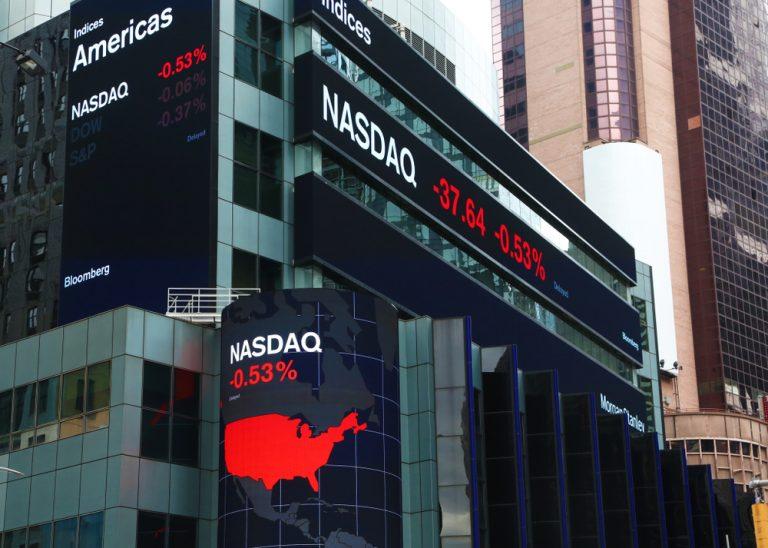
Between the US economy being among the worst-hit by the COVID pandemic; the Biden poll lead narrowing; and Nancy Pelosi implementing a deadline for new stimulus measures to be announced, all US equities suffered on Monday. However, the Nasdaq led Monday’s losers, with the tech-laden index weighed down by the falls posted by big tech stocks.
Falling by 1.77%, the Nasdaq shed more than 200 points, down to 11,465 points. Shedding 1.76%, the S&P 500 was close behind, falling some 60 points down to 3,422. Likewise, the Dow Jones dropped 1.60%, down to 28,147 points.
US equities were all weighed down by the recent data illustrating the harsh realities of third quarter trading. However, according to Kingswood CIO, Rupert Thompson:
“The US elections remain a major focus. The markets seem to have taken a liking to the idea of a Biden victory and possible clean sweep by the Democrats because it would lead to a sizeable fiscal boost. However, this result is still not a done deal with the betting odds of a Biden victory narrowing back down to 60% from 65% a week ago. The final Presidential ‘debate’ on Thursday may be Trump’s last chance to narrow the polls which still favour Biden.”