Babcock shares slip despite interim profit growth

0

Babcock International Group PLC (LON: BAB) have seen their shares slip on Wednesday despite reporting strong profits gains in its interim results.

Babcock is a provider of engineering and technical services with supports national defense, safes lives and protects communities and have experienced a volatile financial 2019.

Shares of Babcock slipped 2.5% on Wednesday to 531p. 20/11/19 11:34BST.

The firm did report a sharp rise in profit for the first half of its financial year, but it seems that shareholders were not so convinced as share price fell.

The FTSE250 (INDEXFTSE: MCX) listed engineering firm saw falling revenue on step-downs from big projects reaching the end of their tenure.

For the six months to September, the firm reported pretax profit of £152.5 million, which was a huge rise from the £65.1 million figure a year ago.

However on an underlying basis the figure dropped by 18% to £202.5 million from £245.5 million.

Revenue meanwhile dropped by 2.7% to £2.19 billion from £2.25 billion the prior year, with underlying revenue also slipping by 4.7% to £2.46 billion from £2.58 billion.

Babcock said that the revenue dropped because of the step downs in its Queen Elizabeth Class aircraft carriers contract, which contributed heavily to the falling revenue figures.

Revenue declined on the ending of Babcock’s Magnox contract with the UK’s Nuclear Decommissioning Authority, as well as a one-off benefit of £90 million a year before in asset sales related to the group’s Fomdec contract in Aviation.

Statutory pretax profit benefited from the lack of exceptional charge of £120.4 million, which alluded to the restructuring of the oil and gas division.

“Today’s results show we are doing what we said we would do. Our delivery in the first half is in line with our expectations, with good performance across most of the group. In particular, strong performance from our Marine business has offset some weakness in the Aviation sector,” said Chief Executive Archie Bethel.

“If we exclude the step downs resulting from big projects like the aircraft carriers coming to an end, and from the impact of procuring planes last year for the French Fomedec contract, our underlying revenue grew by 3.6%. This momentum, combined with the second half phasing of margin and cash flow that we expect, means I am pleased to confirm that the full year guidance we gave in May remains unchanged,” Bethel added.

Although Babcock did report impressive gains, shareholders have been cautious as reflected by stock price movements this morning. Where competitors such as Ultra Electronics (LON: ULE) and QinetiQ Group plc (LON: QQ) have reported strong trading updates, it seems that shareholders are demanding more from Babcock following the update. The firm still has a long way to catch up to global titans such as Lockheed Martin (NYSE: LMT) or Boeing (NYSE: BA) who have experienced a strong trading year with continued demand.

Aviva shares crash following Hong Kong update

2

Shares of Aviva plc (LON: AV) have crashed on Wednesday morning, after the firm announced plans to sell off its Hong Kong division.

Shares of Aviva crashed 3.92% to 401p. 20/11/19 11:19BST.

On Monday, the FTSE100 (INDEXFTSE: UKX) listed firm announced that it was determined to turn its slump in Chinese and Singapore operations around.

After Bloomberg reported that rival companies MS&AD Insurance Group (TYO: 8725) and Manulife Financial Corp (TSE: MFC) had submitted bids, it seemed that Aviva were determined to make Singapore operations work.

CEO Maurice Tulloch announced plans to overhaul overseas and Asian operations, however the optimism that was sparked on Monday seems to have fallen through.

Hong Kong is currently in political and economic turmoil, with violence and protests flooding global news headlines. The economy has collapsed into recession and the ability to trade for multinational firms has been hindered by heightened political tensions with China.

The insurance firm said it will simply its business structure into five operating divisions and sell its stake in the Hong Kong business to co-investor Hillhouse Capital.

“I am committed to running Aviva better,” said Tulloch ahead of a presentation to investors on Wednesday.

“We will be more commercially focussed, manage costs rigorously and be more disciplined in how we invest,” he added.

Additionally, Aviva set targets for the next three years. The highlights being a 12% return on equity, a £300 million net cost saving and an aim to generate a cash flow between £8.5 billion and £9.5 billion.

However, shareholders can be appeased a the firm alluded to operating profit staying in line with management expectations.

Aviva have a lot to consider about their Asian operations, as they still hold investment in Vietnam and Indonesia.

In tough market conditions, competitors such as Lloyd’s (LON: LLOY) have seen a slump in their third quarter profits which shows that the slumps may not be entirely the fault of Aviva.

Bluejay Mining announce share placing plan

2

Bluejay Mining PLC (LON: JAY) have announced a planned placing and share subscription on Wednesday, in order to raise funds for development projects.

The mining firm announced that the shares will be issued in order to raise funds for developing operations in Greenland.

Shares of Bluejay Mining dipped 0.69% after the announcement and are trading at 10p. 20/11/19 11:06BST.

BlueJay mining will raise £11.5 million through the issue of 115 million shares priced at 10p each.

Interestingly, the funds must be urgently required as the price offered reflected a 3.1% discount to the closing price on Tuesday evening of 10.32p.

Bluejay announced two waves of fundraising as highlighted in the update:

Phase one will entail a firm placing raising £7.5 million through the issue of 75 million shares.

Phase 2 will raise £4 million shares through a share subscription of 40 million shares by Greenlandic and Danish government investment funds, Greenland Venture AS and Vaekstfonden.

Bluejay followed a similar trend as competitors Thor Mining (LON: THR) Amur Minerals (LON: AMC) who made similar announcements a fortnight ago, in order to raise funds for new discovery operations.

Proceeds from the fundraise will go towards advancing the Dundas ilmenite project towards a mining licence grant, and the launch of maiden drilling campaigns at the Disko-Nuussuaq project and Langerluarsk project in 2020, both of which require government approval.

“We are delighted to have received strong support from two important Greenlandic and Danish Government backed institutions. This support demonstrates the mutual desire to grow the country’s mineral resource industry and we hope that Bluejay will be that vanguard,” said Chief Executive Officer Roderick Mcillree.

Shareholders may not be so optimistic, as this may devalue their holdings. However, if discoveries are made by Bluejay in their Greenland operations then this may act as a consolidation and see long term benefits. BlueJay will have to act fast considering the pace of the mining sector where big timers such as Hochschild Mining (LON: HOC) and Serabi Gold (LON: SRB) have made significant gains in their respective updates.

Bodycote shares rally on strong second half trading

0

Bodycote PLC (LON: BOY) have seen their shares rally on Tuesday, after the firm reassured shareholders on strong second half trading figures.

Bodycote saw their shares rally 2.94% on Wednesday morning to 859p. 20/11/19 10:51BST.

Bodycote is a supplier of heat treatments, metal joining and hot isostatic pressing and coating services.

Bodycote said that its performance for the four moth period ending October 31, matched the first half.

Additionally, the FTSE250 (INDEXFTSE: MCX) listed firm gave full confidence for its annual results to be in line with both market and analyst expectations.

In the period from July 1 to October 31, Bodycote said it recorded £244.7 million in revenue, 1% higher than in the same period year before.

Revenue for the 10 months to the end of October was flat year on year, with Bodycote saying its performance showed a “marginally” improving trend on the first-half growth rate.

ADE revenue also increased 6% to £103.4 million, and was up 3% for the ten month period. ADI revenue fell 3% to £141.4 million in the four month period, and slumped 5% for the ten month period.

“Bodycote’s performance in the period reflected a continuation of the trends of the first half, with civil aerospace revenues growing strongly; and the automotive and general industrial market sectors remaining soft,” the company said.

The company added: “Cost control initiatives remain a priority, with a particular focus on the areas of our operations where we are seeing revenue weakness. Consequently, margins and underlying cash generation remain strong. Overall, Bodycote’s board is confident that the group’s full year result will be in line with current market expectations.”

Bodycote said its Specialist Technologies’ revenue grew by 6% in the period versus the year before, with Emerging Markets revenue growing 14%.

Civil aerospace revenue grew ahead of the background market, the company said. Total civil aerospace revenue grew 14%, with North American growth boosting the business.

The market has been volatile for Bodycote, and competitors such as Oerlikon (SWX: OERL) and Kennametal Inc (NYSE: KMT) have seen their shares fluctuate. However, the confidence of Bodycote backed with the results should be enough to tease shareholder optimism.

Mitchells and Butlers shares spike on strong profit growth

1

Shareholders of Mitchells & Butlers plc (LON: MAB) have seen shares spike on Wednesday morning after the firm reported strong profit growth in financial 2019.

Shares of the FTSE250 (INDEXFTSE: MCX) listed firm spiked 5.94% on Wednesday to 472p. 20/11/19 10:39BST.

The firm reported strong growth in financial 2019, with an increase in profit deduced to rising sales in a tough environment.

The results will be pleasing for the firm, as rivals have had mixed experiences in the uncertain market conditions.

Competitors such as Greene King (LON: GNK) and Whitbread (LON: WTB) have been hit headlines of slowing business and takeover bids, and this performance shows that Mitchells and Butlers seem to be handling matters well.

However, headliner JD Wetherspoon (LON: JDW) reported strong profits in their third quarter, which may create stiff competition for Mitchells and Butlers.

In the 52 weeks to September 28, Mitchells & Butlers recorded £177 million in pretax profit, 36% higher than the £130 million reported the year before.

Revenue grew 4.2% year on year to £2.24 billion from £2.15 billion, with total sales up 3.9%.

Total like-for-like sales grew by 3.5%, with strong performances across all of Mitchells & Butlers brands contributing to “continued, consistent outperformance” of the market, the company said.

“The work we have undertaken, principally through our Ignite programme of initiatives, is driving a strong trading performance and generating profit growth whilst we continue to invest in our estate and pay down debt,” the company said.

Chief Executive Phil Urban commented: “These strong results reflect the work we have done over the last few years, first to build sustained sales growth and then to convert that into profit growth.

“It has been extremely encouraging to see an improvement in like-for-like sales growth across the portfolio during the year, fuelled by our Ignite programme of work. This puts us in a stronger position as we move forward into the next financial year, in what we expect to remain challenging market conditions.”

“Ordinarily we expect a drag on profit in the year of investment due to lost trade during closure and the cost associated with opening the invested business. This year we have been focusing on enhancing the ‘in year’ return of our investment projects and have eliminated profit drag by reducing closure time, more efficient use of resources and setting businesses up for success from the first day of trading,” the company added.

In the first seven weeks of the new financial year, Mitchells & Butlers said like-for-like sales have grown by 1.4%, having “continued to outperform the market in a period of adverse weather”.

The company added: “The market remains challenging with a high level of macro uncertainties, but we will remain focused on maintaining a strong balance sheet and reducing our net debt whilst positioning the business to generate value for our stakeholders.”

Mitchells and Butlers boast a portfolio of brands including Harvester, Toby Carvery, All Bar One, Miller & Carter, Premium Country Pubs, Sizzling Pubs, Stonehouse, Vintage Inns, Browns, Castle, Nicholson’s, O’Neill’s and Ember Inns.

Kingfisher shares sink following disappointing update

2

Kingfisher plc (LON: KGF) have seen their shares sink on Wednesday as the firm updated shareholders with a set of disappointing results.

Kingfisher are a DIY retailer that have operations across the world, but have boasted strong trading figures in Europe in recent years.

Shares in Kingfisher sunk 5.7% to 196p. 20/11/19 10:26BST.

The poor set of results follow a disappointing interim update in September, where the firm saw its half year profits fall significantly.

The FTSE100 (INDEXFTSE: UKX) listed firm said trading in the three months to October was “disappointing”, with sales falling 3.7% to £2.96 billion.

Like-for-like revenue slipped 3.7%. Kingfisher said this “reflects continuing disruption from new range implementations, lower promotional activity and ongoing operational challenges in France, and softer market conditions in our main markets”.

“My early assessment is that we have not found the right balance between getting the benefits of group scale and staying close to local markets. We are suffering from organisational complexity, and we are trying to do too much at once with multiple large-scale initiatives running in parallel,” said chief executive Thierry Garnier, who was brought in to turn the company’s fortunes around.

“I am proud to be leading a group with strong assets, excellent market positions, differentiated business models and strong brands,” he said.

B&Q sales sank 3.5% year on year to £820 million, slightly offset by an eight per cent rise in Screwfix sales to £477 million.

Richard Hunter, head of markets at Interactive Investor, said Garnier “could be forgiven for thinking that he has been handed a poisoned chalice”.

He added that Kingfisher’s transformation plan has not been effective and the firm’s vast complexity leaves it vulnerable to nimbler competitors, leading to plunging sales.

“Unfortunately the near-term outlook from the company is equally bleak and the new CEO will have the combined challenges of both assimilating Kingfisher’s culture for himself as well as making the necessary improvements to the company’s fortunes.

“This further decline brings Kingfisher’s status as a FTSE 100 constituent into question and without some improvement in the lead up to the December reshuffle, the company is a strong contender for relegation,” he said.

Kingfisher are one of many firms who have seen slips in the DIY and homebuilding industry, established names such as Barratt Developments (LON: BDEV) have seen slow sales in their most recent update. Additionally, Galliford Try (LON: GFRD) and Bovis Homes (LON: BVS) agreed a merger deal in order to combat the slump in demand and slow trading period.

Fever-Tree loses its sparkle in UK

4
Fever-Tree (LON:FEVR) warned on Wednesday that “short-term headwinds” in its UK market will hit its revenue for the full year. Shares in the producer of drink mixers were up during Wednesday morning trading. Fever-Tree blamed tough comparators with last summer and a slowdown in consumer spending. “Our performance has been behind our expectations in the second half as we continued to lap very tough comparators in July and August and more recently seen a slowdown in consumer spending, as reflected in the wider retail data,” the company said in a statement. Fever-Tree said that it now expects revenue for the full year to lie within the £266 million to £268 million range, which represents a year-on-year growth of 12-13%. Earlier this year in March, Fever-Tree saw its annual adjusted core earnings surge, boosted by the UK gin craze. Indeed, Fever-Tree’s premium tonic water is often paired with the alcohol, benefitting from the nation’s growing thirst for gin. However, Fever-Tree’s announcement on Wednesday does not come as too much of a surprise. The company previously warned in July that the UK had seen a moderation in growth rates for the first half of 2019. “We continue to see growth across all four regions. Indeed, sales accelerated in our key growth markets of the US and Europe,” Tim Warrillow, CEO, commented on the announcement. “Fever-Tree’s progress in the US is particularly encouraging and the signing of a US bottling partner is a further step in building our operations in this exciting market,” the CEO continued. The CEO said: “Despite challenging comparators, our performance in the UK On-Trade underlines the strength of the brand and while the mixer category in the Off-Trade is moderating alongside the recent slowdown seen across the wider grocery channel, we continue to maintain our clear UK market leadership position.” Shares in Fever-Tree Drinks plc (LON:FEVR) were up on Wednesday, trading at +6.26% as of 09:17 GMT.

The story writes itself: markets flat on trade war inaction

The story begins to write itself at this point. Goldman Sachs (NYSE: GS) tells us that the negative impact of the US-China trade war will diminish in 2020, but the refusal of gold prices to stage any kind of concerted climb-down tells us the opposite story. As the Tuesday session lets out its final breath, the predictable bottom line is the same as it has been for what will soon feel like an eternity: there hasn’t been substantive progress of resolving trade tensions, so markets have nothing to celebrate. Speaking on the market’s movements, or lack thereof, Spreadex Financial Analyst Connor Campbell commented,

“The markets were a mixed bag on Tuesday afternoon, the uncertainty regarding the US-China trade deal leaving the European and US indices without a uniform direction.”

“The Dow Jones, which at one point spiked to 28150, pulled back under 28000 as the session went on. That 50 point loss seems, in part at least, to stem from the confusion surrounding the trade deal. From a ‘constructive’ phone call on Saturday morning to reports of Chinese pessimism on Monday, with a Huawei (SHE: 002502) ban delay and hopes of Chinese stimulus thrown in to muddy the waters, it is hard to work out exactly where the superpowers stand.”

“One relatively clean positive, at least, was the claim by Goldman Sachs that the negative impact the trade war is having on the global economy should start to fade in 2020. And even then that is only if there isn’t any further escalation – and remember, there is another round of tariffs scheduled for December.”

“Elsewhere the CAC lost its initial 0.4% rise to fall 0.1%, but with the DAX holding onto its own half a percent increase. The FTSE, meanwhile, put some distance between it and 7300 with a 30 point rise.”

Outside of trade war fears, the UK had the small matter of the general election to contend with.

“Sterling showed the hint of some pre-debate nerves on Tuesday, flitting in and out of the red against both the dollar and euro without ever seriously threatening to undo yesterday’s gains. It will be interesting to see how the currency behaves on Wednesday morning, post-Boris v Jeremy. A perceived Tory win could see it climb higher; the alternative may give the right-leaning markets cause for concern.”

A Conservative triumph does seem likely this evening. Though an important distinction should be made between a volume contest – or even valence attributes such as debating skills – and the merit of individual policies, I imagine the Labour leader will fail to articulate his policies convincingly, and will likely succumb to Boris’s highly compelling “Marxist!” jibes or empty promises to champion the NHS.

Why is Labour’s co-operative company model logical?

Its important to begin by saying that neither the mutualised structure, nor its benefits, are completely extinct within British society. Indeed, not only do companies such as the Co-operative Group adhere to an explicitly co-operative structure, but John Lewis functions as an employee-owned mutual and Lidl has the kind of pay structure you’d expect from a mutualised company, without actually being one. So, why have Labour decided to champion this kind of company composition?
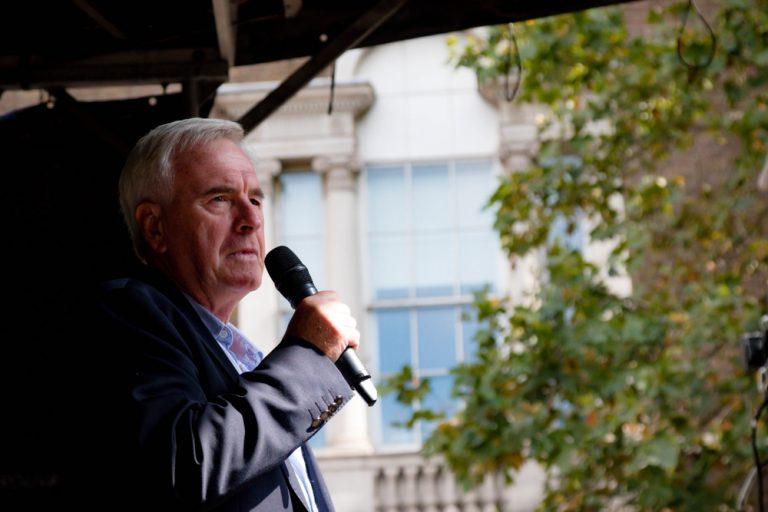
According to John McDonnell, workers and consumers will “take back control”.

Giving a speech in Westminster on Tuesday, McDonnell laid out the following tenets for company restructuring and regulation under a Labour government:

  • Employees and elected members will sit on company boards and have greater say over pay structure.
  • Public sector chief executives would not be allowed to earn more than 20 times living wage (ie a maximum salary before bonuses of £350,000).
  • Employees would own shares in their companies.
  • Introduction of an ‘Excessive Pay Levy’ to charge companies over pay disparities between the highest and lowest brackets.
  • A requirement for policies to lay out their policy for addressing the gender and ethnicity pay gap.
  • A warning that any company not adequately tackling climate change will be delisted from the FTSE 100.
  • No windfall tax on oil companies making excessive profits (the last two policies seem somewhat contradictory in message).
  • An overhaul of the UK regulatory system, including establishing its own regulatory bodies.
Speaking on the aims of these policies, McDonnell said that the plan was to create a business model that wasn’t based on the “unfettered pursuit of profit maximisation”. he added that the relentless appetite for shareholder value and “corporate greed” had been detrimental to regular working people whose hard work created the wealth that a small number shuffled around in zero-sum games. “Labour’s reforms to how our large businesses and public utilities are governed, owned and regulated and how both workers and consumers are represented will genuinely enable them to take back control,” he added He said Labour wants to “rewrite the rules” of the business model and “treat people fairly and with respect”. Under the current model, people have “often been treated as virtual chattels”. As is often thought of Corbynist Labour policies, they likely ask for too much, too quickly. I think this policy package will, or already has been, tarred with the same brush of judgement. I will say, however, that these policies move toward the correct, or at the very least an admirable, direction. Co-operative or mutualised company structures are conducive not only to fairer work conditions but, following Fordist logic, could lead to greater productivity. Such policies lead to better quality employment: fairer representation, a stake in Company progress and narrative and an interest in giving your best to an employer that treats you with dignity. And these themes are hardly the musings of left-wing ideologues either. In the eminent wisdom of his book ‘The Future of Capitalism’, my idol and Oxford University Economics Professor Paul Collier speaks out against the precarious, impersonal and myopic shareholder structure, and talks favourably about a return to pre-1986 mutualised corporate structures. Ultimately, a shift of focus, from agglomeration to reciprocity. New Statesman author Jason Cowley called the essence of Collier’s ideas ‘radical’, and I certainly can’t disagree that such a move would be a slap in the face to free-market doctrine. But from the perspective of the policymaker, such ideas are entirely within the remit of the state, and vital in their often forgotten role (in everything but rhetoric) of ameliorating divisions and tensions within society. With this being the case, and within the current context of austerity-Brexit Britain, I side with Collier in saying such policies are quintessentially pragmatic and very much needed. As far as Labour are concerned, I applaud the idea but I’d urge them to reign in their ambitions. Even if all the changes being tabled are ostensibly wise, forcing such a seismic shift within such a short space of time isn’t politically prudent. It will likely lead to deepening of existing divides, adversarial politics and the emotional bombast that fester in British society, and prevent productive discussions from being had. Also, in the interest of appearing to be a realistic party of government, I’d suggest Labour look for synonyms for the word ‘worker’. It is inherently Marxist terminology, and while this point may appear superficial or even facetious, I think we can all appreciate they don’t do themselves any favours, and right wing rags will happily use any ammunition they’re given.  

Uniphar announce two new acquisitions

1

Uniphar Group Plc (LON: UPR) have announced that they have acquired Nordic based EPS Group and Irish firm M3 Medical.

The total potential cost for EPS Group and M3 medical will be approximately €40 million, and they payment will be spread over four years.

The deal will be financed from the funds raised from the initial public offering in July, and coupled with a combined placing shortly after was valued at €139 million.

On a proforma basis, for 2019, these acquisitions in aggregate are expected to deliver revenue of about €22 million.

Both the EPS Group and M3 Medical will be integrated into the Commercial & Clinical Medtech division of Uniphar.

Uniphar Chief Executive Ger Rabbette said: “These acquisitions are a key strategic step in Uniphar’s plan to offer its pharmaco-medical clients a pan-European service by adding new countries and new agencies to our roster.

“With this development, we add to our already considerable expertise in the area of interventional technologies in key therapeutic areas, and Uniphar advances its ambition to become a leading independent distributor of medical devices throughout Europe. We expect to invest in these platforms in the short term as part of growing our unique and compelling proposition to emerging and specialist medical device manufacturers seeking a commercial partnership across their European business.”

“It gives us the opportunity to develop our existing relationships and to extend these across new geographies through Uniphar’s growing European offering,” said Killian O’Dowd, managing director of M3 Medical. “Uniphar’s scale, digital solutions, regulatory expertise and impressive ambition in Europe will be a great platform for M3 Medical to grow and flourish in the years to come.” These seem like two impressive acquisitions for Uniphar, and reinforces the firms plans to diversify and grow within the next few years. In the pharmaceuticals and medical industry, there have been updates. Global competitors such as Pfizer (NYSE: PFE) smashed market expectations in their third quarter update.Additionally, GlaxoSmithKine (LON: GSK) another titan in the industry saw their shares surge after strong profit gains. Whilst the big guns are dominating the pharmaceuticals industry, firms such as RA Pharma (NASDAQ: RARX) and UCB (EBR: UCB) have merged to spur product development and innovation.