
“I’m not a bull, but I’m very conscious of the market’s ability to bounce back.”Looking forward, Vanguard representatives said that they expected Trump’s hawkishness to persist and that Jay Powell would likely be forced into further accommodative monetary policy. Regarding the inverted yield curve, the consensus was that the Fed needed to continue its rate cuts, with the hope that developing markets would follow suit. The Company remained optimistic and highlighted potentially fruitful leads for investors to pursue. Discussed as almost a given, there was a bullish long-term outlook for gold, and for more proactive investors, Mr Lakha advised looking into deep-out-of-money-puts on a two-month rollover. Other market and macro financial news has come from; the London Stock Exchange Group (LON: LSE) and Sterling.
Market and Currency Outlook with Spreadex and Vanguard Capital

Ok, the bull may not be THAT appropriate. Last week we were told there is a one-in-three chance that recession is coming – sadly, markets don’t seem to want to get it over with. Manufacturing PMI is at its lowest level in months, miners are struggling (outside of gold and vanadium), the US bond market hasn’t resolved its inverted yield curve and the world superpowers are still toying with the prospect of a currency war. All that being said, market’s have proven surprisingly resilient and have steadied since Monday’s currency dive. Aware of sounding like a game show host, its still all to play for; there are still exciting opportunities for investors and there is potential for a bounce-back, however we should remain vigilant of poor performance within growth indicators.
Spreadex thoughts on markets today
Discussing currency movements over the week, financial advisor Connor Campbell described a return to something that resembles business as usual, despite what remains a tentative and unsteady status quo.
“A hellish start to the week settled into a tense quiet on Wednesday morning, investors nervously waiting for the next major skirmish in the US-China trade war.”
“A continued […] rebound from the pound – which is up 0.2% against both the dollar and the euro – and trouble in its commodity sector, with Glencore (LON: GLEN) the worst hit after a 32% fall in earnings, ensured the FTSE wasn’t able to lift itself back above 7200. Instead the UK shed 10 or so points, straining to keep above 7160.”
“Choosing, seemingly, to ignore a sharp, and potentially recession-suggesting, plunge in German industrial production, the DAX rose half a percent after the bell. That leaves the index teasing 11650, compared to the sub-11400 lows struck at its worst moments on Tuesday. As for the CAC, a 0.2% increase pushed it back to 5250.”
“Looking ahead to the rest of the day and, without much on the economic calendar, the markets are going to remain incredibly susceptible to the minutiae of the trade war, especially if Donald Trump wants to work out his itchy thumbs.”
Ultimately, markets are still holding their breath, and rightly so. With China and the US locking horns ones again and negative news on growth indicators emerging daily, you’d think market sentiment could only take so much fraying before it snaps.
Vanguard overview and advice
Perhaps its not all doom and gloom, though. Speaking to the CEO of Vanguard Capital AG, Sezer Sherif, and the Company’s senior financial advisor, Imran Lakha, it appears markets still have a leg to stand on.
Speaking to the UK Investor Magazine, Vanguard representatives said that markets would only encounter severe turbulence should there be a downturn in the credit market.
The pair noted that fundamentals throughout the market were poor, with indicators for global growth (PMIs, auto sales etc) and the earnings outlook (based on guidance for the third quarter of the calendar year) were both rolling over. However, they stressed that bonds and equities should not be tarred with the same doom and gloom brush as other indicators, and that current liquidity conditions – as ensured by central bank policy – have not changed enough to make them think that equity markets couldn’t bounce back.
Summing up his current position, Mr Lakha stated,
Glencore earnings drop by a third and EPS dive 89%

British-Swiss commodity trading and mining company Glencore PLC (LON: GLEN) informed investors today that its first half fundamentals suffered a prolonged freefall.
With a sense of poetic justice, the Company announced that with metal prices plummeting, its Mutanda prospect in Congo was ‘no longer economically viable’. As such, it said it would halt production at the site, which is the world’s largest cobalt mine. This comes after swathes of litigation being brought against the Company last summer, regarding its operations in the Democratic Republic of Congo and alleged corrupt practices.
Today, Glencore posted its results for the first half of 2019 and revealed a damning set of fundamentals. The Group’s first half adjusted earnings EBITDA were down 32% on a year-on-year basis, down to 5.58 billion; its adjusted EBIT were down 56% to £2.23 billion. The Company also announced that its net debt had widened 11% to £16.30 billion and its funds from operations had narrowed 37% to £3.52 billion.
Its investors fared even worse, with earnings per share diving 89% to US $0.02 and net income attributable to equity holders collapsing 92% to £226 million.
Glencore comments
Chief Executive Officer, Ivan Glasenberg, commented, “Our performance in the first half reflected a challenging economic backdrop for our commodity mix, as well as operating and cost setbacks within our ramp-up/development assets. Adjusted EBITDA declined 32% to $5.6 billion.” “[Our] African copper business did not meet expected operational performance. We have moved to address the challenges at Katanga and Mopani with several management changes as well as overseeing a detailed operational review, targeting multiple improvements to achieve consistent, cost-efficient production at design capacity. Our teams have identified a credible roadmap towards delivering on the significant cashflow generation potential of these assets, at targeted steady state production levels. At Mutanda, we are planning to transition the operation to temporary care and maintenance by year end, reflecting its reduced economic viability in the current market environment, primarily in response to low cobalt prices. We continue to progress studies on the sulphide project, having the potential to extend operations for many years, and anticipate being able to provide an update at our Investor Day in December.” “Looking ahead, we are confident that commodity fundamentals will move in our favour and that our diverse commodity portfolio will continue to play a key role in global growth and the transition to a low-carbon economy. Our asset teams are focused on delivering the full potential of our business, which together with our promising range of commodities, should see us well positioned for the future. Through continued constructive collaboration, we remain focused on creating sustainable long-term value for all stakeholders.”Investor notes
After a slight recovery, the Company’s shares are down 1.75% or 4.05p to 227.30p a share 07/08/19 11:01 BST. UBS analysts remain unchanged in their ‘Hold’ stance, while Deutsche Bank reiterated their ‘Buy’ rating for Glencore stock. Elsewhere in the mining and minerals sector, recent updates have come from; Jubilee Metals Group PLC (LON: JLP), Cora Gold Limited (LON: CORA), Kavango Resources PLC (LON: KAV), Ariana Resources plc (LON: AUU), Rio Tinto plc (LON: RIO) and Bushveld Minerals Limited (LON: BMN).President Energy posts sales and production growth

Argentina-focused oil and gas producer President Energy PLC (LON: PPC) posted increases in its sales and reduced bank site, alongside growth in average production, in a first half comparison on a year-on-year basis.
Sales were up 7% compared to H1 2018, up to US $23.5 million, while adjusted EBITDA stood at $8 million. Additionally, the Group’d bank debt dipped from $10.15 million at period opening to $4.82 million as the first half drew to a close.
President Energy average net production stood at 2,500 boepd, which was up 8% on the last financial year’s average. Further, the Company added that it had 1,100 boepd tested, proven and ready to produce, in addition to existing production. The completion of a work-over facility at its Louisiana project should be completed and production should be ‘back in line’ by September.
President Energy comments
Peter Levine, Chairman, stated,
“President has delivered positive results in H1, notwithstanding the headwinds as previously announced which should now, step by step, be receding in the rear-view mirror.”
“In the space of only some 20 months President has enjoyed a period of transformative progress including the successful integration of four valuable acquisitions, a strategic pan-regional pipeline, the bringing on of new production, generation of positive cash flow and attaining good margins. Despite this, President’s share price, uncoupled from such progress, has dropped some 35% in value during that time.”
“President, remains confident as to its future prospects and success as an energy business and is examining initiatives to deliver value for shareholders.”
Investor notes
After rallying healthily, the Company’s surge was mooted and their shares are currently up modestly by 0.76% or 0.050p to 6.60p a share. Analysts from Peel Hunt have reiterated their ‘Add’ stance on President Energy stock. The Group’s p/e ratio is 796.22 and their dividend yield is currently unavailable. Elsewhere in the oil and gas sector, there have been updates from; Mosman Oil and Gas Limited (AIM: MSMN), Nostrum Oil and Gas PLC(LON: NOG), Reabold Resources PLC (LON: RBD) and Trinity Exploration and Production PLC (LON: TRIN).SDL shares rally on 53% increase in H1 operating profits

Marketing translation software and services provider SDL plc (LON: SDL) hase seen its share price rally after it booked bumper profit, earnings and revenues during the first half.
For H1 2019, the Company achieved revenues of £182.5 million, up 28% on a year-on-year basis. This drove increases in operating profits to £11.9 million, up 53% on-year, and in profit before tax, which rose 40% on-year.
Owing to these sales fundamentals, shareholders enjoyed hikes in yields during the first half. Basic earnings per share rose 31% to 8.9p and adjusted diluted EPS jumped 14% to 12.3p.
SDL said that its recent acquisition, Donnelley Language Solutions, had performed well. It also noted that its premium services had grown to make up 40% of Language Service revenues, with revenues for the sector growing from £18.6 million to £52.0 million between H1 2018 and H1 2019.
SDL comments
Adolfo Hernandez, Company CEO , said,
“We are pleased to have delivered a good start to the year, which resulted in a 14% increase in adjusted diluted EPS over the prior year, benefiting from the acquisition of DLS and strong growth in key areas such as premium services and machine translation. During the first half, we continued to deliver on our transformation strategy, including the roll out of our automation programme, Helix, and completed the development of our next generation end-to-end translation platform, SDL Language Cloud, ahead of its launch in September. We enter the traditionally stronger second half with good sales momentum and a healthy sales pipeline. This, alongside the actions that we are taking on productivity, gives us confidence of delivering improved profitability for the full year, in line with management expectations.”
Investor notes
Following the update, the Company’s shares rallied 11.11% or 49.00p, to 490.00p a share. Peel Hunt reiterated their ‘Buy’ stance on SDL stock, having upgraded their stance at the start of August. Their p/e ratio was 17.85 and the dividend yield is 1.43%. Elsewhere in the tech sector, there were updates from; Dialight Plc (LON: DIA), Seeing Machines (LON: SEE), Bidstack Group PLC (AIM: BIDS), Nektan PLC (LON: NKTN) and Keywords Studios PLC (LON: KWS).Alien Metals conducts sampling at Mexican gold concessions

Copper, zinc, lead, silver and gold development company Alien Metals Limited (AIM: UFO) today announced a series of follow-up exploration and sample collection at its wholly owned Donovan 2, Los Campos and San Celso concessions, following previous studies.
The Company told investors that 98 samples had been collected from their three projects, with all samples being sent the ALS Chemex de Mexico laboratory for analysis.
Work at the Donovan 2 site was being done to try and localise the source of the float sample that returned 0.45 g/t gold from the south western area of the concession. Further, planning for the proposed induced polarity survey over the central ground magnetic anomaly, and surface sampling of potential Volcanic Massive Sulphide mineralisation, are in their final stages.
At the Group’s Los Campos site, 50 samples have been collected following further surface mapping and sampling of the area.
Alien Metals also collected 38 samples from its San Celso site, to try and provide evidence to support the presence of vein extensions at the project.
Alien Metals comments
Dan Smith, Company Chairman, stated, “Given the increase in the silver price during 2019, the timing for a potential farm-out or joint-venture in respect of the Los Campos and San Celso projects is increasingly attractive. These short sampling programmes enrich and corroborate historic data, ensuring the Company is well-prepared to advance these projects. We will provide an update following receipt of the assay results, likely to be during the course of August.”Investor notes
Following the update, the Company’s shares have rallied 2.24% or 0.0023p to 0.10p a share 06/08/19 13:29 BST. Neither a p/e ratio nor dividend ratio are available for this stock, Alien Metals has a market cap of £1.42 million. Elsewhere in the mining and minerals sector, recent updates have come from; Jubilee Metals Group PLC (LON: JLP), Cora Gold Limited (LON: CORA), Serabi Gold PLC (LON: SRB), Kavango Resources PLC (LON: KAV), Ariana Resources plc (LON: AUU), Rio Tinto plc (LON: RIO) and Bushveld Minerals Limited (LON: BMN).

US labels China ‘currency manipulator’ but receives little sympathy
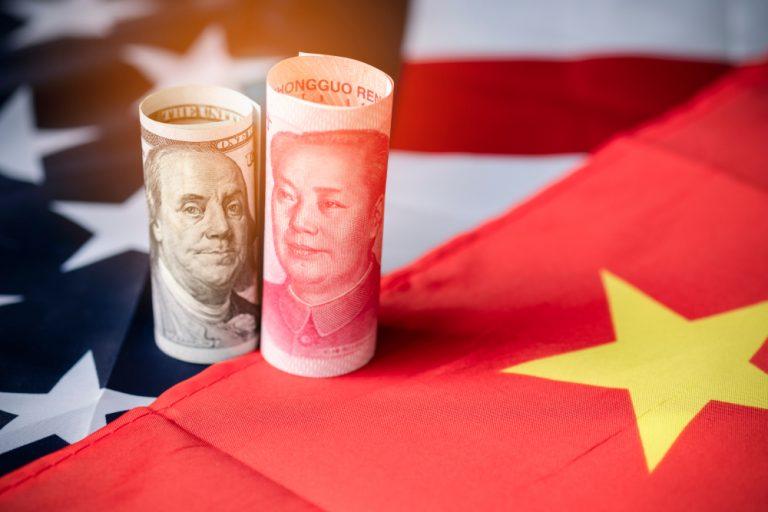
Following yesterday’s currency war fears and Donald Trump’s verbal retort, Wall Street’s main stock market indexes saw their worst day of trading in 2019. Today, the market reacts to President Trump calling China ‘currency manipulators’, the first accusation of its kind from a US president since Bill Clinton’s administration in 1994.
https://platform.twitter.com/widgets.js Responding to yesterday’s currency movement, the US Treasury stated, “China has a long history of facilitating an undervalued currency through protracted, large-scale intervention in the foreign exchange market. “In recent days, China has taken concrete steps to devalue its currency, while maintaining substantial foreign exchange reserves despite active use of such tools in the past.” Through the course of trading yesterday, Chinese currency recovered to regular form at over 7 against the dollar, having dipped as low as 6.92 – the lowest rate seen in a decade. Today, US officials will go to the IMF to discuss potential reactionary and counteractive measures to China’s rehashed market mechanism. As it stands, any hope of a resolution to the drawn-out trade tensions seems as distant as it did some 18 months as the first round of – largely superficial – trade talks broke down.China is intent on continuing to receive the hundreds of Billions of Dollars they have been taking from the U.S. with unfair trade practices and currency manipulation. So one-sided, it should have been stopped many years ago!
— Donald J. Trump (@realDonaldTrump) August 5, 2019
No sympathy for the US as China plays its Trump card
As stated, downwardly setting the renminbi (or Yuan) rate has been China’s go-to weapon of choice when attempting to exert its will on the market. However, the market’s reaction has not been, as we might have expected, a prolonged period of lamenting China. Of course, in the post-2008 crash epoch, markets went from being forward discounting to more present-day reactive, so with China’s denial of the US’s ‘currency manipulator’ accusations today, markets are quickly steadying from yesterday’s plunge. More surprising, maybe, is the reaction of the international community. Naturally, Chinese officials attributed yesterday’s currency movement to market-driven forces led by US aggression. Former Chinese foreign exchange regulator, Guan Tao, commented, “The renminbi’s depreciation through seven to the dollar was a market move, not a government target […] It is a result of what the US government has done [during the trade war] not what the Chinese government has done.” Zhang Ming, from the Chinese Academy of Social Sciences, added, “The renminbi is depreciating mainly because of market pressures related to the trade war, disappointing second-quarter economic data and the [Chinese] government’s crackdown on domestic financial risks.” Chinese commentators argue that the renminbi would have moved more had the Chinese government not been proactive about rate setting. The surprise, perhaps, is that international observers – the IMF included – are sympathetic to this view. As such, Trump is unlikely to receive a supportive pat on the head when he brings his complaints to the IMF today. In the IMF’s last review of the Chinese economy in July 2018, its staff argued that, “the renminbi remains broadly in line with fundamentals,” its also, “welcomed the increase in the flexibility of China’s exchange rate, which should continue”. The People’s Bank of China have a more old-fashioned approach to its currency than most Western countries, favouring a system of stringent management more akin (at least in the fact that it favours intervention and control) to the Gold Standard system, as opposed to the Western model of floating exchange rates. To avoid a currency sell-off similar in fashion to Turkey last year, it is expected that the PBoC will continue to tightly manage the renminbi. Wang Tao of UBS, commented, “The [renminbi] could come back below seven before breaching it again,” “We expect the PBoC to tightly manage exchange rate expectations and prevent [the renminbi] from depreciating significantly.”Outlook
Plainly, the tensions will likely get worse before they get better. This isn’t to say that there will be a perpetual escalation; rather a continued mutual awkwardness and back-and-forth of displays of aggression that will continue to dampen investor sentiments. That being said, backing down would be deadly for either side – but equally neither side can afford to escalate the conflict exponentially. Ironically, both sides are reliant on one-another (China for tax revenue and employment from US firms based in China, and the US on Chinese goods and labour). Other market and macro financial news has come from; the London Stock Exchange Group(LON: LSE) and Sterling.Boohoo shares rally on potential Karen Millen acquisition
Online fashion retailer Boohoo Group PLC (LON: BOO) has seen its share price rally on Tuesday morning, following news of its potential acquisition of clothing brands Karen Millen and Coast.
The online retailer specialises in own-brand fashion, and has acquired Little Thing and Nasty Gal (2017) since its inception in Manchester in 2006. The Company currently has 13 million active customer accounts across its existing brands globally – and has potential to grow depending on its strategy following the prospective acquisition of Karen Millen.
The Karen Millen holding company saw losses of £5.7 million in the year ending February 2018, following losses of £11.9 million the previous year. In June, its Icelandic owners Kaupthing Bank put it up for sale.
Any potential deal for Karen Millen would see parts of Coast included in the deal, after the brand was acquired out of administration last autumn by Kaupthing.
However, as yet Boohoo have not made clear what they would do to the highstreet offerings of Karen Millen, or more specifically whether or not they would make any guarantees about the jobs of the Company’s existing staff members.
Combined, Karen Millen and Coast employ 1,100 people throughout 32 stores and 177 concessions in the UK, with Ocean also holding concessions in the Middle East, Singapore and Malaysia.
Sales proceedings have been going on for six weeks and are being led by Deloitte, through a process of pre-pack administration.
Comments on Boohoo acquisition of Karen Millen
Richard Lim, chief executive of Retail Economics, said pre-pack administration allows buyers, “to dispose of the parts of the business that they deem unprofitable”. “In the case of Boohoo, they are looking at value in the online proposition of Karen Millen, and they probably prefer to pick it up as a pre-pack, which will enable them to dispense of the physical stores,” He continued, “It is well known Karen Millen has been struggling in the past few years. But Boohoo will look at it and see another potential revenue stream. “Karen Millen is a different customer segmentation for them, but one that I think could flourish as an online-only proposition. Boohoo will use all the expertise they have acquired in recent years using social media, and bring the brand to a newer audience.”Investor notes
The Company’s shares are up 3.52% or 8.10p to 238.20p a share 06/08/19 12:22 BST. Analysts from Peel Hunt and Liberum Capital reiterated their respective ‘Buy’ stances on Boohoo stock. The Group’s p/e ratio is 54.40 and their dividend yield is currently not available. Elsewhere in retail and on the highstreet, there have been updates from; Burberry Group plc (LON: BRBY), Associated British Foods plc (LON: ABF), H&M (STO: HM-B), Sports Direct International Plc (LON: SPD), and Superdry (LON: SDRY).Jubilee Metals spike in H1 revenues and projects soon operational
Copper ores production company Jubilee Metals Group PLC (LON: JLP) booked bumper growth in revenues and profit during the first half.
The Company’s revenue grew 75% between H2 2018 and the end of H1 2019, up to £14.36 million. Operational earnings were also up by 47% to £5.64 million during the same period.
Across its operations, the Company’s volume of chrome concentrate rose ‘significantly’ to 164,636 tonnes during H1 2019. Jubilee Metals also announced that its DCM fine chrome and Windsor chrome operations became operational, with JV PGM recovery plant for the Windsor PGM project commencing in June and its grinding circuit becoming operational in July. The Windsor PGM project has yielded 212,616 tonnes of PGM rich material and is expected to produce saleable PGM concentrates in August.
Further, the Company’s Sable Zinc Kabwe Refinery became effective, it commenced the accelerated implementation of the upgrade zinc, vanadium and lead circuit and it aims to bring the copper refining line into operation in the second half.Jubilee Metals comments
Leon Coetzer, Chief Executive Officer, says,
“I am delighted to present Jubilee’s Six Monthly Operations Update which showcases the exceptional progress we continue to make across our portfolio of metals processing projects – delivering against our targeted performance and bringing new operations on-line.”
“Such a marked increase in combined revenue – 75% against H2 2018 – reflects our sustained focus on increasing and diversifying our earnings base and maintaining strong margins. This has been achieved through a considerable uplift in production figures across our portfolio, both in chrome and PGMs. Notably our chrome performance has seen significant growth which is attributable to our ground-breaking DCM fine chrome operation and Windsor chrome operation being brought online during the period. Replicating this success, we expect to see a step-up in PGM production following the Windsor PGM project being brought into operation during July 2019.”
“With the acquisition of Sable Zinc Kabwe Refinery for the processing of the Kabwe material fully completed, our technical and operational teams are focussed on bringing the project on-line against accelerated timelines. This means we will soon be adding zinc, vanadium, lead and copper to our commodity basket, an important element of our on-going development strategy to diversify our earnings through additional jurisdictions and increased metal exposure.”
Investor notes
The Company’s shares have rallied 1.09% or 0.035p to 3.24p a share 05/08/19 16:26 GMT. Neither a p/e ratio nor a dividend yield are available on this stock, Jubilee Metals has a market cap of £59.37 million. Elsewhere in the mining and minerals sector, recent updates have come from; Cora Gold Limited (LON: CORA), Serabi Gold PLC (LON: SRB), Kavango Resources PLC (LON: KAV), Ariana Resources plc (LON: AUU), Rio Tinto plc (LON: RIO) and Bushveld Minerals Limited (LON: BMN).Yuan drops to lowest dollar comparison in a decade, trade war re-escalates

Its not over because the fat president sung. With one hand probing the coffers of the US Fed and his other fist shaking at Xi Jinping, you couldn’t accuse President Trump of being docile last week. Today, Yuan devaluation saw China play its first hand in what appears to be the re-opening of the Sino-US royal rumble, but this was in response to Donald Trump’s provocation last Friday.
As told by Connor Campbell, financial analyst for Spreadex,
“The financial markets got a Trump thumping on Friday morning, the European indices left reeling by the President’s shock – but not that shocking – escalation of the trade war with China.”
“Investors probably should have been prepared for this kind of move from the US considering Trump’s negotiations-tanking Twitter rant earlier in the week. The bellicose leader announced that, if a deal can’t be struck between the two superpowers, a fresh $300 billion of Chinese imports would be slapped with a 10% tariff as of September 1st. This on top of those goods already being penalised.”
“Just as it had picked itself up after its post-Fed overreaction, the Dow Jones received a swift kick to the gut, dropping around 300 points to sit at its worst price in over 2 months. Of course, this sparked a round of losses in Asia, including a 2%-plus slide from the Nikkei and a 1.4% drop from the Shanghai Composite, and set the stage for a gory European open.”
Following a week with the Dow diving and the Fed failing to properly address the bond market’s inverted yield curve, China compounded the woes of the global market sentiment with its first salvo. The People’s Bank of China set its daily reference rate for the Yuan at 6.92 (against the dollar), with the bracket for movement being only 2%. This is symbolic, as the 7 threshold hadn’t been passed since the crash in 2008, and the currency only moved over the threshold to 7.03 around midday on Monday. China said the ‘weakness’ was a direct result of trade protectionism and new tariffs placed on Chinese goods. Chris Weston, head of research at Pepperstone Group, said that the move was a ‘statement of intent’ from China, and would prompt fears about capital flight from China, alongside potential further financial restrictions in the Chinese economy.