
The hottest artists to invest in right now

Sponsored by Red Eight
Investors are always looking for the next big thing, but predicting trends in a field as nuanced as the art world is no easy feat. Here’s our insider’s guide to three artists who are about to make it big on the art scene. Now’s the time to invest in their work before the rest of the art world catches up.
RETNA
Born Marquis Lewis in Los Angeles in 1979, the acclaimed street artist RETNA is best known for his striking typography and intricate letterwork which is rich in hidden meaning and symbolism. The artist chose his unusual moniker from the lyrics of a Wu Tang song which was particularly important to him when he was young and became interested in street art after spotting grafitti along the highway.
RETNA’s work includes large-scale murals and sculptures as well as smaller, more gallery-friendly pieces featuring his charismatic geometric script which is aesthetically reminiscent of Egyptian hieroglyphs and Native American symbology. His text is not written in an identifiable language, since RETNA explains that “I want my text to feel universal. I want people from different cultures to all find some similarity in it—whether they can read it or not.”
RETNA’s work has been snapped up by the likes of Usher, Swizz Beatz, and expert curators and collectors like Jeffrey Deitch, and his pieces have consistently over-performed at auction. Examples include his “Soldiers is Another Frame of Mind” (2013) which sold for $36,400 against the high estimate of $22,800, while at the annual Clara Lionel Foundation Diamond Ball in September 2017 Dave Chapelle made a successful $180,000 bid on a RETNA painting.
RICHARD HAMBLETON
Nicknamed the “Godfather of street art”, Richard Hambleton was born in Vancouver in 1952 and is best known for his sinister shadowman silhouettes daubed on buildings in New York. Hambleton studied at the Vancouver School of Art and began his striking “Image Mass Murder” series in 1976, taking influence from the chalk outlines drawn by the police at murder scenes.
In 1979 Hambleton permanently settled in New York and began to work in his studio rather than directly on the streets. During the 1980s art boom he enjoyed significant success and was considered part of the influential group which also included Keith Haring and Jean-Michel Basquiat.
Today Hambleton’s works grace top galleries and museums across the world including the Brooklyn Museum, the Andy Warhol Museum in Pittsburgh, and The Museum of Modern Art in New York. Although until now Hambleton has lagged behind contemporaries like Basquiat, his work is now receiving the recognition it deserves. The recent sale of “Opening” (1983) which beat its €7,000 low estimate by over 20 times at Blindarte in Milan, with a closing price of €150,000.
This is not an isolated event; over the past couple of years the value of his work has shot up from a couple of thousand dollars to 6 figures. The current record price for a Hambleton work is for “As the world burns” which sold at Artcurial in 2018 for $553,332. The future looks very bright indeed for those who own or are able to obtain Hambleton pieces before prices climb even higher.
MARK SLOPER
Mark Sloper is the genius behind Illuminati Neon which draws on the artist’s punk roots as a friend of the Sex Pistols and producer of the recent Sky TV documentary, Punk 67. Sloper went to art college in Sheffield before falling in love with punk. In the Illuminati Neon studio in Shepherds Bush each piece is bespoke and hand-blown, featuring witty punk messages which bring a touch of irony or humour to the image.
Illuminati Neon is rapidly developing a dedicated following on the international art circuit, and in September Mark Sloper’s work featured in the world’s best emerging artists exhibition at the prestigious Saatchi Gallery in London. For the moment Illuminati Neon’s pieces remain extremely affordable, making this artist exceptionally attractive to art investors looking for the next big thing.
AfriTin shares sink following Namibian operational delays

AfriTin Mining Ltd (LON: ATM) have seen their shares sink on Tuesday afternoon after the firm reported that it had experienced delays at its Namibia mine.
AfriTin Mining is a mining company with a portfolio of near production tin assets in Namibia and South Africa.
The firm saw shares sink 4.07% to 2.95p. 26/11/19 13:00BST.
Earlier this year, AfriTin shares rallied on encouraging Uis venture tests, saying that the Namibian operations had promise.
Today shareholders have been updated that the firm has raised £3.8 million in a convertible note issue, partly helps up by an existing shareholder to allow compensation for the delays in Namibian operations.
The £100,000 notes last for 18 months and pay an interest rate of 10% per year. They are convertible at 4 pence per share, a 36% premium to AfriTin’s closing price in London on Monday.
The notes have been placed with tin trading firm AfriMet Resources AG and existing shareholders.
AfriMet is a subsidiary of Swiss commodity merchant Vanomet AG. Were AfriMet to covert the notes, it would hold 5.8% AfriTin.
Guernsey-based AfriTin will use the funding for general purposes as it looks to complete feasibility studies for the expansion at Namibia’s Uis tin mine, and also work on testing a recent lithium discovery.
At Uis, the company said mining is going well, but warned there has been a delay in connecting the site to the grid, though this has been resolved.
Chief Executive Anthony Viljoen commented: “I am pleased to announce the raising of £3.8 million by way of a convertible loan note, anchored by AfriMet. We have been collaborating with AfriMet to establish multiple channels for revenue generation from the trade in tin and tantalum products as well as offering participation to our existing shareholder base, who have also subscribed to the loan note.
“Our mining activities are proceeding as planned and there are two mining areas producing ore. This bodes well for our steady state production requirements in the future. We should ship our first tin concentrate from Uis at the end of November, a noticeable achievement for the company.
“Ramp up at the processing plant has progressed slightly slower than expected due to the delay in receiving grid power. The connection in grid power is now complete and this will allow for testing of final processing refinements for the ramp up to steady state phase one levels into 2020,” Viljoen continued.
Firms such as Bluejay Mining (LON: JAY) and Amur Minerals (LON: AMC) have also used share placing to raise funds for projects.
Established names such as Hochschild Mining (LON: HOC) and MC Mining (JSE: MCZ) have seen their shares crash since Friday after they cut their annual profit expectations.
Paragon Banking shares slip despite increasing profits

Paragon Banking Group PLC (LON: PAG) have seen their shares slip on Tuesday despite reporting an increase in profits on the back of strength in commercial lending.
Paragon Banking Group is one of the United Kingdom’s largest providers of mortgages and personal loans.
Shares of Paragon Banking slipped 0.2% on Tuesday afternoon to 502p. 26/11/19 12:37BST.
The global banking industry has seen general decline, as market leaders such as Lloyd’s (LON: LLOY) and HSBC (LON: HSBA) have seen their third quarter profits decline in tough trading conditions.
Additionally, overseas banks including Deutsche Bank (ETR: DBK) appear to be in crisis following a third quarter loss report.
The FTSE250 (INDEXFTSE: MCX) listed bank reported a 5% rise in underlying earnings for the fiscal year, as a focus on commercial lending helped the firm offset a slowdown in mortgage business caused by Brexit complications.
“The performance of the UK mortgage and housing markets has remained subdued in the face of economic concerns arising from Brexit and the wider economy,” the company said.
Lending at the business rose 36.3% to £968 million while the mortgage division saw a tame 3.5% rise.
The company said that underlying pretax profit rose to £164.4 million for the year ending September 30.
Chief executive Nigel Terrington said: “We are delighted to report another excellent financial and operational performance, underpinned by our effective diversification strategy and focus on specialist lending. “Volumes, profits and dividends are up strongly, and we are moving closer to our medium-term target of over 15 per cent return on tangible equity. “Paragon’s transformation to a broadly based specialist banking group has continued over the last year. “Our customers have increasingly complex needs which are supported by ongoing technology investments and the deep experience of our employees. “This approach, alongside a disciplined and prudent risk appetite, has enabled us to achieve strong lending growth at improving margins, whilst maintaining an exemplary credit performance. “Whilst there is uncertainty in the environment we have prepared well and look forward with optimism to the opportunities ahead.”London Stock Exchange shareholders set to vote on Refinitiv deal
Shareholders of London Stock Exchange Group Plc (LON: LSE) have met on Tuesday morning to vote on the potential takeover deal with Refinitiv.
Shares of the LSE jumped 1.4% on the news, and trade at 6,958p. 26/11/19 12:19BST.
The London Stock Exchange has flirted with deals of a potential takeover, as a £32 million bid was retracted by the owner of the Hong Kong Exchange (HKG: 0388) was retracted in October.
Refinitiv is a global provider of markets data and infrastructure and is jointly owned by Blackstone Group LP (NYSE: BX) and Thomson Reuters (NYSE: TRI) who own a 55% and 45% stake respectively.
Shareholders met to vote on the exchanges $27 billion takeover of Refinitiv, which will allow a wider market to trade with and give it a foot holding in the distribution of market data.
LSE Chairman Don Robert told the meeting in London that the exchange’s board was unanimous in recommending the Refinitiv deal because it was a “compelling opportunity” in the best interests of shareholders and the company.
“We feel very strongly this is in the long-term strategic interest of the London Stock Exchange. It will give us an opportunity to have a truly global business,” LSE Chief Executive David Schwimmer said.
The industry has seen many proposals at cross border mergers, for over ten years and profits from traditional stock market businesses have declines.
The decline in revenues led to both the LSE and New York Stock Exchange (NYSE: ICE) look to move into profitable sectors such as data analytics, where revenues continue to grow.
The outcome of the vote is expected to be announced later on Tuesday, and should give shareholders confidence as many members seemed to behind the deal.
The outcome of the deal will either way benefit shareholders of the LSE, this will deter bidders as seen in October by the Hong Kong billionaire and also provide shareholders some reassurance that ensured efforts are being made to diversify. Certainly, after the impressive third quarter update shareholders seem to be sufficed with the performance of the LSE and should remain optimistic for future outlook.De La Rue shares sink as survival prospects fall
De La Rue plc (LON: DLAR) have seen their shares crash on Tuesday morning after the firm warned shareholders about ‘significant doubt’ over future trading.
De La Rue is a British company which has its headquarters in Basingstoke. The firm manufacturers paper and security printed products including bank notes, printed passports and tax stamps.
Shares of De La Rue crashed 22.57% on Tuesday to 135p. 26/11/19 12:02BST.
At the end of October, the firm issued a profit warning to shareholders following a speculation about tough market conditions.
Whilst recovery has been made, significant efforts will be required to save an increasingly failing business.
In the update provided this morning, De La Rue have bailed on plans for a dividend this year and warned shareholders about the ability for the firm to continue to operate.
“We have concluded there is a material uncertainty that casts significant doubt on the Group’s ability to continue as a going concern,” it said today as it fell to a £9 million loss.
Net debt has soared while the group warned it has become overly reliant on banknote printing contracts.
The firm said “The risk that the group is not able to generate the necessary cost savings to enable a significant contract to deliver required profitability levels and cashflow risk associated with the unwind of the working capital build from H1.”
De La Rue flagged “a period of significant management change and instability” over its last six months and said it would suspend future dividend payments in an attempt to keep a lid on its net debt.
Shareholders should be alarmed as the former chairman, chief executive and senior independent have left the company which shows that De La Rue could be a sinking ship.
“This has led to inconsistency in both quality and speed of execution,” new CEO Clive Vacher said. “The new board is working to stabilise the management team, which we believe will take some time.”
“De La Rue is teetering on the brink,” warned Markets.com’s chief market analyst, Neil Wilson.
“Far from drawing a line under the previous performance before the arrival of Vacher and [new chairman Kevin] Loosemore, the profits warning in October – the second this year – was only the meat in the rather unsavoury sandwich.”
“The company is on the edge here. There has been trouble in Venezuela and the SFO investigation remains ongoing – but by far the biggest blow and the source of the company’s collapse in market capitalization was losing the contract to make UK passports,” Wilson added.
“I don’t buy the argument that printing banknotes in a cashless world makes them structurally irrelevant – cash in circulation is growing all the time. The need for more secure notes that De La Rue makes is becoming more important, not less. Bad management and decisions seems to be the main reason for the malaise.”
Vacher concluded “We have seen significant changes since the start of the year in the market for currency, including pricing pressure as a result of reduced overspill demand. This has had a material impact on volumes and profitability in H1 2019/20 and it will also take time for the currency market to normalise”
“Our authentication business continues to show good growth and provides some degree of balance to the currency headwinds, while demand for polymer substrate is also exceeding our expectations”.
“In response, we are reviewing our cost base and will make the structural changes that will further strengthen our competitiveness in a challenging market. We continue to focus on building momentum in the higher-margin security feature market and continue to innovate to improve our position in this fast-growing area”.
“Between now and the end of calendar Q1 2020, we will complete a full review of the business and design a comprehensive turnaround plan for the company. In the meantime, we have already identified and started to implement the urgent actions needed to stabilise the business and allow us to complete the review. With strong emphasis on cost control and cash management, coupled with a focus on innovation and reversing the revenue decline, we will become a leaner, more efficient company and drive shareholder value.”
It seems that De La Rue are falling victim to the tough market conditions and Brexit complications which are stalling business.
De La Rue could follow the similar fate of high street retailers such as Mothercare (LON: MONY) and Thomas Cook (LON:TCG).
Shareholders are now expecting the worse, and if De La Rue can make any recovery from this crisis then shareholders will be appeased.
However, it only seems like a matter of time before we see the eventual collapse of De La Rue and shareholders should brace themselves for a turbulent ending.
Pound falls as Conservative poll lead narrows
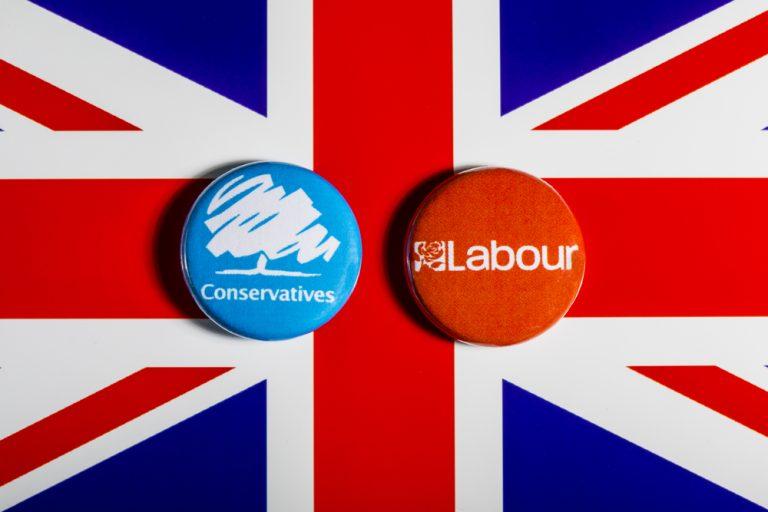
With the general election little more than two weeks away, the general public and market indices alike wait with baited breath. What is on offer are two starkly different visions for the future of the UK, with both equally likely to intensify existing divisions. Today, however, the pound showed the market’s preference, as it dipped following a narrowing of the Conservative party’s lead in the polls.
“It is hard to disagree that a Conservative majority is the most likely outcome of the election, but with markets priced for this with a high degree of confidence, the hurdle is low for GBP slipping back to the bottom of its recent range,” says Adam Cole, a foreign exchange strategist with RBC Capital Markets.
Analysts have already warned that Sterling has erred on the side of overconfidence in a Conservative majority, and the publication of each party’s manifestos through the past week has done little to temper the anxieties of markets or the UK’s oldest party.
Labour face the same criticisms of ‘nice ideas, where is the funding coming from?’, which is a question they’ll struggle to sidestep. Regardless of their insistence to the contrary, extracting tax from the highest earners is a fool’s errand without an international and unilateral effort, which puts their fiscally-led ambitions in jeopardy.
Meanwhile, the Conservatives will have to lean heavily on their Brexit policies, as many of their proposals outside of infrastructure spending are either efforts to reverse the damage it has inflicted since 2010, or are simply uninspiring. The party has struggled to answer substantive questions on policy, surrounding NHS performance and the stark failure of their flagship ‘starter homes’ housing policy. Their inability to offer any kind of tangible guarantees to the electorate were evidenced on the latter issue alone: when put under the cosh Housing Secretary Robert Jenrick merely restated the party’s commitment to a ‘vibrant’ market, while Liz Truss looked like she’d seen a ghost as Andrew Neil took apart the party’s failings on live TV.
The contest looks more closely thought then imagined then. Though the Conservatives are certainly the favourites, we’re hardly being spoilt for choice with credible options.
Speaking on recent polling data and the market’s response, Spreadex Financial Analyst Connor Campbell commented,
“Showing an increasing sensitivity to election matters, the pound gave back some of Monday’s gains following the latest poll.”
“Yesterday the pound rose on reports that the Conservatives were facing an 80-seat majority after December 12. Well, today, a survey by Kantar shows Boris Johnson and co.’s lead has been cut from 18 points to just 11 in the space of 7 days, news that has left sterling down 0.3% against the dollar and euro alike. That followed an ICM poll late on Monday giving the Tories just a 7 point lead, a 10-point reversal week-on-week.”
“With the pound in the red, the FTSE was able to eke out a 0.1% rise while its Eurozone peers trickled lower. Returning to 7400 after last Friday sinking below 7250, the UK index sat at its best price for 2 and a half weeks. In contrast the DAX and CAC slipped 0.2% apiece, slipping under 13250 and 5925 respectively.”
Overall, it has been a fairly quiet morning following Monday’s rallies. Greencore Group plc (LON: GNC) reported a revenue dip, Topps Tiles (LON:TPT) are pessimistic on the GE outlook, Pets at Home shares (LON:PETS) saw its profits increase and the market reacts to Uber (NYSE: UBER) losing its London licence.
“The muted movements of the European indices, alongside the prospective flat open for the Dow Jones later today, reflects a lack of trade deal updates this Tuesday. Though there was a call between key players Liu He, Robert Lighthizer and Steven Mnuchin, the post-discussion statement claiming that ‘both sides discussed resolving core issues of common concern’, had ‘reached consensus on how to resolve related problems’ and agreed to ‘stay in contact’ over their remaining differences was a tad too vague to spark significant growth. At least, not after Monday’s gains.”
FCA issues ban on marketing of mini-bonds to retail investors

The FCA have announced that they will ban the marketing of mini-bonds to retail investors following the collapse of London & Capital Group earlier this year.
The restriction will become active as of January 1st 2020, and last for 12 months while the FCA looks to take action to enforce permanent legislation into marketing restrictions.
Mini-bonds have tempted investors on the potentially greater returns compared to mainstream products but have also made investment more risky.
However, amid the high return potential there has been controversy including the notable collapse of London Capital & Finance, where over 12,000 people had invested and are facing difficulties recovering their funds.
The FCA described a mini-bond as a ‘kind of IOU issued by a company to an investor’.
In return the investor receives a fixed rate of interest over a set period of time, and at the end of the tenancy the investors money is repaid.
The return on investors’ money entirely depends on the success and proper running of the issuer’s business. If the business fails, investors may get nothing back, which highlights the risk in the initial investment.
However, the FCA only has intervention powers in markets and not the sale of the products themselves.
The regulator said they could still be marketed to “sophisticated investors”, who could declare themselves able to understand the risks, or high net-worth individuals with an annual income of more than £100,000 or net assets of £250,000 or more.
Almost 12,000 people who put a total of £236 million into a high-risk bond scheme marketed as a fixed-rate ISA with London Capital & Finance (LCF), lost their money.
Andrew Bailey, FCA chief executive, told the BBC’s Today programme: “This is the sixth piece of intervention we’re doing this year. We are also in close discussions with the internet service companies, because we want to limit the marketing of these things through that channel.
“We think it is inappropriate to market the complex versions of these instruments to retail customers, not to the high net-worth individuals, but to retail customers.
“We want to see more action. I’m keen that the legislation that the government proposed on online harms – which I know addresses really important issues which are outside our world – can also include financial harms.
“I also want more action from Google – I think they can play a big role because it is the major channel now and we find these things just popping up all the time.”
Moira O’Neill, head of personal finance at Interactive Investor, said she could understand the attraction of mini-bonds.
“Savers are now in the unfortunate position where even if they can lock their money away for four years, they will only get 2%. So the prospect of lending money to a company via a mini-bond for a similar period and getting four times that amount, or more, is tempting,” she said.
“But mini-bonds are paying higher rates than bank accounts precisely because they do contain an element of risk – essentially the risk that the company could go out of business.
“And it’s often too difficult for customers to assess if are they paying enough to take that risk.”
“My gut reaction has been long been one of general wariness as even the name mini-bond is probably a misnomer. But the rise of mini-bonds has been hard to ignore. “Meanwhile, the sector as a whole has escaped the kind of in-depth analysis that is normal for both the equity and corporate bond market.”The FCA have issued a statement saying that the ban will apply to ‘more complex and opaque arrangements where the funds raised are used to lend to a third party, invest in other companies or purchase or develop properties’.
The FCA defended its actions to enforce the marketing bam following an increased incident rate of promotions leading to frauds and scams which involve no attempt to meet financial promotion rules.
The FCA has made a concerned effort to tackle the risk for investors from mini bonds, as they see the risk to consumers.
The FCA have investigated more than 80 cases of regulated activities that may have been carried out with the right FCA authorization.
Additionally, the FCA have looked to persuade the internet service providers, particularly Google, to take more action, for instance to take down websites promptly where they are likely to involve a breach of law or regulations.
Andrew Bailey added : ‘We remain concerned at the scope for promotion of mini-bonds to retail investors who do not have the experience to assess and manage the risks involved. This risk is heightened by the arrival of the ISA season at the end of the tax year, since it is quite common for mini-bonds to have ISA status, or to claim such even though they do not have the status.
‘In view of this risk, we have decided to complement our substantial existing actions with a further measure which will involve a ban on the promotion and mass marketing of speculative mini-bonds to retail consumers. We believe this will enable us to further consumer protection consistent with our regulatory principles and the FCA Mission.’
The ban will mean that unlisted speculative mini-bonds can only be promoted to investors which are sophisticated or high net worth, excluding retail or casual investors.
The press released concluded by saying that the FCA intends to launch a communications campaign to improve consumer awareness of the risks, and considerations that might be needed to be made before pursing high risk investments.
Commenting on the FCA’s ban on the promotion of mini bonds, Michael McKee, partner at DLA Piper, said: “After London Capital & Finance’s collapse it was inevitable that the FCA would take a hard line on mini-bonds which always looked more risky than most other retail products.”
Udg Healthcare shares dip despite increased operating profit

Udg Healthcare PLC (LON: UDG) have seen their shares dip on Tuesday despite increases in operating profit growth and a sound update to shareholders.
Udg Healthcare were formerly known as United Drug is a Dublin based international company and partner to the healthcare industry. The firm provides clinical, commercial, communication and packaging services.
The pharmaceuticals industry has seen a mixed set of results by firm across financial 2019.
Market leaders such as Pfizer (NYSE: PFE) and GSK (LON: GSK) have reported bullish interim updates, which gives them further foot holding the global pharmaceuticals market.
Additionally, Roche (SWX: ROG) announced the acquisition of US drugmaker Promedior last week.
The FTSE250 (INDEXFTSE: MCX) listed firm reported adjusted operating profit growth of 5% to $158.4m (€143.8m) in the 12 months to 30 September, as it announced its third acquisition of 2019.
On a more sour note, shareholders will be concerned that the firm saw revenue decline by 1% to $1.3 billion.
UDG Healthcare PLC reported a “year of strong strategic progress” on Tuesday, with both platforms doing well.
“2019 was another year of strong strategic progress for UDG Healthcare. We delivered good financial growth with adjusted earnings per share increasing by 7% on a constant currency basis, the top end of guidance,” said Chief Executive Brendan McAtamney.
“Our two global platforms, Ashfield and Sharp delivered a strong performance through a combination of underlying growth and the benefit of acquisitions.”
Last year, UDG reported two new US business acquisitions in Create NYC and SmartAnalyst which caused shares to rally.
Ashfield reported a 3% revenue growth to $949.2 million, with adjusted operating profit rising by 10% to USD110.0 million in a “good” year.
“Looking ahead to financial 2020, we expect to continue to deliver good growth across our businesses, supplemented by further strategic acquisitions utilising our strong balance sheet,” said CEO McAtamney.
Shareholders should not be too phased by the dip in share price this morning, but should be more optimistic for future outlook as the firm looks to complete its acquisition deals.Greencore shares slip following annual revenue decline
Greencore Group plc (LON: GNC) have seen their shares sink on Tuesday after the firm gave shareholders a disappointing update alluding to declining annual revenues.
Greencore Group plc is an Irish food company, which was established by the Irish government in 1991. The firm now sells convenience food related and boasts itself as the largest sandwich manufacturer globally.
Shares of Greencore sunk 5.48% to 234p on Tuesday morning. 26/11/19 11:07BST.
Greencore have had a mixed financial 2019, as the firm reported struggles in July which led to shares slipping, however recover was made soon after.
The company, which prepares over 700 million sandwiches a year, said in an update on Tuesday that it had completed the sale of its US business for £55.9 million on Monday, which helped pre-tax profit triple to £56.4 million in the year to the end of September.
The FTSE250 (INDEXFTSE: MCX) listed firm reported declining sales from continuing operations by 3.5% to £1.4 billion in the year to the end of September.
Chief operating officer Peter Haden will also step down as an executive director at the end of December, before leaving the group in April, as part of a bid to “simplify the management structure”.
Patrick Coveney, chief executive officer, said he expects next year to deliver profitable growth, with a target to achieve mid single-digit organic revenue growth in the medium term.
He added, “over the past twelve months we have fundamentally reset our business”, saying that the group’s plan was “expanding our category and channel capabilities within the diverse, growing and attractive UK food to go market”, such as the recent £56 million acquisition of UK salad maker Freshtime.
House broker Shore Capital said Greencore was now “fully focused on the UK market, and with leading exposure within attractive ‘food to go’ categories”, seeing future growth being augmented by selective bolt-on deals and capital discipline.
The food and drinks industry have seen mixed results and firms have had limited success.
Firms such as J D Wetherspoon (LON: JDW) and Greggs (LON: GRG) have given shareholders strong updates seeing their shares rally.
Notably, Compass Group plc (LON: CPG) saw their shares sink this morning as the firm gave a gloomy outlook to shareholders for financial 2020.
Compass Group shares sink following pessimisitc outlook

Shareholders of Compass Group plc (LON: CPG) have seen their shares sink on Tuesday morning, after the firm gave shareholders a gloomy outlook amid speculative future business.
Compass Group plc is a British multinational contract food service which resides in Surrey. It is the largest contracted foodservice company in the world with operations in over 50 countries and employs over 550,000 people.
Shares of Compass Group sunk 5.77% after the announcement to 1,956p. 26/11/19 10:50BST.
Earlier this year, the FTSE 100 (INDEXFTSE: UKX) listed firm reported strong growth driven by North American operations and the performance seems to have continued through the next quarter.
Despite a relatively strong financial 2019, Compass have given shareholders a gloomy update alluding to tough market conditions and Brexit complications.
Compass reported a 5.7% increase in full year underlying revenues reaching £25.2 billion for the year ending 30 September. Operating profit rose 4.7% to £1.9 billion.
Operating margin was 7.4% while free cash flow grew 9.3% to £1.25 billion.
Group chief executive Dominic Blakemore said that despite the good performance, Compass was “not immune to the macro environment”.
“Deteriorating business and consumer confidence in Europe has impacted our business and industry volumes, new business activity and margin,” he said.
He added that the firm was taking “prompt action” in Europe and the rest of the world markets to adjust its cost base.
The cost saving action is expected to result in £300m of exceptional costs across this year and next.
Blakemore continued: “Our expectations for the group in 2020 are positive although we remain cautious on the macro environment in Europe. The pipeline of new contracts in North America is strong and Rest of World is growing well, although we are seeing some hesitation in decision making in Europe.
“Thanks to the group’s geographic and sectoral diversity, we are nevertheless confident of continued progress. As such we expect organic growth to be around the mid-point of our 4-6 per cent range whilst maintaining our strong margin1 as we mitigate the expected volume pressures through our cost actions.
“In the longer term, we remain excited about the significant structural growth opportunities globally, the potential for further revenue and profit growth, combined with further returns to shareholders.”
The food and drinks industry have seen mixed results and firms have had limited success.
Firms such as J D Wetherspoon (LON: JDW) and Greggs (LON: GRG) have given shareholders strong updates seeing their shares rally.
Other competitors such as the Restaurant Group (LON: RTN) have not been so successful, as they saw their shares dip yesterday despite success from their headline branch Wagamama.