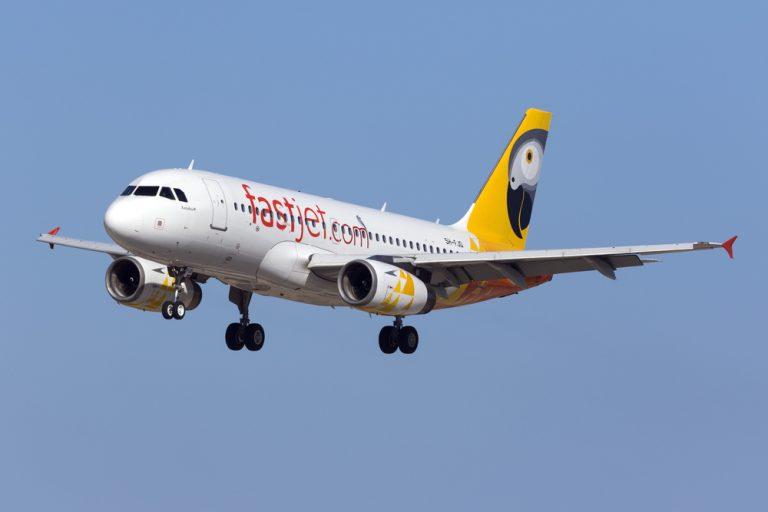
Fastjet shares plummet following considerations to sell Zimbabwe operations

2

Shares of Fastjet PLC (LON: FJET) have crashed on Wednesday afternoon after the firm speculated about selling its Zimbabwe unit.

Fastjet Plc is a British/South African-based holding company for a group of low-cost carriers that operate in Africa.

Shares crashed 34.55% to 0.36p. 27/11/19 14:48BST.

The firm said that it was considering selling its Zimbabwe operations in a restructuring deal. Fastjet added that profitability remained elusive amid Mozambique issues and tough market conditions.

It seemed that earlier this year fortunes had changed hands for Fastjet, after the firm reported a rise in revenues and narrowed losses back in July.

However, this optimism was short lived as the firm is now fighting to stay afloat in the market.

On October 21, Fastjet announced it suspended flight operations in Mozambique amid “ongoing supply and demand challenges”.

During the first six months of 2019, revenue from Mozambique had fallen to $2 million from $4 million the year prior.

While the group’s FedAir operation remains resilient and is expected to be profitable for the year, this has been off-set by the continued volatility and uncertainty in the Zimbabwean market,” Fastjet said in a statement.

“Fastjet Zimbabwe has increased its year on year revenue despite the difficult trading conditions following the introduction of a new currency which effectively devalued the existing currency by up to 15 times its previous value at official rates and has pushed inflation rates to above 200%,” Fastjet added.

In order to continue trading in its current form, however, Fastjet warned it expects to need further funding by the end of February.

Fastjet is currently in dicussions with shareholders about options to raise equity or plans to restructure the firm.

This restructure would involve Fastjet selling its Zimbabwe business for $8.0 million to a consortium which includes Solenta Aviation Holdings Ltd, currently a 60% shareholder in Fastjet.

The Zimbabwe sale would also relieve Fastjet of $5.4 million in debt and $3.2 million in future aircraft orders.

The proceeds from the sale would be used to fulfill debt obligations and fund future capital projects into 2021.

“The disposal, if agreed, approved and implemented, would be expected to de-risk the significant uncertainty and cash drain that shareholders have historically suffered and allow the group to continue operating under a more stablised and simpler business model,” Chief Executive Officer Mark Hurst said.

“This revised strategy allows the group the opportunity to create a single fastjet brand throughout key markets in Africa, leverage its key intellectual property of its brand and airline management solutions and invest in viable, already-established airlines where it can,” Hurst added.

In the airline industry there have been mixed experiences varied by each firm, and results have been sporadic.

Fastjet will have to be careful that they don’t end up with the same fate as Thomas Cook (LON:TCG), who recently collapse in September.

Amid tough market conditions, big players such as IAG (LON: IAG) and Ryanair (LON: RYA) have cut their medium term profit forecasts leading to skepticism from shareholders.

Additionally, IAG announced at the start of the month that they will purchase Europa Air which has alerted competitors such as Ryanair and easyJet (LON: EZJ)

Egdon Resources shares spike on two renewed gas licenses

1

Shareholders of Egdon Resouces Plc (LON: EDR) have seen their shares spike on Wednesday afternoon after the firm secured a gas licence extension.

Egdon Resources plc is an independent onshore focused oil and gas exploration and production business. The firm is an established oil and gas exploration and production business with 44 licenses in proven oil and gas producing basins in the UK

Shares of Egdon resources spiked 8.31% to 3.2p. 27/11/19 14:31BST.

Big name competitors such as Shell (LON: RDSA) and SABIC (TADAWUL: 2010) have seen third quarter profits sink following volatile oil prices.

Additionally, both Nostrum Oil and Gas (LON: NOG) and Chariot Oil and Gas (LON: CHAR) saw their shares crash following modest updates.

Earlier in November, Egdon saw their shares sink following fracking bans from the government, but it seems that Egdon have bounced back from the setback.

The firm updated shareholders saying that it had received a six month extension for two UK offshore gas licenses.

The UK Oil & Gas Authority extended the period for the P1929 and P2304 licences until the end of May 2020.

With the new extension, the firm will be able to execute a farm-in deal for the licenses to provide funding for the projects by the end of January.

P1929 has estimated contingent gas resources of 231 billion cubic feet of gas and P2304 another 18 billion cubic feet.

“We are pleased to have secured extensions from the OGA for both P1929 and P2304 which contain the Resolution and Endeavour gas discoveries, key conventional projects for Egdon,” Managing Director Mark Abbott said. “This follows on from our recent announcement of securing an exclusivity agreement with a large internationally recognised exploration and production company as our preferred partner for Resolution and Endeavour.”

“Today’s news represents further positive progress for these projects and results from the proactive and constructive engagement between Egdon, the Counterparty and the OGA,” Abbott added. “Having secured the licence extensions, our focus now turns to finalising a farmout agreement and we look forward to updating shareholders on progress in this regard in the New Year.”

AXA set to exit coal investments to address environmental policy issues

0

French Insurance firm AXA (EPA: CS) have made a concerned effort to strengthen their environmental policies as they gave the market an update on Wednesday.

Shares of AXA are trading at EUR24 (+0.14%) 27/11/19 14:06BST.

The insurance and finance industry has seen mixed results, as shares have been up and down. Competitors including Aviva (LON: AV) and Lloyd’s (LON: LLOY) have seen their shares crash following poor respective trading updates.

AXA announced that it would commit to exit coal more quickly across a greater number of countries, as policymakers look to transition into a low carbon economy.

At a time where environmental policies have never been so important, the move to exit coal investments by 2030 is a positive one for AXA and will certainty favor their media image.

AXA said that as an investor it would exit completely from the coal industry across countries in the Organisation for Economic Cooperation and Development (OECD) and the European Union by 2030, and the rest of the world by 2040.

This will put pressure onto other financial institutions and industrial companies to make a concerned effort to step up their fight against climate change.

In other steps announced on Wednesday, the French insurer said it will put 12 billion euros (£10 billion) in “green investments” between 2020-2023.

AXA added that as an insurer, it would restrict coal undewriting policy and stop selling insurance contracts, apart from employee benefits offers, to clients developing new coal projects that exceed 300 MW in capacity.

“AXA is leading the way by driving its portfolio of coal down to zero by 2030,” said Regine Richter, Energy Campaigner at Germany-based campaign group Urgewald.

This comes as a move after firms such as UniCredit (BIT: UCG) and Coca Cola (LON: CCH) have announced new environmentally friendly policies.

Certainly, when fighting climate change competition has to be put to one side as it is a communal effort. The steps made by AXA are ones in the right direction and should set an example to the industry and other multinationals looking to address the issue.

RBS set to launch digital bank Bó

2

Royal Bank of Scotland Group plc (LON: RBS) have announced to the market that they are set to release their standalone digital Bank Bó.

Shares of RBS currently trade at 231p (+0.17%). 27/11/19 13:44BST.

Over a fortnight ago, it was announced that both HSBC (LON: HSBA) and RBS were set to roll out their respective new digital banking platforms.

As HSBC prepares to roll out HSBC Kinetic, RBS is putting the finishing touches onto Bó.

The Bó app is designed to encourage customers to budget and save better, alerting them if they overspend.

This has come as a response where banks such as RBS, HSBC and Lloyd’s (LON: LLOY) have seen a slump in their third quarter profits.

The expansion of brands such as Monzo and Starling Bank has put pressure on the heavyweight banking firms to conjure up a response to the use of new fintech.

Bó will target the 16.8 million Britons with savings less than £100.

Bó Chief Executive Mark Bailie told reporters on Wednesday the venture could offer its parent cheaper funding by amassing customer deposits on its lower cost banking platform, although he did not say how much the bank had spent on the project.

RBS are still majority publicly owned after the financial crash in 2008 led to a public bailout, and its biggest brand Natwest serves over 16 million customers.

Bailie said Bó aimed to attract what he described as a “material” number of customers relative to NatWest within five years. “A few hundred thousand customers doesn’t make any difference to the bank,” he said, without giving a precise target.

From recent market data, start-ups such as Monzo and Starling have picked up thousands of new customers this year from rivals, leading to the creation of these mobile banking platforms.

“We’re blocking them at the front door,” Bailie said, adding such attacks were expected for new online ventures.

Bailie said Bó, which offers similar functions to other digital banks, would differentiate itself with its focus on helping customers budget better.

“We’ve got a big data set, and the data set says that customers have a broken relationship with money,” Bailie said.

In a time where rivals such as Standard Chartered (LON: STAN) and Bank of Ireland (LON: BIRG) have posted bullish updates, the move to release Bó will come to stimulate customers in an attempt to turn performance around.

Cairn Energy exit Norwegian operations

1

Cairn Energy PLC (LON: CNE) have announced the sale of their Norwegian operations to Solveig Gas in an update to shareholders on Wednesday.

Cairn Energy PLC is one of Europe’s leading independent oil and gas exploration and development companies.

Shares of Cairn Energy are trading at 180p (-0.17%). 27/11/19 13:27BST.

Cairn received a double blow at the end of October when they were hit with legal battles with the Indian government, which caused shares to dip.

The sale was announced for a fee of $100 million, which will also mean that Cairn Energy will exit operations and business in Norway.

The sale will allow Cairn to reduce its committees exploration and development spending by around $100 million.

The proceeds of the sale will be reinvested into existing operations, Cairn added.

Chief Executive Simon Thomson said: “This is a further attractive transaction for Cairn shareholders in line with our consistent strategy to realise value and redeploy capital within our portfolio.

“We continue to have a material business in the UK North Sea where the production performance of the Kraken and Catcher assets remains strong. We wish all of the team in Stavanger every success in the future.”

FTSE250 (INDEXFTSE: MCX) listed Cairn has assets in the Americas, Africa, and the UK, including the producing Catcher and Kraken fields in the North Sea.

The deal is expected to be completed by early 2020 and remain subject to written consent by the Norwegian Ministry of Petroleum and Energy, partner and third-party approvals.

This is an interesting move by Cairn, and the exiting of these Norwegian operations doesn’t seem to have worried shareholders as much as expected.

The energy market is becoming increasingly tough to trade in as reputable names such as Shell (LON: RDSA) have seen a slip in their third quarter profits amid volatile oil prices.

Additionally, smaller names such as i3 Energy (LON: I3E) and AFC Energy (LON: AFC) have seen their shares crash in the last week.

Brewin Dolphin shares jump on rising funds report

Brewin Dolphin Holdings plc (LON: BRW) have seen their shares jump after the firm reported a rise in funds across its financial year.

Brewin Dolphin plc is one of the largest British investment management and financial planning firms with 39 offices throughout the UK and Channel Islands.

Shares of Brewin Dolphin jumped 1.55% to 347p. 27/11/19 12:54BST.

At September 30, the asset manager’s total funds under management stood at £45 billion, up 5.1% from £42.8 billion at the same point a year ago.

Brewin Dolphin’s Direct Discretionary funds grew 4.8% to £26.3 billion, seeing a 6.6% rise in total Discretionary funds to £40.1 billion.

Brewin Dolphin reported impressive growth in July, despite tough market conditions as the firm alluded to tense political and economic barriers to trading.

It seems that this run of good results is expected to be translated across the full trading year.

However, the success has been matched by competitors such as Intermediate Capital Group (LON: ICP) and AJ Bell PLC (LON: AJB) who gave shareholders impressive updates.

However, the success has not been so widespread as Hansard Global Plc (LON: HSD) posted a modest growth report.

“This year has seen economic uncertainty resulting in subdued client activity; however, the performance of the business has held up very well. We have delivered organic net discretionary funds growth of 3.7%, and we remain on track to meet our target to grow new discretionary funds organically by a third by the end of financial 2020,” the asset manager said.

The FTSE250 (INDEXFTSE: MCX) listed firm saw £1.3 billion in net inflows with investment performance adding a further £600 million.

The “strong” inflows, the asset manager said, is proof the company has “continued to broaden”.

Brewin Dolphin saw their income rise by 3.1% in the year ending September 30, to £339.1 million from £329 million, but pretax profit slipped 8.6% to £62.6 million from £68.5 million.

“I am very pleased with our financial performance, particularly over the second half of the year. The group has continued to deliver strong and resilient organic growth, against the continued uncertain economic and political backdrop. This is demonstrated by the strength of our discretionary funds flows. Our strategy of focusing on our advice-led wealth management service continues to deliver results,” said Chief Executive David Nicol.

He added: “We continue to invest in our business to support future long-term growth. We have completed and integrated a number of strategic acquisitions and the replacement of our core custody and settlement system is on track. These initiatives are laying the foundations for long-term growth and will ensure that we are well placed to capture future market opportunities.”

Brewin Dolphin is proposing a final dividend of 12.0 pence per share, giving a full year dividend of 16.4p – both flat on the year before.

“The progress we have made over the past year means we can look ahead with considerable optimism,” Nicol concluded.

Sosandar shares slip on widened loss report

1

Shareholders of Sosandar PLC (LON: SOS) have seen their shares slip on Wednesday, after the firm reported a widened loss caused by heavy investment.

Sosandar PLC is a women’s clothing retailer, and have been trading since 2005, with headquarters in the UK.

Shares of Sosandar slipped 0.92% to 24p. 27/11/19 12:40BST.

At the end of October, Sosandar saw its shares surge as the firm expected to post growth in their interim update. However this was not to be case.

The firm reported that its interim loss widened as it invested heavily, however the firm did report that revenue grew strongly.

For the six months ended September 30, pretax loss deepened to £2.8 million from £2.0 million the year prior. This was despite revenue jumping 56% to £2.8 million from £1.8 million the year before.

Profit took a blow caused by administrative costs, which surged from £3 million a year ago to £4.3 million as reported on Wednesday.

“We are delighted to be reporting on a period of significant progress for Sosandar,” Chief Executive Officers Ali Hall and Julie Lavington said.

“The investments that were made in the latter part of the second quarter have resulted in exceptional autumn trading,” Hall and Lavington added. “Post period end, October was particularly notable, as we hit a special milestone – the first month where net revenues exceeded GBP1 million, a performance which November is on course to exceed.”

“Our vision is to be a global one-stop online destination for our customers, and with a widened product range, strong balance sheet, and a broadened, aggressive, and increasingly effective marketing strategy, we are confident that financial 2020 will be an important next step in that journey,” Hall and Lavington concluded.

The clothing sector has seen mixed results by firm.Marks and Spencers (LON: MKS) and Superdry (LON: SDRY) saw their profits sink due to a slump in clothing sales, which led to mass store closures.

Additionally, Koovs (LON: KOOV) and Laura Ashley (LON: ALY) have seen their shares sink following trading announcements.

Shareholders of Sosandar are likely to be concerned, as the firm has still not made a recovery from its initial losses. However, shares have not plummeted as significantly as the market may have expected and this might show investor optimism in the brand itself to deliver long term goals.

AB Dynamics shares plummet despite impressive update

0

Ab Dynamics PLC (LON: ABDP) have seen their shares plummet on Wednesday despite giving shareholders a very strong annual update.

AB Dynamics are a firm that supply integrated test systems for the global automative industry. Their products are integral to the testing and development of cars and automobiles.

Shares of AB Dynamics plummeted 8.12% to 2,618p. 27/11/19 12:22BST.

The firm reported that profit growth had surged 40% but gave shareholders a gloomy outlook for financial 20.

The global automative industry has seen slumps and firms have been attempting to respond to slowing business.

Firms such as Nissan (TYO: 7201) and Suzuki (TYO: 7269) have seen their shares slip following production guidance cuts.

Additionally, Renault (EPA: RNO) and Volkswagen (ETR: VOW3) gave shareholders a gloomy outlook, much too similar to AB.

The firm reported a pretax profit of £11.0 million for the 12 months to August 31, 38% higher than the year before. The adjusted figure was up 59% to £13.7 million.

“The group’s performance in 2019 was very strong, delivered through continued development of new products and services to a buoyant market for advanced driver assistance systems and autonomous vehicle development,” said Chief Executive James Routh.

It was a tenth successive year of record revenue and adjusted profit, AB Dynamics noted, with the market background “very favourable”.

“The outturn also benefited from our success in reducing our lead times, which had lengthened with strong levels of demand, to more appropriate levels,” it added.

Looking ahead, the company is investing “heavily” into new product development. The order book is “healthy”, it continued, and the outlook is healthy despite the difficulties some customers are facing selling into a weak global automotive market.

AB reported a 50% rise in track testing revenue to £49.8 million, while lab testing and simulation revenue more than doubled to £8.2 million.

Firms have attempted to combat slow business through mergers, as seen with Fiat Chrysler (NYSE: FCAU) and Peugeot (EPA: UG).

Despite the impressive update, shareholders seem to be more worried about the gloomy outlook that has been given by AB which has reflected movements in the stock price across Wednesday trading.

Grainger shares receive boost from strong update

1

Grainger PLC (LON: GRI) have seen their shares boosted on Wednesday morning after the firm reported strong results.

Grainger is a British based residential property business, and have been trading since 1912. They have headquarters based in Newcastle upon Tyne, United Kingdom.

Shares of Grainger were boosted 1.67% after the positive announcement and trade at 280p. 27/11/19 12:03BST.

The demand for housing has been up and down, particularly in the UK following political and economic uncertainties and Brexit complications.

Home builders such as Taylor Wimpey (LON: TW) and Homeserve (LON: HSV) have seen their shares rally on the back of increasing rental home demand.

Grainger said that it had delivered a strong performance against a backdrop of both political and economic uncertainty, supporting by strong rental property demand.

The FTSE250 (INDEXFTSE: MCX) said for the financial year to September 30, its net rental income grew 45% to £63.5 million from £43.8 million in 2018.

The strategic focus on the UK private rented sector continues to deliver real growth in the business, underpinned by a strong demand for rental homes across the country.

Profit before tax rose 30% to £131.3 million from £100.7 million, the company said. As a result, the company proposed a final dividend of 3.46p per share, which showed a 9% rise from 2018.

Total dividend for the year was 5.19p, which again saw a climb from 4.75p in 2018.

“Looking forward to the year ahead there is great focus on building our best in class operational platform, driven by the quality of our people and new technology, as well as delivering circa 1,000 new homes for our customers across the country,” Chief Executive Officer Helen Gordon said.

“Our focus on continuing to build the longer-term investment pipeline will continue as we pursue our ambition to grow the business significantly over the next five years.”

In the housing market, there have been slumps and business has been volatile. However, firms have attempted to combat the slow business period. A few weeks back it was reported that Galliford Try plc (LON: GFRD) and Bovis Homes Group plc (LON: BVS) had agreed a home building deal.

British American Tobacco shares rally on confident 2019 expectations

3

British American Tobacco PLC (LON: BATS) have seen their shares rally on Wednesday morning after the firm gave a confident expectation outlook for 2019.

British American Tobacco plc is a British multinational cigarette and tobacco manufacturing company headquartered in London. It is the second-biggest cigarette maker in the world as of 2012.

Shares of British American Tobacco rallied 2.09% to 3,048p. 27/11/19 11:43BST.

Earlier this year, British American Tobacco announced that they would be cutting 2,300 roles in an attempt to reinvest in the growth of its new products.

The firm joined a long list of multinational brands such as HSBC (LON: HSBA) and Audi (ETR: NSU) to announce job cuts in tough market conditions.

A few months on, the firm has reassured shareholders that they will report strong figures for financial 2019.

In the US, the FTSE100 (INDEXFTSE: UKX) listed firm said it delivered good revenue on a constant currency basis, supported by pricing and reduced discounting.

BAT continues to expect US industry volumes for 2019 to be down by 5.5%, while for 2020 it expects a drop in the range of 4% to 6%.

For the Tobacco Heating Products division, the glo product in Japan held its volume share at 4.9% reborn with the launches of glo Pro and glo Nano in a highly saturated market.

Overall, BAT said it expects to report a rise in adjusted operating profit for 2019 in the upper half of its 5% to 7% guidance range.

Constant currency for the year is expected to grow in the upper half of its guidance range, between 3% and 5%.

“We expect to deliver a strong performance in 2019, building on the good progress we made in the first half. Our focus on our global strategic brands is delivering share gains and strong price mix in combustibles, both globally and in the US. Increased investment and new product launches are delivering good New Category revenue growth in the second half, despite the recent slowdown in the US vapour market. We believe that the issues around vaping in the US should lead to a better and stronger regulatory environment in which we are well placed to succeed,” said Chief Executive Jack Bowles.